
Your heated display acts as a silent salesperson, but without proper oversight, it can quickly become a significant drain on your monthly revenue. With fixed-rate commercial electricity quotes in May 2026 sitting between 22p and 30p per kWh, accurately calculating heated display cabinet running costs is essential for any serious UK cafe owner. You’re likely familiar with the stress of fluctuating utility bills and the constant challenge of maintaining the legal 63°C safety limit without sacrificing the texture of your food.
We believe that total competence in the kitchen starts with understanding your equipment’s thermal efficiency. This guide promises to demystify energy consumption by providing a practical formula for estimating your overheads. You’ll learn how specific technical features, such as superior insulation in bespoke serving counters or precision-engineered grab and go displays, lead to long-term savings. We’ll move from the broad reality of current energy tariffs to the fine details of unit selection, drawing on our experience as manufacturers to help you build a more profitable and sustainable business.
Key Takeaways
- Learn the exact mathematical formula to calculate heated display cabinet running costs by correctly interpreting equipment spec sheets and distinguishing between peak power and average consumption.
- Understand how technical features like thermal breaks and double-glazing in bespoke serving counters directly reduce heat loss and lower your monthly operational overheads.
- Implement strategic operational habits, such as optimized pre-heating schedules and smart food placement, to maximize thermal mass and improve energy distribution.
- Discover why bespoke UK manufacturing and CAD modelling provide a superior return on investment by tailoring equipment like grab and go displays to your specific site requirements.
- Master the balance between maintaining the mandatory 63°C food safety temperature and reducing the overall carbon footprint of your cafe’s hot food service.
Understanding the Financial Impact of Heated Display Cabinets
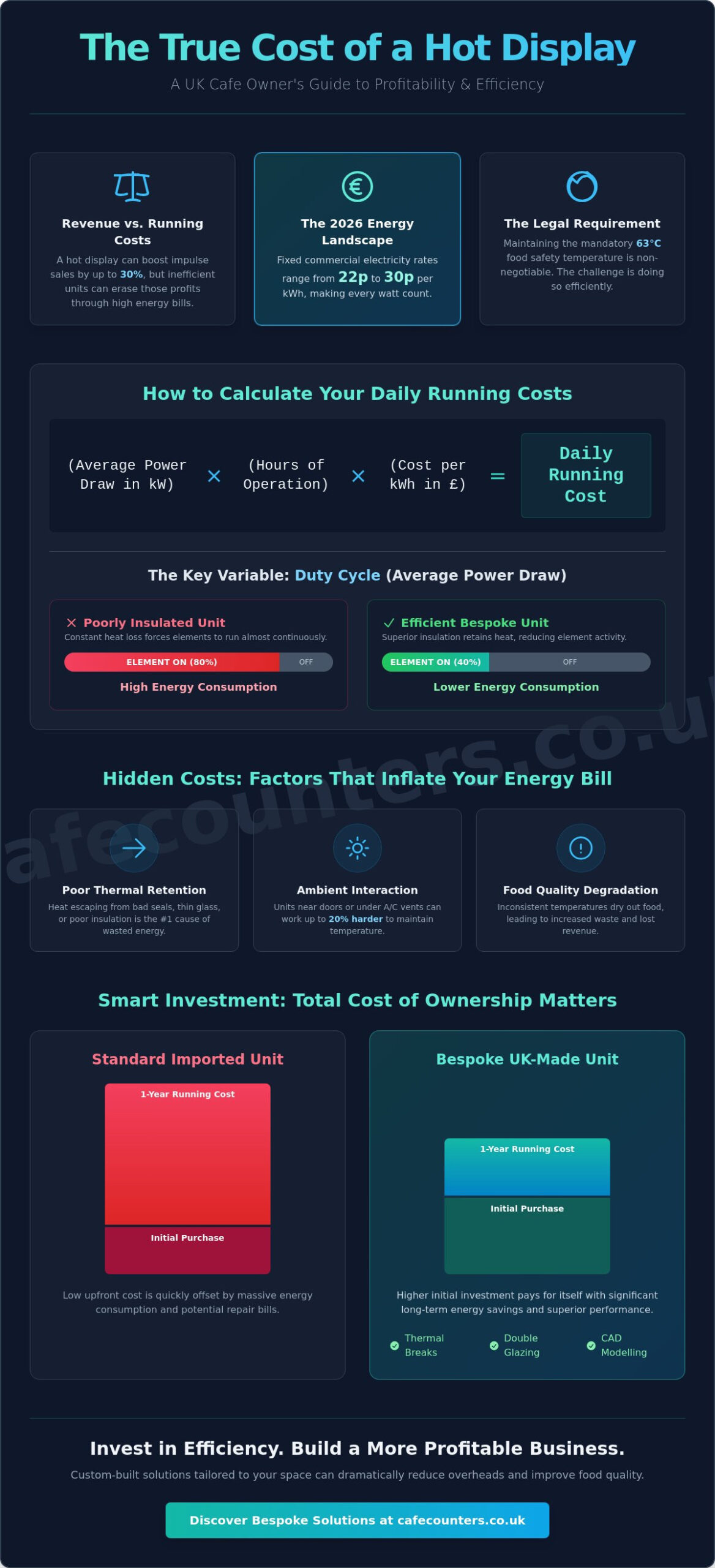
In the fast-paced environment of a UK cafe, a heated display is far more than just a storage unit. It’s a vital sales tool. Industry data suggests that a well-presented, brightly lit hot food display can increase impulse purchases by up to 30%. However, as we move through 2026, the financial landscape for hospitality has shifted. With fixed electricity rates often quoted between 22p and 30p per kWh, the conversation around food warming equipment has moved away from simple aesthetics toward rigorous operational efficiency. Every watt consumed must be justified by the revenue it generates.
Business owners are now forced to weigh the undeniable revenue boost of hot grab and go items against the mounting pressure of utility bills. A common mistake is prioritizing a low initial purchase price over long-term performance. Cheap, poorly insulated imported units often consume more in annual electricity than their original cost. This makes the total cost of ownership, rather than the sticker price, the most important metric for your bottom line. When you analyze heated display cabinet running costs, you’re looking at the long-term health of your business.
The Hidden Cost of Poor Thermal Retention
Thermal efficiency is the foundation of any sustainable food service operation. When a unit lacks high-grade insulation or precision-fitted glass, heat escapes into the surrounding room. This forces the heating elements to cycle more frequently to maintain the legally required 63°C internal temperature. In a busy cafe environment, ambient drafts or air conditioning can exacerbate this issue, driving up energy consumption significantly. Several factors contribute to this hidden drain on your resources:
- Element Fatigue: Elements that run constantly to compensate for heat loss have a shorter lifespan.
- Ambient Interaction: Units placed near doors or under AC vents work 20% harder if they aren’t properly shielded.
- Food Quality Degradation: Inconsistent temperatures caused by heat leakage can dry out products, leading to waste.
Investing in energy-efficient models isn’t just about environmental responsibility; it’s a practical business necessity to prevent profit margins from being eroded by invisible heat loss.
Revenue vs. Running Costs: The Profitability Balance
Maintaining profitability requires a meticulous look at your margins. While hot pasties or breakfast rolls carry high margins, those gains are quickly neutralized if your display unit is inefficient. High-performance solutions, such as Vision Heated Counters, are designed to strike this delicate balance. They use advanced materials and precision engineering to ensure that the energy you pay for stays within the cabinet. Beyond the technical specs, the psychological impact on your customers is profound. A unit that holds heat consistently ensures food looks appetizing and fresh, which sustains the high sales volumes needed to offset your energy overheads.
How to Calculate Your Heated Display Running Costs
Understanding your equipment’s technical specifications is the first step toward total operational control. Many cafe owners look at the “Total Load” or “Power Rating” on a spec sheet and assume this is the constant draw. However, according to research on kitchen energy consumption, actual usage patterns vary significantly based on the unit’s thermal efficiency and how it’s operated throughout the day. To master your heated display cabinet running costs, you must distinguish between peak power, measured in kW, and energy consumed over time, measured in kWh.
Peak power represents the maximum energy the unit draws when it’s first warming up or recovering temperature after a door has been opened. Once the cabinet reaches its set point, the thermostat cycles the heating elements on and off to maintain that heat. This is known as the duty cycle. A well-insulated unit might only have its elements active for 30 minutes out of every hour, effectively halving the energy consumption compared to a poorly made alternative that struggles to hold its temperature.
The Calculation Formula for UK Businesses
To calculate daily cost, multiply the average kW usage by hours active, then by your pence-per-kWh rate. In May 2026, with typical fixed business electricity rates sitting around 25p per kWh and the Climate Change Levy (CCL) at 0.775p per kWh, the mathematics of your kitchen become much more transparent. Let’s look at a practical example:
Imagine you operate a 1.5kW unit for 10 hours a day. If the unit is well-engineered with a 50% duty cycle, it’s only drawing full power for 5 hours total. Your calculation would be: (0.75 average kW x 10 hours) x £0.25775 (inclusive of CCL). This results in a daily running cost of approximately £1.93. When you add your daily standing charge, which typically ranges from 45p to 65p, you can accurately forecast your monthly and annual overheads with total confidence.
Comparative Costs by Unit Size and Type
The physical design and intended use of your display will dictate its position on the cost spectrum. Countertop units are generally more economical due to their smaller internal volume, while full-height floor-standing displays require more energy to circulate heat evenly. However, the most significant variance occurs between open and closed systems. Grab & Go displays offer high-speed service but lack a front glass barrier, meaning they naturally consume more energy to fight ambient drafts than closed-glass Deli Counters. Choosing a model with a digital eco-mode allows you to reduce temperatures during off-peak hours, providing a significant financial benefit. If you’re planning a new layout, selecting the right bespoke serving counters can help ensure your equipment is perfectly sized for your volume, preventing you from paying to heat empty space.
Key Factors That Influence Energy Consumption
While understanding your utility rates provides a baseline for financial planning, the physical construction of your unit determines the actual heated display cabinet running costs over its lifespan. Professional manufacturing focuses on thermal retention through the use of thermal breaks and double-glazing. A thermal break is a non-conductive material placed between the internal and external surfaces of the cabinet. This prevents heat from migrating through the metal chassis, ensuring the warmth remains focused on the food rather than heating the exterior of your counter.
The method of heat distribution also plays a critical role in efficiency. Fan-assisted heating systems use small, energy-efficient motors to circulate air, which eliminates cold spots and ensures every item stays at the mandatory 63°C safety threshold. This is often more efficient than static heat, as it allows the unit to maintain a lower core temperature while still protecting food safety. By using CAD modelling during the design phase, we can map these airflow patterns with total precision. This ensures that the air path is optimized for the specific dimensions of the cabinet, which minimizes turbulence and prevents the heating elements from working harder than necessary.
Insulation and Material Quality
Reliability in food display is built on the quality of materials used in the internal production process. High-grade stainless steel paired with specialized, heat-resistant gaskets creates an airtight seal that is essential for energy conservation. Single-pane glass is increasingly becoming a liability for businesses looking to minimize overheads. Double-pane glass provides an insulating layer of air that significantly reduces heat transfer to the cafe floor. These same deli counter engineering principles, which prioritize temperature stability and durability, are critical when designing a heated unit that won’t bleed energy.
Advanced Control Systems
Modern equipment has moved beyond the era of manual dials and guesswork. Digital thermostats offer precision within fractions of a degree, preventing the over-heating cycle that frequently wastes electricity in older models. Advanced humidity control systems also impact the energy required to maintain temperature. By managing moisture levels, these systems ensure the air inside the cabinet carries heat more effectively, reducing the load on high-wattage elements. Finally, the integration of modern LED lighting serves a dual purpose. It reduces the direct electrical draw of the unit and lowers the secondary heat load, allowing the primary heating elements to operate with much greater precision and less waste.
Strategic Ways to Minimise Operational Expenses
While engineering excellence provides the foundation for efficiency, your daily operational habits dictate the final figures on your energy bill. High-quality equipment can only perform to its peak when managed with precision. Reducing heated display cabinet running costs requires a combination of automated scheduling and disciplined staff behaviour. We view the operation of a professional kitchen as a series of controlled processes where small adjustments lead to significant long-term savings.
Staff training is perhaps the most cost-effective tool at your disposal. Implementing “door discipline” ensures that cabinet doors are only opened for the minimum time required to serve a customer or replenish stock. Every second a door remains open, the unit loses a substantial volume of heated air, forcing the elements to work at maximum capacity to recover the 63°C safety threshold. By treating the thermal environment of the cabinet with the same respect as a walk-in freezer, you protect both your food quality and your profit margins.
Operational Best Practices
Automation is a powerful tool for maintaining consistency across your team. We recommend using programmable timers to initiate the pre-heat cycle exactly 30 minutes before your first service begins. This practice eliminates the waste of running an empty unit for hours during the early morning setup. There is also a technical benefit to what we call the “full cabinet” theory. Unlike surface-level suggestions that focus only on visual appeal, filling your display correctly creates a thermal mass. Once your products reach the target temperature, they act as a heat reservoir, helping to stabilize the internal environment and reducing the frequency with which the heating elements must engage. During slower periods, consolidating items to a single level allows you to maintain safety while potentially lowering the intensity of the heat draw.
Maintenance for Efficiency
Technical maintenance is a critical pillar of our project management philosophy. Dust accumulation on fan grilles and vents restricts vital airflow, forcing internal motors to work harder and consume more electricity. Regular cleaning of these components ensures the unit operates within its original design parameters. You should also conduct frequent checks of the door seals; a degraded or split gasket allows heat to bleed out constantly. If you notice “hot spots” or inconsistent temperatures, it may indicate a failing thermostat or element that is drawing excess power. The return on investment for professional installation and commissioning by UK experts is found in these details, as a correctly calibrated unit will always outperform a poorly set-up alternative. If you are looking to optimize your front-of-house efficiency, explore our range of Bespoke Serving Counters designed for maximum thermal performance.
Investing in Efficiency: The TFSE Advantage
Choosing a display solution involves more than selecting a model from a catalogue. At TFSE, we believe that true operational efficiency is born from a deep understanding of your specific commercial environment. Our bespoke UK manufacturing process allows us to optimize every unit for its intended site, ensuring that your heated display cabinet running costs are kept as low as possible from the day of installation. Unlike off-the-shelf rental units that are built to a generic standard, our equipment is engineered to meet the unique demands of your footfall and layout. This site-specific optimization ensures that you aren’t paying for excess capacity or higher wattage than your volume requires.
We utilize advanced CAD modelling for every project to simulate airflow and heat distribution before a single piece of steel is cut. This meticulous planning phase ensures that heating elements are sized correctly for the cabinet’s volume, preventing the common issue of over-specified units that waste energy. By focusing on precision engineering at our internal production facilities, we project total competence and reliability in every weld and gasket. This regional artisanal pride is more than a signature of quality; it’s a guarantee that your investment is built to endure the rigours of a high-volume UK cafe while maintaining a lower carbon footprint.
Bespoke Counter Solutions for UK Hospitality
The synergy between your display equipment and your serving area is vital for a seamless customer journey. By integrating heated displays or grab & go displays into a wider bespoke cafe counter project, you ensure that every millimetre of space is working for your bottom line. We tailor the power and capacity of our units to your actual sales data, which prevents you from paying to heat empty display tiers during quieter periods. This level of high-end customization is why professional planning consistently leads to lower lifetime running costs compared to standardized alternatives. Our ability to manufacture everything from patisserie displays to stainless steel back-bar units in-house gives us total control over the thermal integrity of your entire serving line.
Next Steps for Your Business
Securing the future of your business requires a partner who understands the mounting pressure of utility overheads in 2026. We invite you to share your vision with us so we can provide the technical expertise required to bring it to life. Our comprehensive service includes detailed consultations and after-sales support to ensure your equipment maintains its peak energy efficiency for years to come. Don’t let unpredictable heated display cabinet running costs dictate your profitability. Contact our team today to request a technical consultation and discover how our British-made quality can transform your operational overheads into a manageable, predictable asset. We’re ready to act as your steady, reliable hand in this complex field.
Optimising Your Cafe for Sustainable Profitability
Controlling your overheads in 2026 requires more than just monitoring your utility meter; it demands a strategic approach to equipment selection and operational discipline. By mastering the formula for heated display cabinet running costs and prioritising units with superior thermal retention, you protect your margins from the invisible drain of heat loss. We’ve seen how precision engineering, from airtight gaskets to advanced airflow patterns, transforms a standard display into a high-performance asset that supports your bottom line.
At TFSE, we’ve been champions of UK-based manufacturing since 1991, providing our clients with the technical expertise needed to thrive in a competitive market. Our use of advanced CAD modelling ensures every unit achieves maximum thermal efficiency, while our national installation and commissioning service guarantees your equipment performs exactly as intended from day one. Don’t let energy waste compromise your vision for a high-quality food service environment. We’re here to provide the steady, reliable hand your project deserves.
Contact TFSE Products for a Bespoke High-Efficiency Heated Display Consultation and take the first step toward a more profitable, energy-efficient future. We look forward to helping you build a space that perfectly balances visual impact with long-term durability.
Frequently Asked Questions
How much does it cost to run a commercial heated display cabinet per day?
Daily costs vary based on your unit’s power rating and your specific electricity tariff. For a typical 1.5kW cabinet running for 10 hours on a 25p/kWh rate with a 50% duty cycle, the cost is approximately £1.93 excluding the standing charge. Including the daily standing charge of 45p to 65p and the Climate Change Levy, most small cafe owners can expect a total daily expenditure between £2.50 and £3.50 per unit.
Does a fan-assisted heated display use more electricity than a static one?
Fan-assisted units use a small motor to circulate air, but they’re often more energy-efficient than static models. By distributing heat evenly, these units eliminate cold spots and allow the heating elements to cycle off more frequently. Static heat often requires higher temperatures to ensure every corner of the display meets the mandatory 63°C safety threshold, which leads to higher heated display cabinet running costs over a standard service day.
Can I reduce running costs by turning the temperature down?
You can’t safely reduce running costs by lowering the temperature below the legal minimum of 63°C. Maintaining this threshold is a non-negotiable food safety requirement to prevent bacterial growth. Instead of lowering the temperature, focus on improving thermal retention through better insulation or using a unit with a digital eco-mode. These technical features allow the cabinet to hold the required heat with significantly less electrical draw during off-peak periods.
Is it cheaper to rent or buy an energy-efficient heated display?
Buying a bespoke, high-efficiency unit is generally more cost-effective over the equipment’s lifetime than renting a generic model. While rental agreements avoid upfront costs, the units provided are often standard models not optimised for your specific site. A bespoke unit, engineered with CAD modelling to suit your exact footfall and ambient environment, reduces long-term operational overheads. This ensures the savings on your energy bills eventually outweigh the initial capital investment.
How does LED lighting affect the running costs of my hot display?
LED lighting significantly lowers heated display cabinet running costs by reducing both direct power draw and secondary heat load. Traditional halogen bulbs consume more electricity and generate substantial heat, which can interfere with the cabinet’s internal thermostat. Modern LEDs provide superior illumination for impulse sales while allowing the primary heating elements to operate with greater precision. This ensures the energy you pay for is used solely for food safety rather than internal lighting.
What is the most energy-efficient temperature for a heated food cabinet?
The most energy-efficient setting is the lowest temperature that consistently keeps all food items at or above 63°C. We typically recommend setting your digital thermostat between 65°C and 67°C to provide a safe buffer without wasting energy on excessive heat. Running a cabinet at 80°C when it isn’t required by the specific food type unnecessarily increases your utility expenditure and can negatively impact the texture and quality of your products.
Does the location of the cabinet in my cafe affect its energy consumption?
The physical placement of your cabinet has a profound impact on its energy efficiency. Units positioned near entrance doors, under air conditioning vents, or in direct drafts work up to 20% harder to maintain their internal temperature. This constant battle against ambient air currents forces the heating elements to stay active for longer periods. For optimal performance, place your display in a stable environment where it isn’t subjected to rapid changes in air temperature.
How often should I service my heated display to maintain efficiency?
We recommend a professional technical service at least once a year to ensure all components are operating at peak efficiency. Daily tasks, such as cleaning fan grilles and checking door seal integrity, are equally vital for preventing energy waste. A technician can identify failing elements or miscalibrated thermostats that might be causing an invisible spike in your electricity usage. Regular maintenance ensures your display continues to deliver the thermal performance promised during its initial installation.