
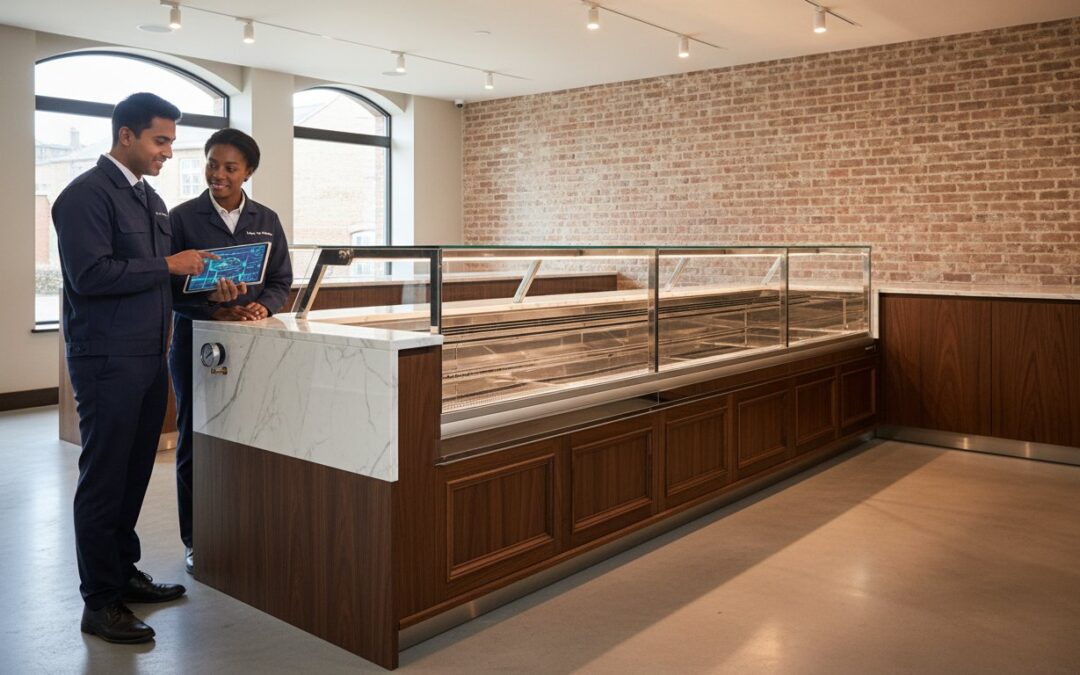
Refrigerated units are projected to account for over 78% of the food display market in 2026, yet the difference between a high-performing showcase and a costly failure often rests on the precision of the initial setup. Executing a professional food display cabinet installation UK project requires more than just floor space; it demands a synergy between artisanal design and rigorous mechanical standards. You’ve likely felt the pressure of balancing aesthetic appeal with the technical complexity of F-Gas regulations and the threat of rising energy bills from poorly ventilated units.
We understand that these technical hurdles can feel overwhelming when you’re trying to launch a new site or upgrade a deli counter. This guide provides the expertise you need to master the technical requirements and strategic planning for high-performance installations that ensure long-term efficiency. We’ll walk through the essential steps of professional commissioning, from ensuring UK safety compliance and navigating HFC phase-downs to achieving a seamless integration with your bespoke serving counters for a maximum operational lifespan.
Key Takeaways
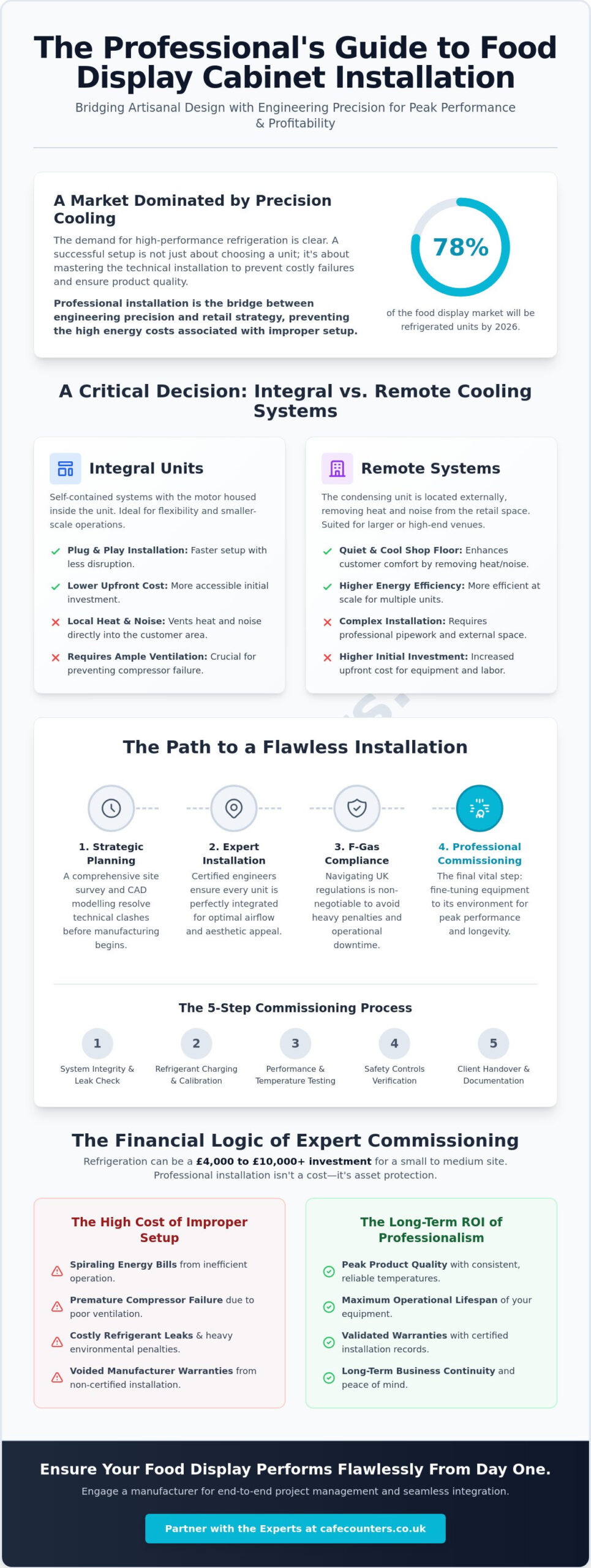
- Professional installation serves as a bridge between engineering precision and retail strategy, preventing the high energy costs associated with improper setup.
- Choosing between integral and remote cooling systems requires a detailed evaluation of your site’s ventilation and noise requirements to ensure long-term reliability.
- A comprehensive site survey and CAD modelling process are mandatory steps for any food display cabinet installation UK project to resolve technical clashes before manufacturing.
- Compliance with UK F-Gas regulations is non-negotiable; mastering the five-step commissioning process protects your business from heavy penalties and operational downtime.
- Engaging a manufacturer for end-to-end project management ensures that bespoke units like salad bars and heated gantries are perfectly integrated into your physical space.
The Strategic Role of Professional Food Display Cabinet Installation
A successful retail environment relies on the invisible precision of its infrastructure. Professional food display cabinet installation UK is far more than a simple delivery and plug-in service; it represents a synergy between mechanical engineering and retail spatial design. When a unit is positioned without considering airflow or ambient heat, it becomes a liability rather than an asset. We view the installer as a strategic partner who ensures your high-value patisserie products or fresh deli items remain at peak quality from the moment your doors open. This meticulous approach prevents the hidden costs of improper setup, such as energy waste and premature compressor failure, which can derail a project’s profitability before it even begins.
Expert commissioning is the final, vital step in bringing a physical space to life. It involves fine-tuning the equipment to its specific environment, ensuring that temperature consistency is maintained despite the external pressures of a busy shop floor. For businesses investing in high-end displays, this technical precision is what separates a standard shop fit-out from a high-performance retail destination. By establishing a reliable foundation through expert installation, you’re choosing long-term business continuity over the risks of operational downtime.
Preserving Product Quality Through Technical Precision
The shelf-life of fresh deli items depends entirely on consistent airflow management. If a cabinet isn’t commissioned correctly, “dead zones” in temperature can lead to spoilage or dry out delicate pastries. In open-plan cafe environments, technical precision also addresses noise reduction and heat dissipation. A poorly installed unit forces the compressor to work harder, venting excess heat into the customer area and creating an unpleasant acoustic environment. By ensuring each display case sits flush within bespoke counters, we achieve a premium aesthetic that suggests quality to every customer. This level of detail is essential for maintaining the artisanal pride of your brand while protecting the integrity of your stock.
The Financial Logic of Expert Commissioning
Improper setup carries financial burdens that often surface months after the project is complete. With refrigeration accounting for a significant portion of a café’s equipment budget, often ranging between £4,000 and £10,000 for small to medium sites, protecting that investment is paramount. Expert commissioning protects your assets by validating manufacturer warranties through certified installation records. It also significantly reduces the risk of refrigerant leaks, which are costly to repair and carry heavy environmental penalties under UK regulations. A methodical, phased approach to food display cabinet installation UK allows your business to transition into full operation without the disruption of technical failures or emergency repairs during peak trading hours.
Evaluating Installation Requirements: Integral vs. Remote Systems
Choosing the right cooling architecture is the most consequential technical decision in any food display cabinet installation UK project. This choice dictates your floor plan, your energy profile, and even the acoustic comfort of your customers. Most commercial environments must decide between integral systems, where the motor is housed within the unit, and remote systems, which sit externally. Both have distinct technical requirements that must be addressed during the planning phase to ensure compliance with UK food safety regulations and operational efficiency.
Modern retail trends increasingly favour minimalist, seamless counter designs. This has led to a rise in drop-in units that sit flush with the worktop, creating a clean visual line. Whether you are installing refrigerated grab and go display units or bespoke patisserie cases, understanding the underlying mechanical needs is vital. Proper ventilation management is the priority here; without it, even the most expensive cabinet will struggle to maintain temperature in high-traffic retail zones, leading to premature component failure.
Integral Units: Flexibility for Dynamic Retail
Integral or “plug-in” units offer unparalleled flexibility for UK cafe environments. They’re ideal for businesses that may need to reconfigure their layout or those operating in leased spaces where external modifications aren’t possible. However, they require strict adherence to clearance guidelines. A common error is neglecting the space needed for effective condenser airflow, which causes the unit to overheat. Our installers also pay close attention to drainage solutions. While many freestanding units use condensate evaporation trays, high-humidity environments may require dedicated plumbing to prevent water pooling. If you’re planning a new layout, our team can help you select the right equipment for your specific floor plan.
Remote Systems: Performance and Customer Comfort
Remote systems are the preferred choice for large-scale operations or high-end boutiques where customer experience is paramount. By removing the heat and noise of the condenser from the serving area, you create a more pleasant atmosphere. The installation is more complex, requiring specialist pipework and F-Gas certified engineering to connect the internal display to the external condenser. Under the retained EU F-Gas Regulation 517/2014, these systems must be meticulously commissioned to prevent leaks. While the initial setup is more involved, the long-term energy advantages are significant. Remote cooling reduces the load on your internal air conditioning, lowering overall utility costs and extending the lifespan of your professional food display.
Strategic Planning: Site Surveys, CAD Modelling, and Integration
Successful execution of a commercial project relies on meticulous groundwork that begins long before equipment arrives on site. A professional site survey is a mandatory first step for UK hospitality projects, acting as the foundation for a trouble-free food display cabinet installation UK. This phase allows us to identify potential technical clashes and logistical hurdles that could otherwise lead to costly delays. By conducting a thorough assessment of your physical space, we position ourselves as your expert partner, ensuring that every patisserie display or salad bar integrates perfectly with your existing infrastructure.
Effective retail design also requires coordinating with various trades. We work alongside electrical and plumbing contractors to ensure that power supplies and drainage points are precisely located. This unified fit-out approach is particularly critical when integrating cabinets into a deli counter, where customer flow and ergonomic efficiency must be balanced with technical requirements. Throughout this process, we maintain strict adherence to UK F-Gas Regulations, ensuring that all refrigeration planning meets current environmental and safety standards.
The Site Survey: Mapping Technical Constraints
Our surveyors evaluate several critical factors during the initial visit to prevent operational headaches. We assess the floor’s load-bearing capacity, which is vital for heavy glass and stainless steel cabinets that can weigh several hundred kilograms when fully stocked. We also verify the existing electrical infrastructure, specifically checking for 13-amp vs. 16-amp requirements to avoid overloading circuits. Identifying access route challenges, such as narrow doorways or stairs, ensures that delivery and positioning happen smoothly without risking damage to the unit or your premises.
CAD Modelling: Precision Engineering
We utilise advanced CAD modelling to create a 3D visualisation of your serving line. This allows you to walk through the ergonomic flow of the space and ensure that staff can work efficiently behind the counter. CAD modelling prevents expensive on-site modifications by identifying spatial conflicts before the manufacturing phase begins. This level of precision is especially beneficial for drop-in units, where the cutout in a bespoke fabrication must be accurate to the millimetre. By resolving these details in the digital phase, we guarantee a seamless physical installation that reflects the high standards of your brand.
Navigating UK Compliance: F-Gas Regulations and Commissioning
Compliance isn’t a mere checkbox; it’s the foundation of your operational security. In the UK, the retained EU F-Gas Regulation 517/2014 dictates the strict management of refrigeration systems. Since January 2020, a service ban on virgin F-gases with a Global Warming Potential (GWP) of 2,500 or more has been in force, making older refrigerants like R-404A obsolete for new setups. A professional food display cabinet installation UK project ensures your equipment utilises modern, low-GWP refrigerants such as R290 (propane). This proactive approach future-proofs your investment against tightening environmental legislation and protects you from the Environment Agency’s civil penalties, which can reach £200,000 per offence.
Health and safety standards for temperature-controlled food storage require more than just a cold environment. They demand a verifiable record of performance. We treat the commissioning phase as a rigorous technical audit, ensuring that every patisserie display or grab-and-go unit operates exactly as the manufacturer intended. This methodical start-up process is what guarantees the long-term efficiency and visual impact promised at the start of your project.
F-Gas Compliance and Environmental Duty
Every engineer handling refrigeration equipment must be F-Gas certified by law. During the installation phase, we conduct mandatory pressure tests and leak checks to confirm the system’s integrity before any refrigerant is introduced. These results form the basis of your mandatory F-Gas logbook, a document you must maintain for inspection. By choosing high-performance, eco-friendly cooling systems, you don’t just stay legal; you align your brand with the 2026 market trend towards sustainable, energy-efficient retail operations.
The Technical Commissioning Checklist
Our technical commissioning follows a structured 5-step path to ensure your site is ready for peak trading. We start by verifying temperature pull-down speeds, ensuring the unit reaches its set point within the required timeframe. We then calibrate the thermostat, cross-referencing internal sensors with independent probes to ensure your deli or patisserie items are stored at safe, legal temperatures. We also test automatic defrost cycles and drainage flow rates to prevent water pooling or ice build-up that could damage your bespoke counters.
The final step is a comprehensive staff handover. We provide essential training on daily maintenance and operational safety protocols, ensuring your team knows how to keep the equipment running at peak performance. Upon completion, you’ll receive a full documentation pack including commissioning certificates and warranty records. If you want to ensure your next project meets these exacting standards, consult with our technical experts to plan your compliant installation.
The Manufacturer Advantage: Seamless Installation and Support
A successful retail environment relies on the invisible precision of its infrastructure. Choosing a single point of contact from initial design to final commissioning eliminates the friction often found between separate equipment suppliers and third-party contractors. When the team that engineered the unit also handles the final food display cabinet installation UK, you gain a level of technical synergy that ensures the specific cooling requirements of your patisserie displays or salad bars are met with absolute precision. This direct connection between the factory floor and your physical space is what guarantees the long-term efficiency and visual impact of your investment.
High-performance commercial refrigerators and bespoke counters perform significantly better when the installation is overseen by the original manufacturer. Our UK-based production and installation teams maintain a continuous chain of quality control that starts at our internal manufacturing facility and ends on your shop floor. This oversight ensures that the durability and artisanal quality promised during the design phase are fully realised during setup. By keeping every stage of the process in-house, we provide a reassuringly steady hand that alleviates the stress of complex commercial projects.
The Direct-to-Manufacturer Advantage
Partnering directly with a manufacturer removes the risk of miscommunication that can occur when multiple parties are involved. If your project faces unique architectural constraints, such as awkward corners or heritage building features, we can adjust technical specifications to fit the space perfectly. You gain the security of partnering with a UK expert founded in 1991, ensuring that your project is backed by decades of regional experience and a deep understanding of the British hospitality sector. This heritage allows us to act as a high-end design consultant and a practical manufacturer simultaneously, delivering solutions that are both beautiful and built to last.
Comprehensive Project Management
Our approach to food display cabinet installation UK involves end-to-end project management that coordinates national delivery schedules with on-site technical setup. We manage the transition from legacy equipment to high-efficiency new systems with methodical care, minimising any impact on your daily trading. The final stage of our process is a rigorous audit where we verify that every cabinet meets our “Expert Partner” standard. This commitment to reliability doesn’t end at handover; it’s supported by a national after-sales and maintenance network that ensures your equipment continues to perform at its peak for years to come.
Building a Foundation for Long-Term Retail Success
Mastering your food display cabinet installation UK is the final, critical step in transforming a design concept into a high-performance physical environment. We’ve explored how technical precision, from F-Gas compliance to the strategic choice between integral and remote systems, directly impacts your bottom line. By prioritising a methodical approach to site surveys and CAD modelling, you eliminate the risks of energy waste and operational downtime before they can take root in your business.
Since 1991, we’ve combined artisanal pride with rigorous manufacturing standards to support the UK’s most ambitious hospitality projects. Our expert team provides comprehensive project management, from initial technical surveys to national after-sales support, ensuring your equipment performs with the same reliability as the day it was commissioned. When you’re ready to secure the long-term efficiency and visual impact of your retail space, consult with our UK manufacturing experts for your next installation project. We’re here to ensure your vision is built on a foundation of quality and technical excellence.
Frequently Asked Questions
Do I need a site survey before ordering a bespoke food display cabinet?
A professional site survey is an essential first step for any bespoke project to ensure the unit aligns with your physical space and technical infrastructure. This process identifies floor load-bearing capacities and electrical requirements before manufacturing begins. By resolving these details early, you avoid the high costs of on-site modifications and ensure a seamless integration with your existing shop floor layout.
How long does a typical commercial refrigeration installation take in the UK?
Most standard food display cabinet installation UK projects are completed within one to three days, though bespoke or remote systems may require additional time. The duration depends heavily on site readiness and the complexity of the pipework involved. A phased approach ensures minimal disruption to your daily trading, allowing for a methodical transition from legacy equipment to your new high-efficiency system.
What are the ventilation requirements for integral refrigerated counters?
Integral units require specific clearance zones to allow the condenser to breathe and dissipate heat effectively. Without adequate airflow, the compressor overworks, leading to increased energy consumption and premature mechanical failure. We recommend maintaining the manufacturer’s specified gaps around the vents and ensuring the ambient room temperature remains within the unit’s climate class rating for optimal performance.
Is F-Gas certification mandatory for food display installers?
Legal compliance in the UK dictates that any engineer installing, servicing, or decommissioning equipment containing fluorinated greenhouse gases must hold a valid F-Gas certificate. This requirement protects your business from significant civil penalties and ensures that refrigerants are handled safely. Our certified engineers provide the necessary expertise to manage modern, low-GWP refrigerants in accordance with current environmental regulations.
Can food display cabinets be installed into existing cafe counters?
Integrating new display units into existing counters is a common requirement for refurbishments, typically achieved through specialized drop-in units. This process involves precise CAD modelling to ensure the cutout matches the cabinet dimensions to the millimetre. It’s vital to assess the structural integrity of the existing counter and ensure that the ventilation and drainage requirements of the new unit can be met within the old housing.
What documentation should I receive after a professional installation?
Upon completion, you should receive a comprehensive handover pack including the commissioning certificate, F-Gas logbook, and manufacturer warranty records. This documentation serves as a legal record of compliance and a vital resource for future maintenance. It also includes staff training notes on daily operational protocols, ensuring your team can maintain the equipment’s visual impact and long-term efficiency from day one.
How does remote refrigeration installation differ from plug-in units?
Remote installations involve placing the condenser unit externally, requiring specialist pipework to connect it to the display cabinet. This differs from plug-in units, which house all components internally and only require a standard power connection. While remote setups are more technically complex to install, they offer superior customer comfort by removing heat and noise from the serving area and providing better energy efficiency.
What happens during the technical commissioning of a new display unit?
Technical commissioning involves a structured series of tests to verify the unit’s performance under operational conditions. Our engineers monitor temperature pull-down speeds, calibrate thermostats against independent probes, and test automatic defrost cycles. This phase ensures that every component is functioning correctly before you load the unit with stock, protecting your high-value patisserie or deli items from temperature fluctuations.