
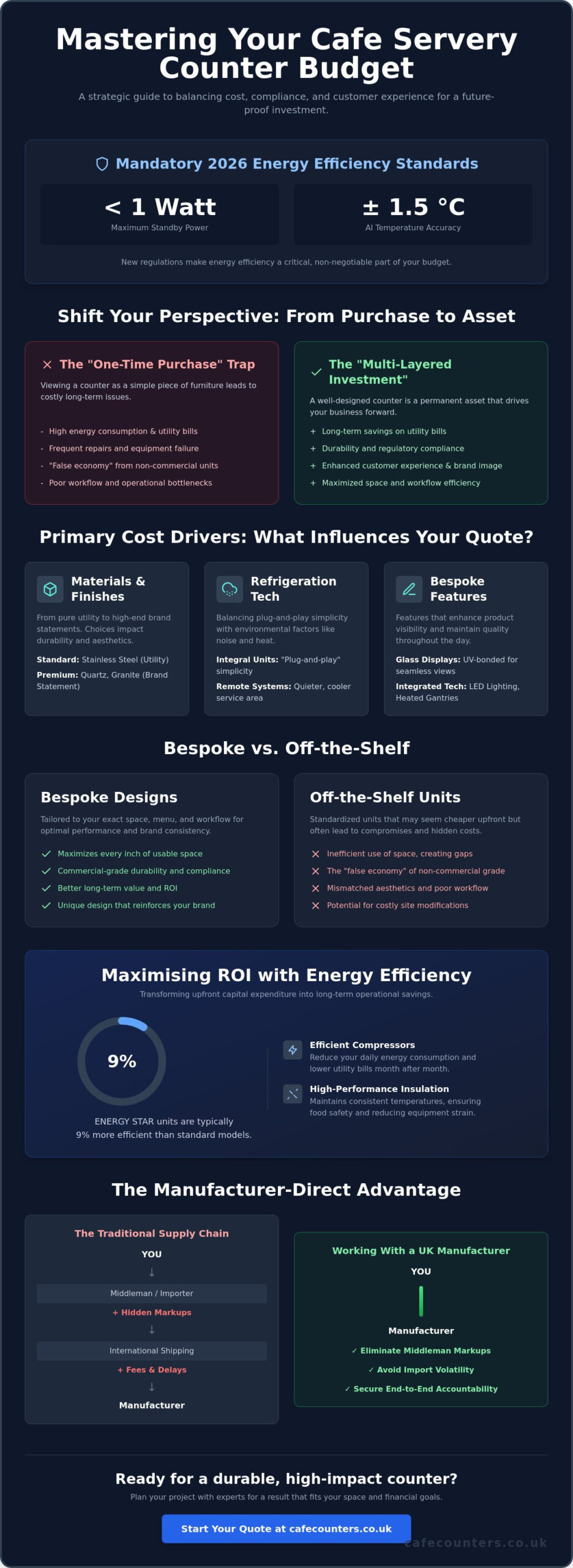
Did you know that by September 1, 2026, new mandatory energy efficiency standards will require commercial equipment to maintain standby power under 1 watt and AI temperature accuracy within ±1.5°C? This regulatory shift means that budgeting for cafe servery counters is no longer just about aesthetics; it’s a strategic move for long-term compliance and operational success. You’ve likely felt the pressure of trying to balance a vision for a beautiful space with the practical fear of hidden installation costs or equipment that fails far too soon. It’s a common challenge in the hospitality sector where every square inch of your service layout directly impacts your bottom line.
We believe that a well-designed counter should be a permanent asset, not a recurring expense. This guide promises to help you master the complexities of commercial counter costs so your project delivers both high-end visual impact and seamless efficiency. We’ll explore how to navigate the 2026 landscape, including the integration of ENERGY STAR units that are typically 9% more efficient than standard models. By the end of this article, you’ll have a clear roadmap for a durable, high-impact counter that fits your space and your financial goals perfectly.
Key Takeaways
- Shift your perspective from seeing a counter as a one-time purchase to viewing it as a multi-layered investment in both customer experience and operational workflow.
- Understand how specific material choices and refrigeration technologies influence the total cost of budgeting for cafe servery counters to avoid unexpected quote inflation.
- Learn why bespoke designs often provide better value than off-the-shelf alternatives by maximizing usable space and preventing the “false economy” of non-commercial grade units.
- Discover how high-performance insulation and energy-efficient compressors transform your upfront capital expenditure into long-term savings on utility bills.
- Uncover the financial and logistical benefits of working directly with a UK manufacturer to eliminate middleman markups and secure end-to-end project accountability.
Budgeting for Cafe Servery Counters: Setting Realistic Expectations
When you begin budgeting for cafe servery counters, it’s vital to view the project through a dual lens of front-of-house impact and back-of-house efficiency. A counter isn’t merely a piece of furniture; it’s the engine room of your service. We often see operators lured by the “cheapest” initial quote, only to find that the lifetime cost of repairs and energy consumption far outweighs the initial savings. A professional budget rests on three foundational pillars: the hardware itself, the level of bespoke customization required to fit your brand, and the technical integration into your specific site.
In the UK, your financial planning must account for stringent food safety and hygiene standards. This includes choosing materials that are non-porous and easy to sanitize, ensuring your investment remains compliant with local regulations for years to come. By treating the counter as a multi-layered investment, you protect your business from the “false economy” of low-quality equipment that fails under the pressure of a busy commercial environment. It’s about building for durability, not just for the opening day.
The Role of the Servery Counter in Your Business Model
Your menu is the primary architect of your counter’s layout. If your focus is on high-margin artisanal cakes, your budget will lean heavily toward Patisserie Displays with precision temperature control. Conversely, a high-volume lunch spot requires robust Grab & Go Displays to maintain speed and throughput. The way customers move through your space, whether it’s a quick transaction or a leisurely understanding the modern food court environment, dictates the ratio of heated to refrigerated units. A well-designed counter doesn’t just hold food; it drives average transaction value by presenting your offerings in the best possible light.
Initial Planning: Avoiding Common Financial Pitfalls
Precision is the hallmark of a successful installation. One of the most expensive mistakes is a poor site survey. Mismatched measurements lead to delays and costly modifications during the installation phase. You must also budget for the “invisible” work of technical integration. This includes ensuring your site has the correct power load, adequate drainage for refrigeration units, and sufficient ventilation for heated gantries. We recommend allocating a contingency fund to handle site-specific complexities—for instance, if your planning application requires you to explore Transport Statements to address local traffic impact—ensuring your project stays on track and within its original financial scope.
Primary Cost Drivers: What Influences Your Servery Counter Quote?
A professional quote is rarely a single figure; it’s a reflection of several technical and aesthetic variables that dictate the long-term performance of your installation. When budgeting for cafe servery counters, you must decide where to prioritise your capital. For instance, the transition from standard stainless steel to premium bespoke finishes like quartz or granite represents a shift from pure utility to a high-end brand statement. These material choices directly impact the fabrication timeline and the final price point, but they also define the durability of your service line.
Technical specifications often carry the most weight in your financial planning. High-performance integral refrigeration units offer a “plug-and-play” simplicity, whereas remote systems require complex pipework but offer a quieter, cooler service environment. Beyond the cooling, the complexity of your glass displays also shifts the budget. While standard glass is functional, UV-bonded “invisible” joints for patisserie displays create a seamless visual experience that elevates the perception of your food quality. Integrating LED lighting and heated gantries further adds to the complexity, ensuring your products are illuminated and maintained at safe temperatures throughout the day.
Choosing a UK-based manufacturer provides a significant advantage in your budgeting process. By working directly with the people who build your equipment, you bypass the hidden markups associated with importers and middlemen. You also avoid the volatility of international shipping fees and import duties, ensuring your budget remains predictable from the initial design phase to the final installation. If you are ready to see how these variables fit into your specific floor plan, you can view our range of bespoke options to start narrowing down your requirements.
Materials and Finishes: Aesthetic vs. Durability
The longevity of high-grade stainless steel fabrication is unmatched in high-traffic environments. It provides a hygienic, robust foundation that resists the wear and tear of daily service. When you add custom worktops like granite or solid surface options, you’re investing in a surface that stays pristine for years. Budgeting for these elements also involves considering the cladding and branding. Whether you choose natural woods or textured plaster, these finishes transform a functional unit into a focal point of your interior design.
Technical Specifications and Display Units
The type of display you choose significantly alters your quote. For example, refrigerated grab and go display units are designed for high-volume throughput and require specific airflow technology to maintain temperatures in open-fronted designs. If your menu focuses on hot service, Vision Heated Counters offer precision temperature control to keep food at its peak. For those looking for a middle ground between modular units and fully bespoke fabrications, “drop-in” units allow you to integrate professional-grade equipment into existing or custom-built counter carcasses, offering a flexible solution for various budget levels.
Bespoke vs. Off-the-Shelf: Balancing Vision with Constraints
Choosing between a ready-made unit and a custom-built fabrication is a pivotal moment in budgeting for cafe servery counters. While modular units offer a lower entry price, they often represent a false economy. Non-commercial grade counters, frequently seen in DIY design galleries, lack the structural integrity to withstand the heat of a busy espresso machine or the constant moisture of a refrigeration unit. Over time, the cost of replacing warped surfaces or failing seals far exceeds the initial investment in a professional-grade solution. We see many operators regret choosing “economy” options when they realize the lack of durability leads to service downtime and lost revenue.
Bespoke design is a strategic tool for maximizing every square inch of your cafe footprint. In tight urban spaces, a standard unit might leave unusable gaps or create bottlenecks that slow down your team. A custom-built counter follows the exact contour of your walls, turning awkward corners into profitable display space. This precision allows for integrated units that match your specific service speed. When your workflow is optimized through better ergonomics, your staff moves less and serves more. This efficiency directly reduces long-term labor costs, as a well-designed layout allows fewer people to handle a higher volume of customers during peak periods.
When to Invest in Bespoke Solutions
Awkward room shapes are the most common reason to choose bespoke. If your site has structural pillars or non-linear walls, modular units simply won’t fit without leaving unsightly gaps. Beyond logistics, bespoke is essential for creating a hero display. High-margin items like patisserie or artisan deli goods deserve a stage that highlights their quality. By integrating multiple functions, such as hot, cold, and ambient displays, into a single seamless counter, you create a cohesive visual experience that modular blocks cannot replicate.
Modular Elements within a Custom Framework
You can achieve a high-end look without a fully bespoke price tag by using modular elements within a custom framework. This involves using standardized internal components while applying bespoke external cladding to match your brand’s aesthetic. This approach allows you to phase a counter project to manage cash flow more effectively. We use advanced CAD modeling to visualize the final product before manufacture, ensuring every component fits perfectly before it reaches your site. This methodical planning eliminates the need for on-site modifications and keeps your budget secure.
Maximising ROI: Energy Efficiency and Operational Savings
A truly professional approach to budgeting for cafe servery counters looks far beyond the initial purchase price. You must evaluate the total cost of ownership over a five to ten-year period. Energy efficiency isn’t just a sustainability goal; it’s a critical budget line item that determines your monthly overheads. While premium hardware requires a higher upfront investment, the reduction in electricity bills often justifies the cost within the first few years of operation. High-quality insulation and high-efficiency compressors ensure that your units aren’t working harder than necessary to maintain the required climate.
Precision temperature control also plays a vital role in reducing food waste. When your displays maintain a steady environment without significant fluctuations, your products stay fresh for longer. This reliability prevents the costly disposal of stock that has fallen outside of safe temperature windows. By investing in equipment that meets the rigorous 2026 energy standards, you protect your business from rising utility costs and future regulatory penalties. Long-term maintenance should also be factored into your initial financial plan. Choosing units with accessible components and a reliable UK-based support network ensures that your equipment remains in peak condition throughout its lifespan.
Energy-Efficient Refrigeration and Heating
Modern display units now feature LED lighting and energy-saving fans that significantly lower power draw without compromising on visual impact. For example, Vision Heated Counters are engineered to maintain consistent food quality while using advanced thermal management to minimise energy consumption. When calculating your “payback period,” consider that ENERGY STAR certified refrigerators are approximately 9% more efficient than standard models. These small percentages add up to substantial annual savings that go straight back into your profit margins.
Labour Efficiency and Customer Flow
The physical layout of your counter directly influences your staff’s productivity. A well-designed space reduces the “steps per serve,” allowing your team to work more efficiently during peak rushes. Integrating refrigerated grab and go display units can lower your staff requirements by allowing customers to serve themselves, freeing up your team for more complex tasks. This ergonomic focus, combined with easy-to-clean surfaces and accessible components, ensures that your daily operations run smoothly with minimal downtime. If you’re ready to design a space that works as hard as you do, you can consult with our design team to explore high-efficiency layouts.
Strategic Planning: The Manufacturer Direct Advantage
Working directly with a British manufacturer provides a level of financial transparency that third-party distributors simply cannot offer. When you bypass the middleman, you eliminate the hidden markups that often complicate budgeting for cafe servery counters. This direct relationship ensures that your investment is concentrated on high-grade materials and precision engineering rather than commission fees. It also establishes a single point of accountability; the team that designs your counter is the same team that builds and installs it. This end-to-end project management acts as a conceptual anchor, protecting your capital from the budget creep that typically occurs when multiple contractors are involved.
Our in-house CAD modelling acts as a vital safeguard against unforeseen expenses. We don’t just estimate how a unit will fit; we map every component against the digital reality of your site. This process identifies potential obstacles, such as structural pillars or misaligned drainage points, before a single sheet of stainless steel is cut. In contrast to multi-party projects where communication errors are common, our designers and fabricators work in the same facility. This collaboration ensures that the final product arrives on-site ready for a perfect installation, eliminating the need for expensive, last-minute modifications that could derail your timeline.
From CAD Concept to Physical Installation
A professional site survey is the bedrock of a fixed, accurate quote. By capturing every detail of your environment, we provide a price that stays firm, giving you the security needed for a successful 2026 hospitality project. Custom fabrication then ensures a “first-time fit,” which is essential for minimising disruption to your business operations. When the team that built your Patisserie Displays or Deli Counters is the same team maintaining them, you receive a level of after-sales support that third-party sellers cannot replicate. This long-term reliability is a signature of British-made quality and artisanal pride.
Finalising Your 2026 Cafe Budget
Successful planning requires a balance between aesthetic impact and operational durability. As you finalise your project, remember to prioritise capital allocation toward these four critical areas:
- High-performance refrigeration that meets the newest energy efficiency standards.
- Ergonomic layouts that reduce staff fatigue and increase service speed.
- Durable, non-porous worktops that maintain hygiene and visual appeal.
- Direct-from-manufacturer fabrication to ensure quality control and authentic craftsmanship.
We invite you to share your vision with us so we can provide the technical expertise required to make it a reality. You can Contact TFSE Products Ltd for a bespoke counter consultation to discuss a project that respects your financial boundaries while delivering a high-end, durable finish. We look forward to helping you build a space that stands the test of time.
Securing the Future of Your Hospitality Project
Building a successful cafe requires a vision that extends well beyond the first day of service. We’ve explored how technical precision, energy-efficient refrigeration, and ergonomic layout choices define the total cost of ownership. By prioritising durability over the “false economy” of non-commercial units, you ensure your space remains profitable and compliant with upcoming 2026 standards. Effective budgeting for cafe servery counters isn’t about finding the lowest initial price; it’s about choosing an expert partner who understands the entire lifecycle of your equipment.
Beyond kitchen infrastructure, a complete business strategy for 2026 includes managing your back-office technology efficiently; to see how you can apply similar lifecycle planning to your IT equipment, learn more about HGC Technologies UK Ltd..
Since 1991, we’ve utilised our UK-based manufacturing facilities and advanced CAD modelling to eliminate site-specific errors before they happen. Our in-house team manages everything from initial design to final installation and commissioning, providing a steady hand through every phase of your project. Request a bespoke cafe counter consultation and quote to begin transforming your vision into a durable, physical reality. We’re ready to help you build a space that stands the test of time.
Frequently Asked Questions
How much does a bespoke cafe counter typically cost in the UK?
The cost of a bespoke counter depends on several variables including the total length of the run, the complexity of the integrated units, and the choice of premium finishes like quartz or granite. Because every project is unique, we provide fixed quotes only after a detailed site survey and CAD design process. This ensures that the price you pay reflects the technical requirements of your specific menu and floor plan without hidden surprises.
Can I save money by using modular units instead of a fully bespoke counter?
Using modular elements within a custom framework is an effective way to manage the costs of budgeting for cafe servery counters. This approach allows you to use standardized internal components while still achieving a high-end, tailored look with bespoke external cladding. While off-the-shelf units have a lower entry price, they often result in wasted space or inefficient workflows that cost more in lost revenue over time.
What are the most durable materials for a commercial cafe counter top?
High-grade stainless steel, granite, and engineered quartz are the industry standards for durability in high-traffic environments. These materials are non-porous and highly resistant to the heat of coffee machines and the moisture of refrigeration units. Solid surface options also provide excellent longevity and the benefit of seamless joints, which makes them incredibly easy to sanitize and maintain to professional hygiene standards.
How does energy efficiency impact the long-term budget of a servery counter?
Energy efficiency acts as a recurring saving on your monthly utility bills, which helps offset the initial capital expenditure of premium hardware. With the 2026 mandate for standby power to remain under 1 watt, choosing high-performance units is now a regulatory necessity as well as a financial one. Investing in superior insulation and efficient compressors reduces the workload on your equipment, extending its operational lifespan and lowering maintenance costs.
Do I need to budget separately for counter installation and commissioning?
Yes, you should always include a specific line item for the technical integration of your counter, including power, drainage, and ventilation requirements. Professional commissioning is vital to ensure that your Patisserie Displays and heated units are calibrated correctly for food safety. We recommend setting aside a contingency fund of approximately 10% to handle site-specific complexities that may arise during the installation phase.
How long does the design and manufacturing process take for a custom counter?
The journey from an initial idea to a finished physical space typically spans several weeks, starting with a precise site survey and CAD modelling. This methodical progression ensures that every component is fabricated to a “first-time fit” standard. By working with a UK-based manufacturer, you avoid the unpredictable delays associated with international shipping and import customs, allowing for a more reliable project timeline.
What is the benefit of buying from a UK-based catering equipment manufacturer?
Buying direct from a UK manufacturer eliminates middleman markups and provides a single, reliable point of contact for your entire project. It ensures a level of quality control and artisanal pride that is often lost with imported, mass-produced units. You also gain the long-term benefit of local after-sales support, meaning that the experts who built your counter are the same ones available to maintain it.
How can a better counter layout improve my cafe’s daily profit?
A well-designed layout reduces staff fatigue by minimizing the “steps per serve,” which allows your team to handle peak rushes with greater speed and accuracy. By strategically placing Grab & Go Displays near the till point, you can also increase average transaction values through impulse purchases. An efficient flow doesn’t just lower your labor costs; it creates a better customer experience that encourages repeat business and higher daily throughput.