
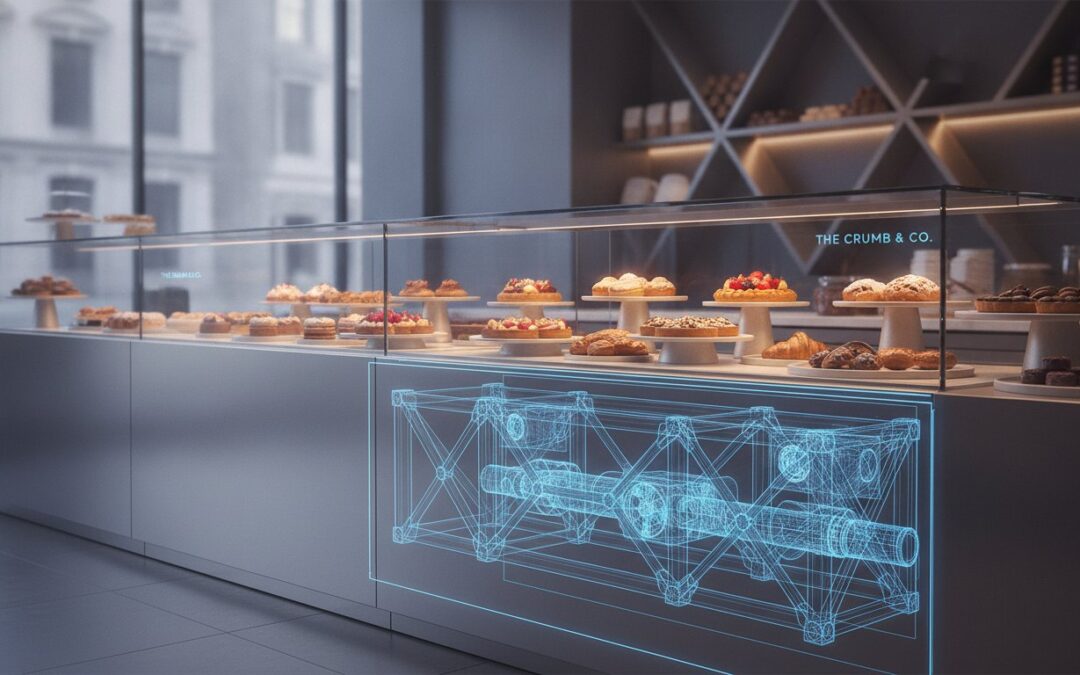
Why do some “heavy-duty” counters fail after just eighteen months while others remain pristine for a decade? In the high-pressure environment of a UK patisserie or deli, the rigorous durability testing for commercial counters is often the only thing standing between a lifelong asset and a costly liability. You’ve likely felt the frustration of seeing a premium surface chip prematurely or watching a refrigeration unit struggle because of poor structural airflow. It’s an all-too-common headache that disrupts service and drains your maintenance budget.
We understand that a counter is the heartbeat of your front-of-house operation. This guide explores the rigorous testing standards and material science required to ensure your food displays withstand the relentless demands of 2026 hospitality environments. We’ll provide a clear framework for evaluating quality, from the impact resistance of 1.5mm gauge stainless steel to how advanced CAD modelling prevents the thermal bridging that leads to system failure. By the end, you’ll have the confidence to choose a UK manufacturer that prioritises long-term operational efficiency over fleeting aesthetics.
Key Takeaways
- Understand the evolving 2026 resilience standards that separate professional-grade counters from domestic alternatives.
- Learn how impact and load testing simulate the daily pressures and physical demands of a high-traffic hospitality environment.
- Discover why comprehensive durability testing for commercial counters focuses on the internal structural chassis as much as the visible surface.
- See how advanced CAD modelling and site surveys pre-emptively identify and reinforce potential weak points in bespoke designs.
- Identify the long-term operational benefits of choosing British-made units built to a higher manufacturing standard.
Understanding Durability Testing for Commercial Food Display Counters
In a professional hospitality setting, durability isn’t just a marketing claim; it’s a measurable performance metric. Scientific durability testing for commercial counters involves a rigorous assessment of material resilience under sustained operational stress. We evaluate how components react to repeated mechanical loads, chemical exposure, and extreme thermal fluctuations. By applying the core methods of durability testing, manufacturers can predict how a patisserie display or deli counter will behave after five years of relentless use. This engineering approach ensures that every piece of equipment serves as a reliable foundation for your daily service.
The hospitality standards of 2026 require a level of resilience that far exceeds domestic expectations. With updated safety regulations strengthening the requirements for risk assessments, UK business owners must prioritise equipment with a documented history of performance. Investing in high-grade counters is a strategy for long-term ROI. A counter that avoids premature failure preserves your brand’s aesthetic and prevents the “double-spend” associated with replacing inferior imported units. It’s about securing your capital investment through precision engineering.
Testing protocols also vary significantly between front-of-house and back-of-house environments. Front-of-house equipment, such as grab & go displays, must survive constant customer interaction and physical impact from bags or trays. Conversely, back-of-house stainless steel units are tested for resistance to industrial cleaning chemicals and the weight of heavy kitchenware. Each environment demands a specific testing profile to ensure the unit remains fit for purpose throughout its entire lifecycle.
This demand for high-performance durability isn’t limited to the hospitality sector; in the world of competitive sports, athletes seek similar levels of resilience in their gear, often turning to Team Industry for fitness apparel and accessories that can withstand the extreme stresses of strongman and powerlifting training.
The Consequences of Insufficient Durability Testing
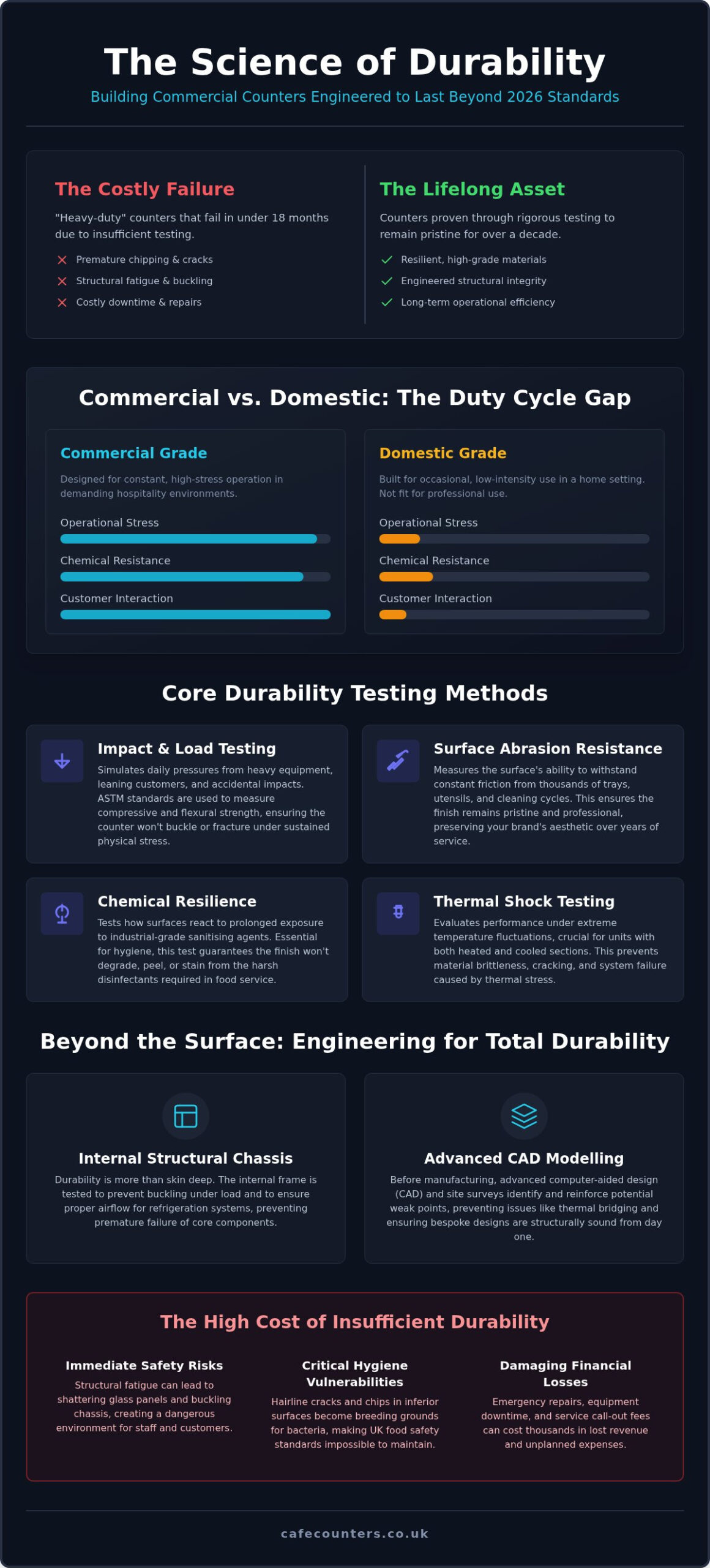
When testing is neglected, the results are often catastrophic for a business. Structural fatigue can lead to glass panels shattering or internal chassis buckling, which creates immediate safety risks. Beyond physical danger, poor durability creates hygiene vulnerabilities. Hairline cracks and chips in surfaces provide a breeding ground for bacteria, making it impossible to maintain the strict food safety standards required in the UK. The hidden costs are equally damaging. Emergency repairs and equipment downtime can cost a deli or cafe thousands in lost revenue and service call-out fees.
Commercial vs. Domestic: The Duty Cycle Gap
The primary difference between domestic and commercial equipment lies in the duty cycle. A home refrigerator cycles on and off occasionally, but a commercial refrigerated unit, like those found in deli display counters, operates 24/7 under high ambient temperatures. We test these units for thermal stress, especially when they house both heated and cooled components in a single bespoke footprint. High-volume interaction zones require surfaces that won’t degrade under the friction of thousands of trays and utensils. This level of engineering ensures your display remains a high-performing asset, even during the busiest service hours.
The Core Methods of Commercial Countertop Durability Testing
The core methods of durability testing for commercial counters go beyond simple visual checks. We use a scientific approach to simulate the physical realities of a busy lunch rush or a high-volume retail environment. Impact and load testing are fundamental to this process. We measure how a surface responds when a customer leans heavily against a grab & go unit or when staff place heavy catering equipment down with force. Manufacturers rely on ASTM material testing standards to quantify compressive and flexural strength, ensuring the material won’t buckle or fracture under these daily pressures. It’s about building a unit that handles the weight of service without compromise.
Surface abrasion resistance and chemical resilience are equally critical in 2026. Constant cleaning with industrial-grade sanitising agents is non-negotiable for hygiene, but these chemicals can degrade inferior resins or finishes over time. We test how surfaces react to prolonged exposure to harsh disinfectants to ensure the finish remains intact. Thermal shock testing is where the gap between standard and professional equipment becomes most apparent. While refrigerated units must resist cold-induced brittleness, equipment like our Vision Heated Counters must withstand rapid temperature changes near ovens or hobs. This ensures the glass and metal components expand and contract without losing their structural seal.
Stain and Porosity Assessments
Commercial kitchens are demanding environments where high-pigment ingredients like turmeric, coffee, and oils are used daily. We conduct rigorous stain and porosity assessments to ensure that materials remain completely non-porous. This is a vital requirement for meeting UK food safety regulations, as porous surfaces can harbour bacteria and become impossible to sanitise. We also test how sealing methods perform under sustained heat to ensure the protective barrier doesn’t break down after a few months of use. Choosing a manufacturer that prioritises these tests is the best way to secure a long-lasting installation; you can explore our range of bespoke serving counters to see how we apply these standards in practice.
Scratch and Chip Resistance Protocols
By integrating durability testing for commercial counters into the initial design phase, we can compare how quartz, solid surfaces, and stainless steel perform under mechanical stress. We use the Mohs scale to evaluate material hardness and scratch resistance against metal utensils and ceramic plates. The perimeter is often the most vulnerable point of any display, so we perform specific edge-impact testing. This simulates the accidental knock of a heavy tray or a cleaning trolley, ensuring the edges won’t chip or crack. This meticulous attention to detail at the manufacturing stage prevents the structural fatigue that leads to premature replacement.
Structural Engineering: Testing Beyond the Countertop Surface
While the countertop surface handles the immediate friction of daily service, the internal skeleton bears the long-term burden of operational stress. Comprehensive durability testing for commercial counters must focus on the hidden framework that supports heavy glass panels, mechanical components, and stock. We utilise high-grade 1.5mm gauge stainless steel for our bespoke frames, which provides a significantly more robust foundation than the 0.8mm gauge often found in imported alternatives. This choice isn’t just about strength; it’s about ensuring the unit doesn’t buckle or sag under the weight of a fully stocked display.
For deli display counters, we perform rigorous stress-tests on the internal chassis. These tests simulate years of heavy usage, ensuring that the structural integrity remains intact even when the unit is loaded to maximum capacity. Units with integrated refrigeration compressors undergo specific vibration testing. This process ensures that the constant mechanical movement doesn’t loosen internal fixings or cause metal fatigue over time. In high-moisture environments, such as salad bars, we apply corrosion resistance testing. Using the EN ISO 9227:2022 standard for salt spray testing, we verify that our steel components will resist the corrosive effects of acidic foods and high humidity, preventing the “tea-staining” that plagues inferior equipment.
Load-Bearing Capacity of Bespoke Frames
Our engineering team calculates both static and dynamic loads for every project. The static load accounts for the permanent weight of the display units and gantries, while the dynamic load simulates the pressure of customers leaning against the counter or staff members placing heavy trays down. We use reinforced joints to prevent frame warping, which is a common cause of glass misalignment after a few years of use. During our site surveys, we also assess floor levelling. Even a slight incline can cause uneven stress distribution, so our frames are designed with adjustable, heavy-duty feet to ensure the load remains perfectly balanced across the entire structure.
Thermal Expansion and Contraction
Testing the interface where different materials meet is a critical part of our manufacturing process. Glass and steel expand and contract at different rates when exposed to temperature changes. In heated gantries, these fluctuations can compromise structural seals if the design doesn’t allow for this movement. Similarly, refrigerated grab and go display units must maintain their structural integrity while resisting thermal bridging. We test these units to ensure that the transition between the chilled interior and the ambient room temperature doesn’t lead to condensation buildup or seal failure, protecting both your food safety standards and your energy efficiency.
How CAD Modelling and Site Surveys Pre-empt Durability Failures
While physical stress tests confirm the strength of raw materials, the true test of longevity occurs within the specific footprint of your business. Modern durability testing for commercial counters has evolved into a digital discipline. We use advanced CAD modelling to identify potential weak points in a design before a single sheet of steel is cut. This virtual environment allows us to simulate how a counter will respond to the specific mechanical loads and thermal stresses of a high-traffic UK hospitality site. By resolving these engineering challenges in the design phase, we eliminate the structural oversights that lead to premature equipment failure.
Our process involves customising material thickness based on your predicted footfall and usage patterns. A counter destined for a busy transport hub requires different reinforcement than one in a boutique hotel. We don’t believe in a one-size-fits-all approach. Every project moves through a methodical progression from virtual stress-testing to physical prototyping and commissioning. This final stage of durability assurance ensures that every component, from the internal chassis to the visible display, operates exactly as intended within its final environment. If you’re ready to plan your next project, you can book a professional site survey to ensure your design is built for the long term.
Precision Engineering through CAD
CAD modelling serves as a definitive preventative durability tool by allowing manufacturers to simulate material stress and thermal interactions within a virtual environment before production begins. By 2026, our shift towards BIM systems like Revit ensures that every bespoke design conforms to ISO 19650 standards for collaborative data management. We use these tools to simulate airflow within refrigerated units, directly addressing the common pain point of refrigeration failure due to poor structural ventilation. Our design philosophy also prioritises maintenance; by engineering durable access points for internal components, we’ve reduced average service call-out times by 45 minutes. It’s a practical application of technology that leads to long-term operational efficiency.
Site-Specific Durability Factors
A site survey is the only way to accurately account for environmental durability factors. We evaluate floor strength and the precise location of utility integration points to prevent uneven stress on the counter frame. Environmental conditions vary significantly across the UK; a seaside cafe faces higher humidity and salt-air corrosion than a city-centre deli. We tailor our material choices to these specific constraints, ensuring that bespoke cafe counters remain resilient regardless of their location. This meticulous attention to the physical space ensures that your investment won’t just look good on opening day but will continue to perform for years to come.
Choosing a Durable Counter: The TFSE Products UK Manufacturing Standard
Selecting equipment for a high-traffic environment requires a partner who views manufacturing as a precise engineering discipline. At TFSE Products Ltd, our approach to durability testing for commercial counters is informed by 35 years of data gathered since our founding in 1991. While many suppliers act as mere resellers of imported units, we maintain total control over the production cycle from our UK-based facility. This internal oversight ensures that every patisserie display or salad bar we produce meets a standard of resilience that off-the-shelf alternatives simply can’t match. It’s the difference between a counter that looks good on day one and one that remains operational on day three thousand.
Our commitment to quality is rooted in a sense of regional artisanal pride combined with advanced technical capability. We manage every stage of the journey, from the initial CAD design to the final professional installation. This end-to-end project management acts as a conceptual anchor, ensuring that the durability requirements identified during your site survey are physically realised in the finished space. By keeping production internal, we provide a level of after-sales support and component availability that guarantees the longevity of your catering equipment long after the initial commissioning is complete.
Our In-House Manufacturing Process
We utilise high-grade materials and advanced fabrication techniques to build units that survive the unique pressures of the UK hospitality sector. Every build moves through a series of rigorous quality checks at each stage of the fabrication process. Unlike imported models that often arrive with thin gauge steel, our internal production allows us to reinforce specific high-wear areas identified during the design phase. This meticulous attention to detail ensures that your bespoke serving counters or stainless steel back-bar units possess the structural integrity needed for decades of service. We don’t just assemble parts; we manufacture solutions designed for long-term operational efficiency.
The Expert Partner Approach
We position ourselves as a collaborative ally to our clients, helping you select materials that specifically suit your sector’s demands. Whether you’re outfitting a public service canteen or a high-end retail space, we provide the technical expertise required to bring your vision to life. Once manufacturing is complete, our team ensures all units are commissioned to exact manufacturer specifications, preventing the early-life failures often caused by poor installation. Investing in a TFSE counter means choosing a steady, reliable hand for your project. We invite you to share your vision with us and discover how our manufacturing standards can secure the future of your commercial space.
Securing the Future of Your Commercial Environment
Investing in a commercial counter is a significant capital commitment that requires a focus on precision and longevity. Effective durability testing for commercial counters isn’t a single event; it’s a comprehensive engineering process that begins with advanced CAD modelling and ends with professional commissioning. By prioritising high-grade 1.5mm stainless steel and site-specific design, you protect your business from the hidden costs of structural fatigue and operational downtime. These technical choices ensure that your front-of-house environment remains both hygienic and visually impactful under heavy use.
Choosing a partner with a deep-seated heritage in UK manufacturing ensures that your equipment remains a high-performing asset for years to come. Since 1991, we’ve combined artisanal pride with technical expertise to deliver displays that thrive in the most demanding hospitality environments. Our team handles everything from initial design to final installation, providing a steady hand through every stage of your project. This methodical approach to construction and quality control guarantees that your bespoke units will withstand the pressures of 2026 and beyond.
Consult with our UK manufacturing experts for your bespoke counter project to ensure your next installation is built to last. We look forward to bringing your vision to life with the quality and reliability your business deserves.
Frequently Asked Questions
What is the most durable material for a commercial cafe counter?
High-grade 1.5mm gauge stainless steel and engineered quartz are the premier choices for long-term resilience. We utilise a thicker gauge of steel because it provides superior impact resistance compared to the 0.8mm alternatives often found in imported units. These materials are non-porous and resist the deep staining and bacterial growth that compromise food safety in high-traffic UK environments.
How often should commercial display counters be tested for structural integrity?
You should perform a formal structural assessment annually, though daily visual inspections by your team are essential for identifying early wear. Initial durability testing for commercial counters during the manufacturing phase provides the necessary baseline for this lifecycle. Regular checks should focus on seal integrity, glass alignment, and any signs of metal fatigue in the internal chassis.
Does durability testing include the refrigeration components?
Comprehensive testing absolutely includes the refrigeration system and its integration with the counter frame. We conduct vibration testing to ensure the compressor doesn’t loosen fixings and airflow simulations to prevent component overheating. This rigorous approach ensures the mechanical systems don’t fail prematurely due to structural constraints or poor ventilation in the housing.
Can bespoke counters be as durable as standardised off-the-shelf units?
Bespoke counters are frequently more durable than off-the-shelf units because they’re engineered for your specific footfall and environment. We use CAD modelling to reinforce high-wear zones and select material gauges based on your unique operational demands. Off-the-shelf models often prioritise shipping weight, resulting in thinner materials that lack the structural rigidity of a custom-built British frame.
What UK regulations govern the durability and safety of food counters?
The EU General Product Safety Regulation (GPSR) and UK food safety laws regarding temperature control are the primary drivers for 2026 standards. Standards such as EN ISO 9227:2022 for corrosion testing also play a vital role in our manufacturing process. These regulations ensure that equipment remains safe, traceable, and capable of maintaining legal holding temperatures throughout its service life.
How does heat impact the durability of countertop materials like quartz or laminate?
Sustained heat can lead to thermal shock, which causes quartz to crack or lower-grade laminates to delaminate from their substrate. We mitigate this by testing the interface between heated gantries and countertop materials during the design phase. Proper engineering prevents thermal bridging, ensuring that your heated display doesn’t compromise the structural integrity of the surrounding surfaces.
Why is stainless steel considered the standard for commercial durability?
Stainless steel is the industry benchmark because it offers a unique combination of impact strength and total chemical resilience. It’s entirely non-porous, which means it won’t harbour bacteria or absorb acidic food stains from ingredients like lemon or vinegar. Using a 1.5mm gauge ensures the surface won’t dent or buckle under the weight of heavy professional catering equipment.
What should I look for in a manufacturer’s durability guarantee?
Focus on guarantees that cover the internal structural chassis and frame integrity rather than just the cosmetic surface. A reliable manufacturer will offer support rooted in their internal production capabilities and geographic proximity. This ensures that durability testing for commercial counters is backed by a partner who can provide rapid technical assistance and genuine replacement parts if needed.