
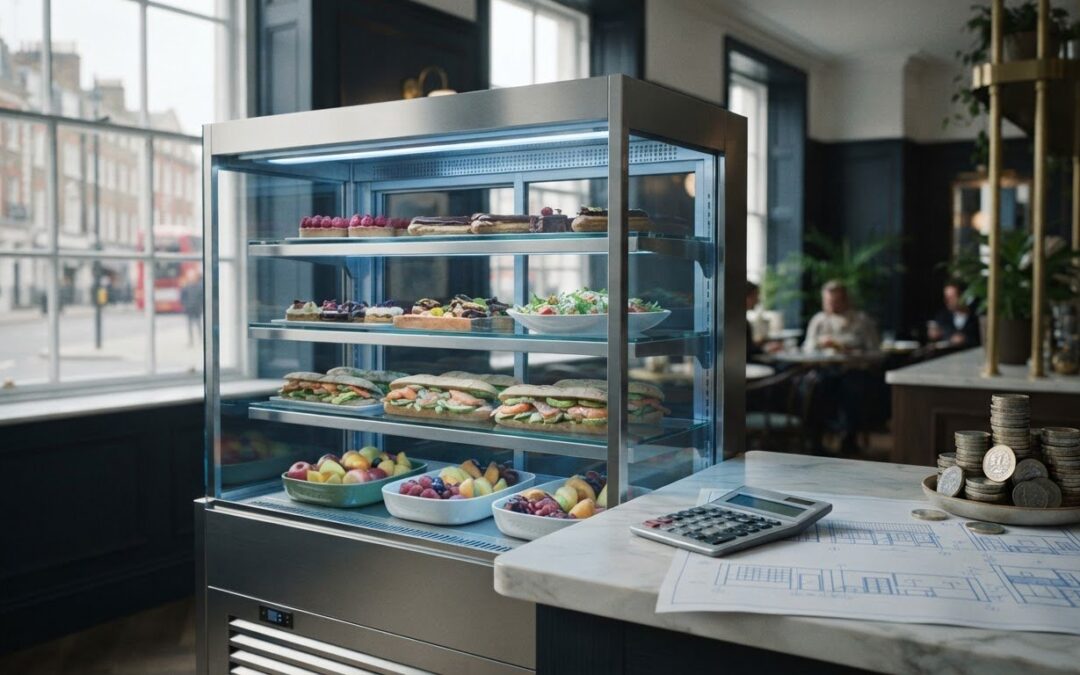
Choosing the cheapest display counter is often the most expensive mistake a hospitality business can make, especially when using an ROI calculator for energy efficient fridges reveals the true cost of ownership. With UK commercial energy tariffs remaining volatile, you’re likely feeling the weight of rising overheads that directly squeeze your monthly margins. It’s frustrating to look at a technical energy label and struggle to see the actual pounds and pence impact on your bank balance. We understand that balancing high initial capital expenditure with the need for long-term profitability is a delicate task for any catering professional.
In this article, you’ll learn how to accurately measure the payback period for premium units, ensuring your investment supports both food hygiene standards and a healthier bottom line. As manufacturers with over three decades of engineering experience, we’ll walk you through the specific variables that dictate lifetime running costs, from thermal efficiency to the latest UK refrigerant regulations. We’ll provide a methodical framework to justify the purchase of high-end equipment, helping you move from broad concepts to a finished, cost-effective physical space with total confidence.
Key Takeaways
- Understand why prioritizing initial purchase price over Total Cost of Ownership (TCO) often leads to higher long-term operating expenses for catering businesses.
- Learn how to use a practical ROI calculator for energy efficient fridges to translate abstract kWh data into concrete annual savings in British Pounds.
- Discover the performance differences between eco-certified units and standard models, including how specific display styles influence overall energy retention.
- Establish a reliable financial baseline to accurately determine the payback period for premium refrigeration upgrades versus budget alternatives.
- Identify how British-manufactured units and precision-engineered layouts minimize cold-air loss to maximize the thermal efficiency of your patisserie or grab-and-go displays.
Why Upfront Costs Mislead: Understanding Commercial Fridge Lifetime Value
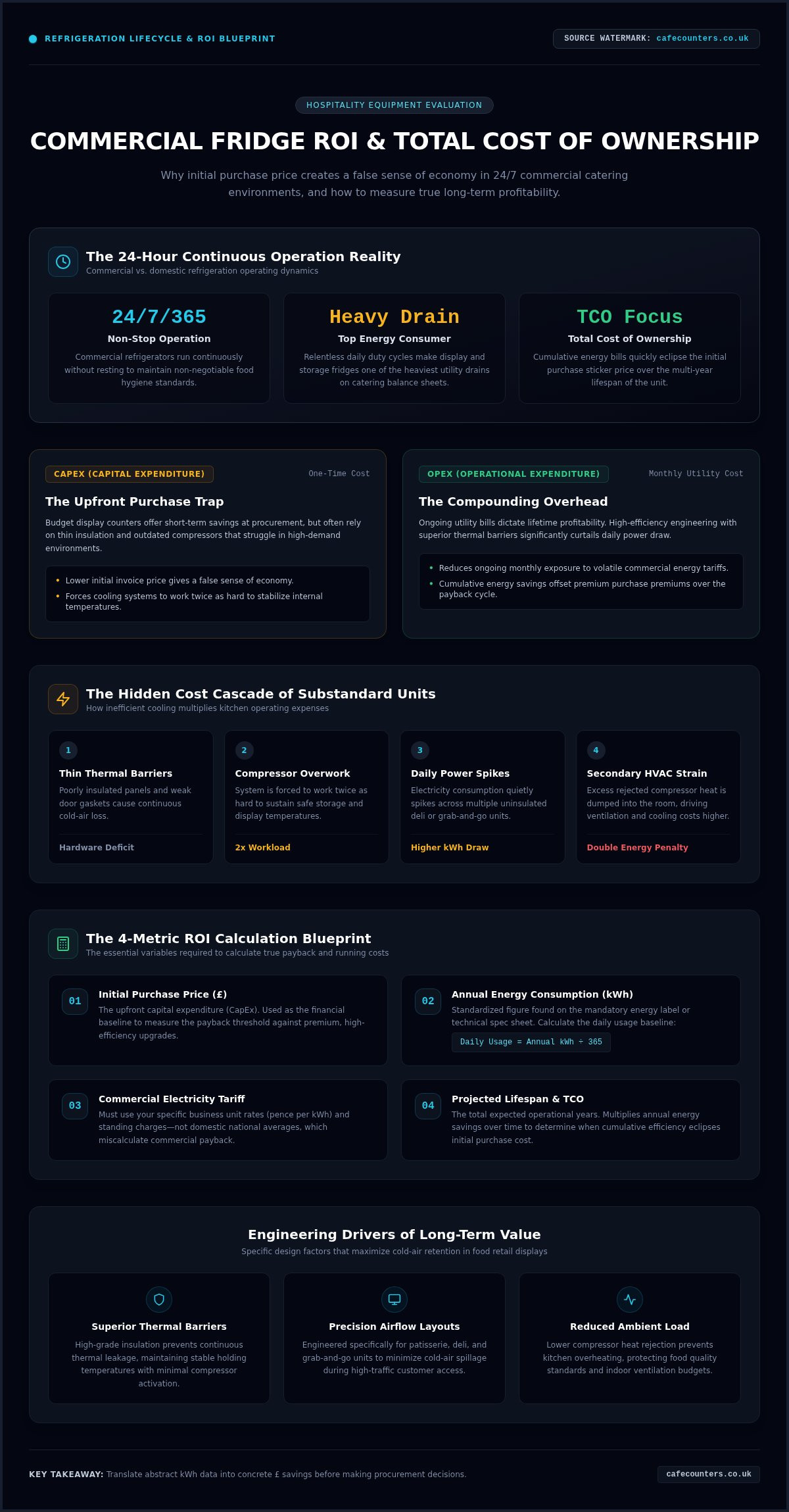
Focusing solely on the initial purchase price of catering equipment creates a false sense of economy that directly harms long-term hospitality profitability. Unlike domestic appliances, commercial refrigerators operate continuously, running 24 hours a day to maintain strict food hygiene standards. This relentless operational demand makes them some of the heaviest energy consumers in your business. When procuring new equipment, relying on a comprehensive Return on Investment (ROI) framework is essential for modern kitchen management. Implementing a precise ROI calculator for energy efficient fridges allows operators to look past the sticker price and evaluate the Total Cost of Ownership (TCO), ensuring that procurement decisions support sustained financial health rather than short-term budget fixes that don’t account for future energy spikes.
The Hidden Drain of Inefficient Refrigeration
Substandard equipment often relies on thin insulation and outdated compressors, which forces the cooling system to work twice as hard to maintain stable temperatures. This inefficiency causes daily electricity consumption to spike quietly. When a catering business runs multiple inefficient display units simultaneously, such as a row of uninsulated grab & go displays or deli counters, the compounding financial drain on utility bills becomes severe. Additionally, the excess heat rejected by struggling compressors enters the room, placing an immediate, heavy strain on your kitchen ventilation systems and driving cooling costs even higher.
Shifting from Capital Expenditure to Operational Savings
Smart procurement requires a clear distinction between capital expenditure (CapEx) and operational expenditure (OpEx) within busy food retail environments. CapEx represents the one-off purchase cost of your equipment, while OpEx covers the ongoing monthly utility bills required to keep those units running. Saving money upfront on cheap, poorly insulated models inevitably inflates your monthly OpEx, trapping your business in a cycle of high overheads. Premium engineering and precision British manufacturing reduce long-term operational overheads by utilizing superior thermal barriers and advanced components that lower daily power draw. By utilizing an ROI calculator for energy efficient fridges, catering operators can confidently transition from short-sighted spending to a strategic model that champions long-term operational efficiency.
The Financial Blueprint: Key Metrics for an Accurate ROI Calculation
Building a robust financial model requires moving beyond guesswork and into verifiable data. To develop an accurate ROI calculator for energy efficient fridges, you must identify four primary variables: the initial purchase price, the annual energy consumption (kWh), your current commercial electricity tariff, and the projected lifespan of the unit. A premium refrigerator is often more life cycle cost-effective than a budget alternative because the cumulative energy savings eventually eclipse the higher upfront investment. It’s vital to use your actual business utility rates rather than national domestic averages, as commercial contracts often include standing charges and varied unit rates that significantly alter the payback period.
Calculating Annual Energy Consumption (kWh)
A kilowatt-hour (kWh) measures the energy used by a 1,000-watt appliance running for one hour. Since commercial cooling never stops, even minor differences in wattage lead to massive annual discrepancies. You can find the annual energy consumption figure on the manufacturer’s technical specification sheet or the mandatory energy label. This figure represents a standardized testing environment, providing a reliable baseline for comparison. To find your daily usage baseline, simply divide the annual kWh by 365. This granular view helps you understand the day-to-day cost of keeping your patisserie displays or deli counters at the correct temperature.
Factoring in Commercial Energy Tariffs and Lifespan
Once you have the annual kWh, multiply it by your specific business electricity tariff, usually expressed in pence per kWh. Don’t rely on domestic estimates; commercial rates are subject to different market pressures and tax structures. A unit that saves just 200 kWh per year might seem insignificant in isolation, but when multiplied by a 15-year lifespan, the financial return is substantial. Precision-engineered units, like our bespoke serving counters, are designed to maintain their efficiency ratings for longer through superior build quality. Regular maintenance, such as cleaning condenser coils and checking door seals, ensures the unit continues to operate at its rated efficiency, preventing the efficiency drift that often plagues cheaper, less durable models over time. By incorporating these long-term factors, your financial blueprint becomes a tool for genuine business growth. Using an ROI calculator for energy efficient fridges ensures you’re making a decision rooted in technical reality rather than aesthetic preference.
Evaluating the Metrics: High-Efficiency vs. Standard Commercial Units
Evaluating the performance profiles of eco-certified units against standard baseline equipment reveals stark differences in daily energy retention. Standard models often rely on standard-grade compressors that run at a single high speed, cycling on and off abruptly. Eco-certified commercial refrigerators utilize variable-speed compressors that adjust their cooling output precisely to the internal thermal load. Additionally, these premium systems incorporate advanced thermal glass and low-voltage LED lighting to reduce auxiliary power demands, ensuring that minimal heat is introduced into the chilled compartment. Analyzing these hardware differences using an ROI calculator for energy efficient fridges helps you see exactly how minor technical upgrades translate into reduced monthly utility bills.
Comparing Energy Labels and Eco-Design Standards
The UK commercial energy rating scale ranks professional refrigeration from A to G, providing a clear benchmark for energy efficiency. High-ranking climate class units are engineered to maintain stable internal temperatures even in hot, humid commercial kitchen environments. Conversely, cheaper, lower-rated models struggle outside of climate-controlled testing rooms. Eco-design standards also dictate the transition toward natural refrigerants, which impacts the long-term legality and servicing of your equipment. Investing in a compliant, high-efficiency unit protects your catering business from future regulatory penalties and premature equipment obsolescence.
The Financial Impact on Grab & Go Displays and Deli Counters
Display styles heavily influence overall energy retention, requiring distinct engineering solutions for different front-of-house environments. Open-front refrigerated grab and go display units draw significant power because they must maintain an invisible air curtain to prevent ambient room air from disrupting the cold zone. Advanced airflow engineering is required to keep these air curtains stable and efficient. For served environments, double-glazed glass panels on deli counters dramatically cut thermal transmission by creating an insulated barrier between the customer area and the fresh produce. When comparing the running costs of open versus closed display models, the closed variants typically use 15% to 20% less energy due to better structural insulation. Factoring these physical dynamics into an ROI calculator for energy efficient fridges ensures your procurement choices reflect the true operational realities of a busy British hospitality venue.
How to Calculate ROI for Energy-Efficient Fridges
Moving from theoretical savings to a concrete financial plan requires a methodical approach. While a digital ROI calculator for energy efficient fridges provides a quick estimate, running the numbers manually ensures every nuance of your specific site is captured. It’s a simple calculation that provides total transparency, allowing you to justify the investment to stakeholders or simply to your own bottom line. By establishing a reliable financial baseline before comparing premium upgrade options, you ensure your procurement choices are rooted in fiscal reality rather than fleeting aesthetics.
Step 1: Gather Your Baseline and Comparison Data
Start by creating a direct comparison between two specific models to see the relative value of the upgrade. You’ll need the following data points:
- List the initial purchase prices (CapEx) for both a standard baseline unit and the high-efficiency alternative you’re considering.
- Document the annual kWh ratings for both models; these are found on the manufacturer specification sheets or the mandatory UK energy labels.
- Confirm your current commercial electricity cost per kWh from your latest utility bill, making sure to use the unit rate in pence rather than a generic estimate.
Step 2: Apply the Payback Period Formula
Once your data is ready, follow these steps to determine the financial outcome of your investment. First, calculate the annual running cost for each unit by multiplying the annual kWh by your electricity rate. Subtract the lower annual running cost from the higher cost to identify your total annual savings in pounds. Next, calculate the upfront price premium by subtracting the standard unit’s price from the efficient model’s price. Finally, divide this price premium by your annual financial savings. The resulting figure is the exact payback period in years.
Interpreting this result is the final step toward a confident purchase. If your new patisserie display or grab & go unit has a projected lifespan of 15 years and a payback period of only three years, you’ll enjoy 12 years of pure operational profit. It’s a powerful way to optimise your catering budget while maintaining high-end display standards. A payback period under five years is generally considered an excellent return for heavy-duty commercial equipment. By utilizing this manual ROI calculator for energy efficient fridges, you move from guesswork to a data-driven strategy that protects your margins.
Long-Term Value: Specifying Sustainable Commercial Food Displays
Specifying sustainable food displays isn’t merely a trend; it’s a strategic investment in the long-term stability of your hospitality business. While using an ROI calculator for energy efficient fridges provides a vital financial forecast, those projected savings only manifest if the equipment is built to endure the rigours of a professional environment. British manufacturing standards ensure a level of build quality and thermal efficiency that mass-produced imports often struggle to match. By choosing precision-engineered systems, you ensure that your patisserie displays and deli counters remain assets rather than liabilities, providing a steady hand in a volatile energy market. We view refrigeration as a core pillar of sustainable growth, where durability and performance work in tandem to protect your margins.
Precision Engineering for Reduced Energy Consumption
The secret to sustained efficiency lies beneath the surface of the counter. We utilize high-density polyurethane insulation to create a formidable thermal barrier, which allows the unit to maintain stable internal temperatures with significantly less compressor effort. This reduction in mechanical strain not only lowers daily power draw but also extends the operational life of the cooling system. Our commitment to UK-sourced materials and rigorous internal production quality control ensures that every component meets exacting standards. When we integrate drop-in units within custom counter configurations, we focus on eliminating the gaps where cold air typically escapes. This seamless integration is critical for maintaining the efficiency levels identified during your initial procurement research.
End-to-End Counter Project Management for Maximum Efficiency
Professional installation and project management act as the conceptual anchors for operational success. A refrigerator that is poorly placed or incorrectly ventilated will never reach its rated efficiency, regardless of its energy label. Our process begins with detailed site surveys and advanced CAD modeling to optimize counter layouts for maximum thermal efficiency. This meticulous planning prevents improper ventilation and the resulting energy waste that plagues many commercial kitchens. Once the physical space is ready, expert commissioning is vital to verify that every unit performs exactly to its eco-specifications. This methodical approach ensures that your investment delivers the reliable, high-performance cooling your business requires. Ready to optimize your display efficiency? Explore custom options on the Café Counters Homepage. By treating refrigeration as a tailored solution rather than a simple purchase, you secure the long-term profitability and reliability that an ROI calculator for energy efficient fridges promises.
Securing Your Catering Profitability Through Precision Engineering
We’ve established that the true cost of commercial refrigeration isn’t found on the initial price tag, but on the monthly utility bill. By utilizing a methodical ROI calculator for energy efficient fridges, you can confidently justify the investment in premium British-manufactured equipment. Shifting your focus toward total cost of ownership ensures that your patisserie displays and grab-and-go units serve as long-term profit drivers rather than hidden drains on your operational budget. It’s about making a data-driven choice that protects your margins for years to come.
As an established UK manufacturer since 1991, we combine decades of engineering expertise with comprehensive CAD modeling to optimize every layout for thermal efficiency. Our end-to-end project management handles the technical complexities, from initial design to final commissioning, ensuring your components operate at peak design efficiency. We take pride in our artisanal heritage and internal production capabilities, providing the steady hand needed to navigate rising energy tariffs with total confidence.
When you’re ready to enhance your display standards and secure sustainable business growth, contact TFSE Products Ltd for an energy-efficient bespoke counter consultation. Our expert national installation services ensure your vision is realized with the precision and quality your catering business deserves.
Frequently Asked Questions
What is a typical payback period for an energy-efficient commercial fridge?
A typical payback period usually occurs within two to five years, though this varies based on your specific UK energy tariff and equipment usage. While premium units require a higher initial investment, their reduced daily power draw creates significant monthly savings. When you consider that a precision-engineered refrigerator often operates for 15 years, the majority of its lifespan represents pure profit. Using an ROI calculator for energy efficient fridges helps you visualize this transition from capital expense to long-term operational gain.
How do I find the annual energy consumption of a commercial refrigerator?
You’ll find the annual energy consumption, measured in kWh/annum, clearly displayed on the mandatory UK energy label or the manufacturer’s technical specification sheet. This figure is derived from standardized testing, providing a reliable baseline for comparing different models. For a more precise site-specific estimate, we recommend using your actual business electricity unit rate from a recent bill to translate these kilowatt-hours into a concrete annual cost in British Pounds, ensuring your financial modeling is accurate.
Do energy-efficient display counters compromise on cooling performance or food safety?
High-efficiency units actually enhance food safety by maintaining more stable internal temperatures. Rather than compromising performance, features like high-density polyurethane insulation and variable-speed compressors ensure the unit recovers quickly after door openings. This precision engineering prevents the temperature fluctuations that can jeopardize food hygiene standards. Investing in premium displays ensures your produce remains fresh and safe while simultaneously lowering your catering business’s monthly utility overheads through superior thermal retention and mechanical reliability.
How much can an eco-design grab and go display save compared to a standard model?
An eco-design grab & go display can reduce energy costs by approximately 15% to 20% compared to standard, uninsulated models. These savings are achieved through advanced airflow engineering, such as stable air curtains and high-performance glass end panels that minimize cold air loss. Over a decade of operation, these incremental daily savings accumulate into thousands of pounds, effectively subsidizing the cost of the equipment through reduced operational expenditure and lower strain on your kitchen ventilation systems.
Are there UK tax incentives or allowances for purchasing energy-efficient catering equipment?
UK businesses can often utilize the Annual Investment Allowance (AIA) to claim 100% tax relief on qualifying plant and machinery, including energy-efficient commercial refrigeration, in the year of purchase. This significantly reduces the net cost of high-end equipment. We recommend consulting with a qualified accountant to confirm current eligibility and limits, as these allowances provide a powerful financial incentive to upgrade to sustainable, precision-engineered counter systems that support long-term business growth and environmental targets.
Why does professional counter installation affect the energy efficiency of a fridge?
Improper installation often leads to poor ventilation, forcing compressors to work harder and consume more electricity. A professional site survey and CAD modeling ensure that your display units have sufficient clearance for heat dissipation, preventing the efficiency drift common in poorly planned layouts. Expert commissioning verifies that every component operates at its peak design specification from day one. This methodical approach ensures your equipment achieves the savings promised by your ROI calculator for energy efficient fridges.
How does climate class impact the real-world ROI calculation for commercial fridges?
Climate class ratings indicate the maximum ambient temperature and humidity levels a unit can handle while maintaining efficiency. A unit rated for Climate Class 4 or 5 is engineered for the heat of a busy professional kitchen, whereas a lower-rated model will consume significantly more energy to stay cool in the same environment. Factoring this into your ROI calculation ensures your financial projections reflect real-world kitchen conditions rather than best-case testing scenarios, protecting your long-term profitability.