
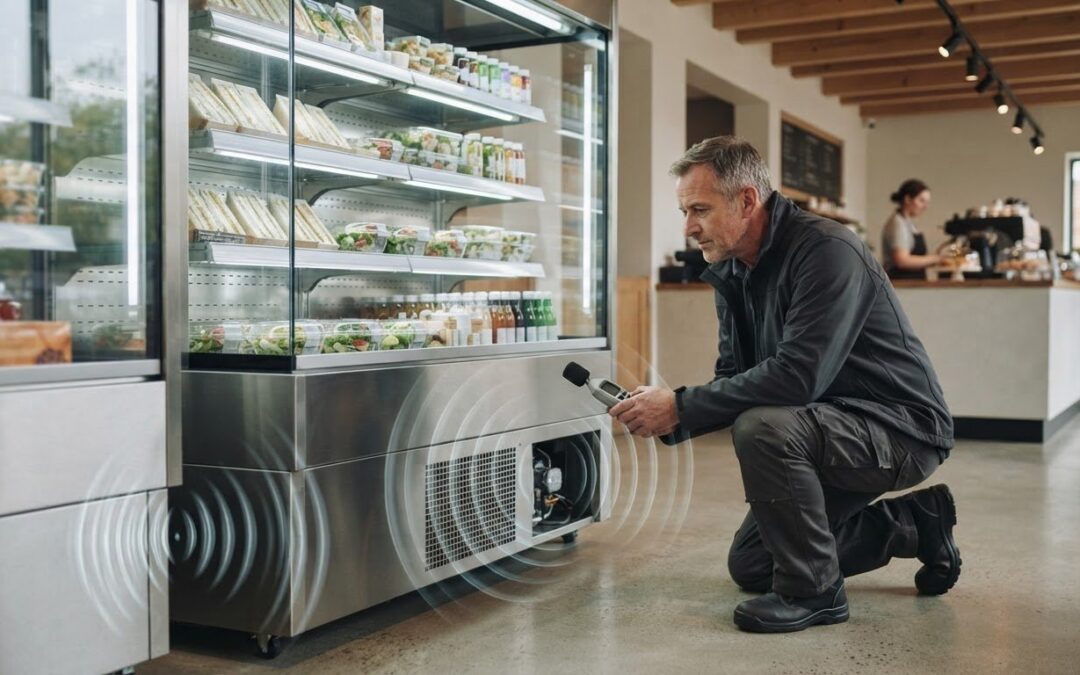
What counts as a normal commercial refrigeration noise level, and when should a change prompt a closer look? A steady hum may be part of everyday operation, but commercial refrigeration noise levels can sound very different depending on the equipment, room and where you’re standing. A decibel figure is useful, but it doesn’t tell the whole story.
The decibel scale is logarithmic: a 3 dB increase represents a doubling of sound intensity, while a 10 dB increase is generally perceived as twice as loud. That’s why comparing figures without knowing how they were measured can mislead. The timing, pattern and location of a sound can offer just as useful clues, helping distinguish routine operation from a new rattle, vibration or other change worth investigating.
This guide explains what decibels can and can’t tell you, what to note when a unit sounds different, and how equipment placement and day-to-day use can shape the working environment. With over 25 years’ experience in the food industry, TFSE Products Ltd brings display planning, design and installation together to help businesses consider equipment as part of the wider space.
Key Takeaways
- Use commercial refrigeration noise levels as a point of reference, not a complete measure of how loud a unit will seem in your space.
- Learn why operating cycles can create different sounds, and why a sound alone doesn’t prove there’s a fault.
- Record what you hear, when it happens and what the unit is doing before investigating a change.
- Review equipment position alongside ventilation, access and the manufacturer’s requirements.
- Consider noise early in display planning so the equipment fits the layout and the way your business operates.
Commercial refrigeration noise levels: what decibels can tell you
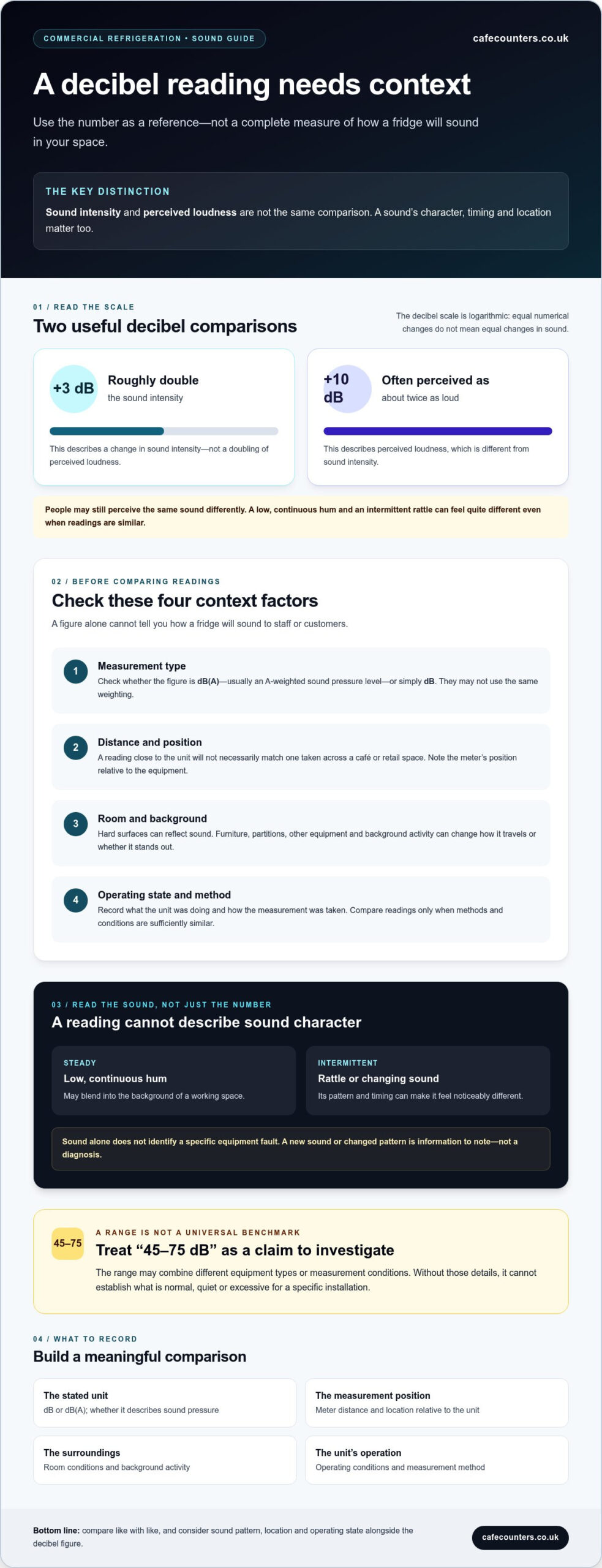
A decibel (dB) is a unit used to express sound level. The scale is logarithmic, so equal numerical changes don’t represent equal changes in sound intensity or perceived loudness. For example, a 3 dB increase corresponds to roughly double the sound intensity, while a 10 dB increase is often perceived as about twice as loud. These comparisons describe different things, and people may still perceive the same sound differently.
A decibel figure needs its measurement context before it can be compared meaningfully with another reading. That context includes the measurement type, distance from the source, room conditions, operating state and method. Without it, a number alone can’t tell you how a fridge will sound to staff or customers.
What does a decibel reading mean for a commercial fridge?
A figure labelled dB(A) usually refers to an A-weighted sound pressure level, which adjusts the measurement to reflect how human hearing responds to different frequencies. A figure shown simply as dB may not use the same weighting. Check what the stated unit represents before comparing specifications or an on-site reading.
Decibels can help describe a sound, but they don’t capture its character. A low, continuous hum and an intermittent rattle may produce similar readings yet feel quite different in a working space. For broader context on how sound affects surroundings, see Understanding Noise Pollution.
Why one noise figure cannot describe every installation
Distance matters: a reading taken close to a unit won’t necessarily match one taken across a café or retail space. Hard surfaces can reflect sound, while furniture, partitions and other equipment can alter how it travels. Background activity also affects whether refrigeration stands out. As a result, the same unit may be noticed differently in two locations.
Manufacturer data and on-site readings answer different questions. A manufacturer’s figure describes the equipment under its stated test conditions. An on-site measurement reflects the unit in a particular room and operating situation. Neither should be treated as directly comparable unless the measurement conditions and method are aligned.
A range such as 45-75 dB should therefore be treated as a claim to investigate, not a universal benchmark for commercial refrigeration. It may combine different equipment types or measurement conditions. Without those details, it can’t establish what’s normal, quiet or excessive for a specific installation.
- Record whether the figure is dB or dB(A), and whether it describes sound pressure.
- Note the meter’s distance and position relative to the equipment.
- Include the room, background activity and the unit’s operating conditions.
- Compare readings only when the measurement methods and conditions are sufficiently similar.
Why commercial refrigeration makes noise during operation
Refrigeration is an active process. Equipment removes heat from its cabinet and releases it elsewhere, with components starting, stopping or changing operation as cooling demand shifts. A compressor is one component commonly used to move refrigerant through the system, but designs differ. Fans, controls and other parts may also contribute to the sounds heard during normal operation.
You might notice a low hum, airflow, a click as operation changes, or a brief gurgling sound. These are general examples, not a specification for every commercial fridge. The sound and its timing vary with the equipment’s design, operating conditions and environment. Sound alone cannot identify a specific equipment fault. A change in pattern or a new sound is useful information to record, but it isn’t a diagnosis.
How the refrigeration cycle contributes to operating sounds
In simple terms, a refrigeration system transfers heat from inside a cabinet to the surrounding space. Its components work together to maintain the required temperature, and their activity can vary as the unit operates. A compressor may be part of this process, while fans or controls can create other audible cues. The exact components and sounds depend on the model, so don’t treat one sound as proof of a fault.
Several units can create a different overall impression from one unit operating alone. Their sounds may overlap, making a steady background hum more noticeable or making it harder to identify where a change began. Activity elsewhere in the room, such as conversation or kitchen equipment, also shapes what staff and customers perceive. That’s why a sound noticed in the working space may not match a description or reading taken close to an individual unit.
How surroundings and installation affect perceived noise
Room layout matters. Hard floors, walls and counters can reflect sound, while equipment position can affect how sound carries into customer or staff areas. Placement should be considered alongside ventilation, access for cleaning and servicing, and the manufacturer’s installation requirements. These are practical planning factors, not guaranteed methods of reducing noise.
Equipment choice also needs to fit its intended role and setting. A commercial refrigerator guide can help frame broader selection considerations, while site planning brings the room layout and day-to-day operation into view. For a food display project, discussing those factors early can help align the counter with the working environment. Explore bespoke display planning as part of that wider process.
In a working business, consider how refrigeration sounds fit alongside other activity. A continuous background hum may blend into routine operations, while sounds from several units can overlap and become more noticeable in customer or staff areas. This context helps explain why the same equipment may be experienced differently in different spaces, without treating perceived loudness as evidence of a fault.
How to assess a change in commercial refrigeration noise
A clear record is more useful than a quick guess about what a sound means. If commercial refrigeration noise levels seem to have changed, describe what you hear and the circumstances around it before drawing conclusions. This gives you a precise account to refer to and share when arranging support. The steps below are an observation checklist, not a way to diagnose a fault or determine whether noise meets a legal nuisance threshold.
What details should you record before seeking an assessment?
Start with plain language. Note whether the sound is a hum, buzz, rattle, click or another quality, and whether it is continuous, intermittent or linked to a particular point in the operating cycle. Avoid naming a component as the cause. “A new rattle near the counter during operation” is an observation; “the fan is failing” is a diagnosis you can’t establish by listening alone.
Then record the context:
- Timing: when you first noticed the change, when it occurs and whether it continues or comes and goes.
- Operating conditions: what the unit was doing, such as starting, running or being loaded, and whether nearby equipment was also operating.
- Location: where the sound is most noticeable, such as beside the unit, at the serving area or in another part of the premises.
- Surroundings: relevant changes in room activity, layout or nearby equipment that could affect what you hear.
If you take a sound reading, document the measuring device and method, the position and distance from the unit, and the operating and background conditions. A figure without those details can be hard to interpret or compare. Keep any measurement separate from your written description, and don’t treat either as proof of a particular cause.
When does a change deserve further attention?
There isn’t one universal loudness cutoff that can tell you whether a unit needs attention. Focus instead on whether the sound is new, persistent or clearly different from the equipment’s usual operation. A change that recurs, continues or affects the working environment is a sensible reason to review the manufacturer’s operating guidance and seek an appropriate assessment if concern remains.
Don’t assume a sound is harmless because it seems familiar, or that it identifies a fault because it sounds unusual. Describe the pattern and follow the equipment guidance for next steps. If the unit’s operation also appears to have changed, include that information rather than attempting adjustments beyond the instructions. Consistent notes help distinguish a one-off observation from a repeated change, while leaving conclusions to a suitable assessment.
Practical ways to manage commercial refrigeration noise in a business
Managing a sound concern starts with safe, low-impact checks, not an immediate change to the equipment. Review the manufacturer’s operating and installation guidance, and note whether the sound seems connected to an ordinary change in operation. Keep ventilation openings clear where applicable, but don’t dismantle, enclose, move or switch off the unit to test an idea. Such changes could affect operation, access or safety.
Which operational checks can help clarify the situation?
Use your observations to describe the issue, not diagnose it. Check the guidance for the unit’s ventilation and clearance requirements, and record whether the sound occurs alongside a change in normal operation. If it persists or causes concern, follow the manufacturer’s instructions and arrange an appropriate assessment. Don’t attempt repairs or make changes that the guidance doesn’t support.
How can layout planning account for refrigeration noise?
During a new fit-out or layout review, consider where equipment sits in relation to staff movement, customer areas and other working activity. Separation may change how noticeable a unit is, but it isn’t a proven acoustic treatment. Keep ventilation, practical servicing access and manufacturer requirements central to any placement decision. A commercial refrigerators guide can add broader professional cooling context to equipment planning, while facilities needing larger-scale infrastructure can consult specialists such as Industrial Power Cooling (IPC) for bespoke industrial cooling systems designed around specific site constraints.
Planning measures involve trade-offs. A layout that places a counter away from a customer seating area, for example, still needs to suit service flow, available space and the equipment’s installation requirements. Use the comparison below to guide discussion, not as a promise that a particular measure will lower commercial refrigeration noise levels.
| Planning measure | Potential benefit | Limit to keep in mind |
|---|---|---|
| Review the manufacturer’s guidance | Clarifies operating and placement requirements for the specific unit. | Guidance helps with correct use, but doesn’t itself establish the cause of a sound change. |
| Keep applicable ventilation openings unobstructed | Supports the intended airflow around the equipment. | It isn’t a guaranteed noise-reduction measure; follow the unit’s instructions. |
| Consider position in the room layout | May help organise customer areas, staff movement and equipment zones. | Available space, servicing access and required clearances can constrain placement. |
| Record a persistent sound and seek an assessment | Provides useful context for an informed review. | A description or reading alone won’t identify a fault or prove a legal nuisance threshold. |
For a new food display project, TFSE Products Ltd’s bespoke planning, design and installation service brings equipment needs into the wider counter layout. Discuss your food display project as part of planning the space, its operation and practical access.
Plan food display refrigeration around your working environment
A food display needs to serve the menu and the people using the space, while fitting the practical realities of the premises. Commercial refrigeration noise levels belong in the early conversation, alongside the display’s purpose, customer-facing layout, staff movement and access for routine work. Considering these factors together helps shape a project around its intended environment. It doesn’t mean a particular design or position will make equipment quieter.
What to consider when planning a refrigerated food display
Start with what the display needs to do. The foods being presented, the service style and the available working area all influence how a temperature-controlled counter fits into the wider layout. Consider its position in relation to customer areas and staff routes, and allow practical access for cleaning and servicing in line with the equipment’s requirements.
- Define the display’s purpose and how it will support day-to-day service.
- Map the counter into the customer-facing layout and staff working area.
- Consider equipment position and access early, rather than as finishing details.
- Keep expectations about sound separate from confirmed specifications for the chosen equipment.
Commercial refrigeration noise levels can be part of the planning brief, but a general expectation is not a product specification. If noise is a particular concern, record the intended setting and discuss it as one project requirement alongside the counter’s function and layout. Consider any equipment figure in the context of its stated measurement conditions, not as a guarantee of how the display will sound in a particular room.
How TFSE Products Ltd supports a food display project
TFSE Products Ltd designs and manufactures temperature-controlled food display counters, commercial fridges and heated display units. Its bespoke planning, design and installation service brings the display into the wider project, helping align the counter with its intended space and operation. With over 25 years’ experience in the food industry, TFSE Products Ltd works with cafés and food retailers to develop food display projects around their practical requirements.
This planning process can bring together intended use, site layout, customer and staff needs, access and equipment considerations. Discussing these details early helps establish a clear project brief; it should not be taken as a promise of quieter operation or a particular sound level. The equipment’s own specifications and installation requirements remain the reference for its use.
For existing customers, TFSE Products Ltd handles service requests, normally achieved within 24 hours. This is service-request information, not a statement about installation or a noise-related outcome.
If you’re planning a new or updated food display, discuss a bespoke food display counter with TFSE Products Ltd. A considered brief gives the project a practical starting point, bringing display purpose, layout and day-to-day operation into the same conversation.
Make your next display project work for the space
Commercial refrigeration noise levels are one consideration in a successful food display project, not a measure of how well the whole space will work. Use what you’ve observed to inform future planning: consider where customers gather, how staff move through the working area and what access the equipment needs. A clear brief helps bring these practical priorities together without assuming a particular layout will reduce noise.
TFSE Products Ltd brings over 25 years’ experience in the food industry to bespoke planning, design and installation for food display counters. Its counters are fully warrantied, and parts are available directly from the manufacturer. These project foundations support a considered approach to selecting and integrating display equipment, while the final design is shaped around the requirements of your premises.
If you’re preparing a new space or refining an existing one, take the next step with TFSE Products Ltd. Discuss a bespoke food display counter and begin shaping a solution around your operation, layout and customer experience.