
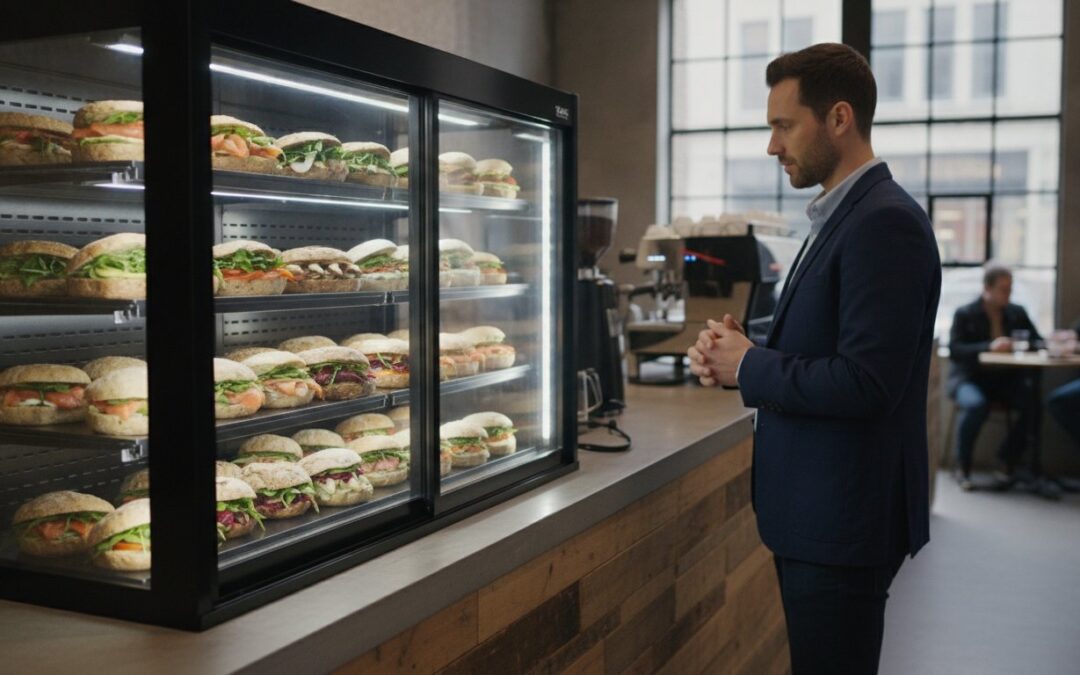
Your grab-and-go counter is the hardest working salesperson in your shop; if it’s failing to maintain a steady 5°C or looks like a generic supermarket unit, you’re losing money every hour. Selecting a commercial display fridge for sandwiches isn’t just about keeping bread cold. It’s about navigating the 2026 UK F-Gas regulations while ensuring your artisanal fillings look as fresh as the moment they were prepped. Our experience in bespoke manufacturing shows that a fridge shouldn’t just be an appliance; it should be a seamless extension of your brand’s aesthetic and commitment to quality.
We understand that the pressure to balance rising energy costs with the need for high-impact visual merchandising is a constant challenge for modern food retailers. You need equipment that works as hard as you do without the stress of inconsistent temperatures or skyrocketing bills. This guide will help you select a professional display that secures food safety, slashes operational overheads, and integrates perfectly with your counter design. We’ll examine the latest in hydrocarbon refrigerants, smart temperature monitoring, and how the right glass configuration can drive impulse purchases throughout the 2026 season.
Key Takeaways
- Identify the ideal equipment type for your specific customer journey, comparing high-volume Grab & Go multidecks with service-focused deli counters.
- Navigate 2026 energy regulations by understanding how eco-friendly refrigerants and efficiency labels impact your long-term operational costs.
- Optimise your commercial display fridge for sandwiches using high-CRI lighting and “Golden Zone” shelf placement to drive impulse purchases.
- Utilise CAD modelling and bespoke UK manufacturing to ensure your refrigeration units integrate seamlessly with your counter design and brand aesthetic.
- Align your equipment selection with peak footfall by calculating volume requirements and choosing the most efficient replenishment strategy for your service team.
Types of Commercial Sandwich Display Fridges for Modern Retail
Selecting the right commercial display fridge for sandwiches requires a deep understanding of your customer’s journey from the front door to the point of sale. A high-street cafe serving hundreds of commuters an hour needs a different solution than a boutique deli where the provenance of the ingredients is the primary draw. We view refrigeration as a strategic asset that must align with your operational rhythm and brand identity.
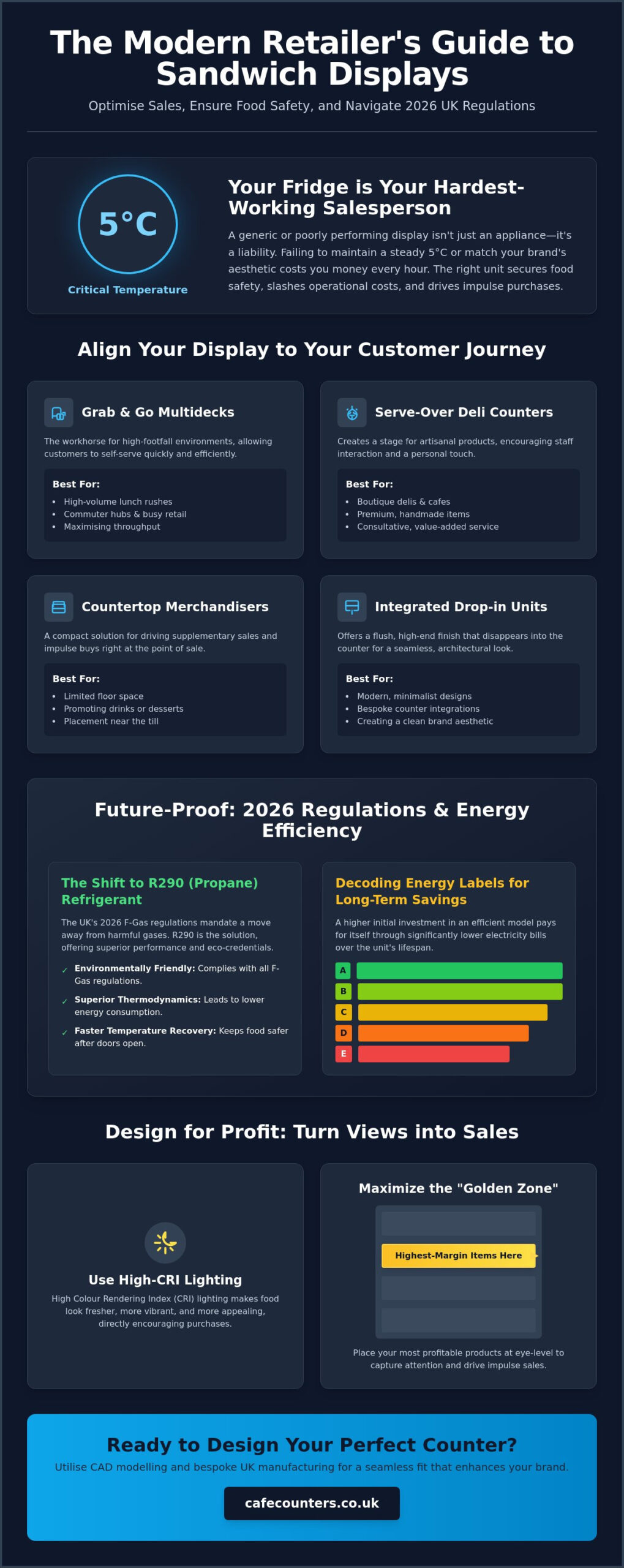
Grab & Go Displays are the workhorses of high-footfall environments. These open-fronted units allow customers to select products without physical barriers, which is essential for maintaining speed during the lunch rush. While they require more robust cooling systems to compensate for ambient air, their ability to move high volumes of stock makes them indispensable for busy retail locations. These units are engineered for visibility, ensuring that every wrap and baguette is presented in its best light.
Deli Counters prioritise a personal touch and artisanal presentation. These units act as a stage for your products, allowing staff to engage with customers while maintaining strict temperature controls. They’re ideal for businesses that offer bespoke fillings or premium, handmade sandwiches that benefit from a higher level of presentation. The glass barrier creates a sense of theatre, positioning your food as a crafted product rather than a mere commodity.
For businesses with limited floor space, countertop merchandisers provide a compact solution for supplementary sales near the till. Meanwhile, Integrate Drop-in Units offer a flush, high-end finish that disappears into the counter structure. This creates a seamless look that’s popular in modern, minimalist cafe designs where the equipment shouldn’t distract from the overall environment.
Grab & Go vs. Serve-Over: Which suits your service model?
Your choice here dictates your staffing requirements and peak-time throughput. A self-service model relies on refrigerated grab and go display units to do the selling for you. This reduces the need for front-of-house staff to handle every transaction, which is a significant operational benefit during busy periods. Conversely, a serve-over model suggests a slower, more consultative approach, where the interaction between the server and the customer adds perceived value to the purchase.
The Rise of Integrated Drop-in Units
Modern cafe design is shifting away from bulky, freestanding equipment toward a more seamless, architectural look. Integrated drop-in units allow the refrigeration to sit flush with your bespoke counter, creating a clean brand aesthetic that doesn’t disrupt the visual flow of your space. While the history of refrigeration shows a move from simple ice boxes to complex mechanical systems, the latest innovation focuses on technical invisibility.
Achieving this flush look requires careful planning for under-counter ventilation. Without proper airflow, even the most advanced commercial display fridge for sandwiches will struggle with efficiency and longevity. We work closely with designers to ensure that every drop-in unit has the necessary clearance and ventilation paths to operate at peak performance within its custom housing, ensuring that your investment is protected for years to come.
Cooling Technology and Energy Efficiency in 2026
The regulatory landscape for refrigeration has shifted significantly, making the technical specifications of your equipment more important than ever. Every commercial display fridge for sandwiches manufactured today must navigate the UK’s stringent post-Brexit F-Gas regulations. We’ve seen a decisive transition toward natural refrigerants like R290 (Propane). This shift isn’t merely about environmental compliance; R290 offers superior thermodynamic properties that lead to lower energy consumption and better temperature recovery after the cabinet doors are opened or stock is replenished.
Operational costs are a primary concern for any retail business, and understanding energy labels is the first step in managing those overheads. The A-G rating system provides a transparent way to calculate long-term expenses. While a unit with a lower energy grade might seem like a bargain initially, the cumulative cost of electricity over a five-year period often makes high-efficiency models the more economical choice. We focus on engineering units that exceed these minimum standards, ensuring your investment remains viable as energy prices fluctuate.
Advanced airflow systems are the silent guardians of your product quality. In a sandwich display, inconsistent air distribution leads to “hot spots” that can compromise high-risk ingredients or “cold spots” that might freeze delicate salad leaves. Modern systems use precision-engineered fans and baffles to create a uniform curtain of cold air. To further protect your margins, we recommend using night blinds or thermal curtains. These simple additions can reduce energy leakage by a significant margin during out-of-hours periods, preventing the compressor from working unnecessarily when the shop is closed.
Maintaining Food Safety Standards
Adhering to rigorous food safety standards is the foundation of a successful catering operation. While the Food Standards Agency mandates that chilled foods stay at 8°C or below, professional best practice suggests a target of 5°C or lower to account for frequent door openings. Digital controllers and integrated temperature alarms are essential for compliance, providing a clear record of performance. To ensure maximum shelf life and prevent bacterial growth, you should maintain an optimal sandwich storage temperature between 2°C and 5°C.
Design Features That Improve Efficiency
The physical build of a display unit determines its thermal resilience. Double-glazed glass panels are a critical feature, acting as an insulating barrier that reduces the workload on the cooling system. We also utilise low-energy LED lighting that illuminates your products without adding heat to the internal cabinet. Regular maintenance remains the most effective way to protect these systems. A simple monthly cleaning of the condenser prevents dust buildup from forcing the motor to overwork. If you’re looking for a seamless fit for your shop, our team can help you integrate drop-in units that combine these high-efficiency features with a bespoke aesthetic.
Strategic Merchandising: Designing for Profit
A commercial display fridge for sandwiches serves as a silent salesperson, but its effectiveness depends entirely on how it’s integrated into your retail environment. While we’ve discussed the technical necessity of meeting energy efficiency regulations, the visual presentation is what ultimately drives the impulse purchase. We approach merchandising as a blend of psychology and engineering, ensuring every design choice serves a commercial purpose. Eye level is buy level. It’s a simple rule, yet its execution requires precision.
Lighting shouldn’t just provide visibility; it should enhance the natural colours of your ingredients. We utilise high-CRI (Colour Rendering Index) LEDs that replicate natural daylight. This prevents the washed-out, clinical look often associated with cheaper units and ensures that fresh greens and vibrant proteins look as appetising as possible. When your food looks better, it sells faster. This is especially true for premium baguettes and handmade wraps where the visual texture of the bread and fillings is a key selling point.
The “Golden Zone” refers to the shelves situated between chest and eye level. This is where your highest-margin items should reside. By angling these shelves and using frameless glass designs, you remove the visual noise of thick frames, creating an unobstructed view of the product. Glass-to-glass joints further this contemporary feel, making the cabinet appear as a high-end display case rather than a piece of industrial equipment. This removes the physical and psychological barriers between the customer and the product.
Visual Impact and Branding
Your refrigeration should reflect your brand’s specific aesthetic. We offer custom internal finishes, ranging from classic brushed stainless steel to matte black or bespoke powder-coated colours. For shops looking to elevate their sandwich offering, using patisserie-style displays provides a sense of luxury that justifies a premium price point. These units often feature more delicate shelving and refined glasswork, positioning your food as a crafted, artisanal product.
Customer Flow and Accessibility
Strategic placement is vital. Positioning your commercial display fridge for sandwiches to capture customers while they queue ensures they have time to browse before reaching the till. This is a core element of effective cafe layout design. You must also ensure that self-service units remain accessible to all customers, adhering to height requirements that allow for easy reach from a seated position. Optimising these areas near the payment terminal can significantly increase your average transaction value without requiring additional floor space.
Strategic Selection: Choosing the Right Fridge for Your Footfall
Selecting the ideal commercial display fridge for sandwiches requires a precise calculation of your peak-hour requirements. It isn’t simply a matter of buying the largest unit that fits your floor plan. You must account for your recovery time; this is the speed at which the refrigerator returns to its set temperature after a customer has removed a product. If your shop experiences a high-volume lunch rush, you need a system with a powerful compressor that can handle frequent air exchanges without allowing the internal temperature to drift into the danger zone.
Your replenishment strategy also dictates the physical configuration of the unit. Front-loading models are common for smaller operations, but high-traffic environments often benefit from rear-loading access. This allows your staff to restock the display from the back without obstructing the customer’s path or interrupting the flow of sales. Additionally, you must evaluate the ambient temperature of your shop. Most UK retail environments require a unit with a Climate Class 3 or 4 rating, ensuring the fridge can maintain 5°C even when the surrounding air reaches 25°C or 30°C during the summer months.
Logistics are often overlooked until the day of delivery. We always advise clients to measure every doorway, corridor, and tight corner between the kerbside and the final installation point. A bespoke counter fit is only possible if the equipment can actually reach the site. Planning for future-proofing is equally vital. Choose a unit where the motor and condenser are easily accessible for servicing. This ensures that a minor maintenance task doesn’t turn into a major operational disruption, protecting your investment for the long term.
Capacity vs. Footprint
In many UK high-street units, floor space is at a premium. To maximise your sales per square metre, we recommend utilising vertical space with tiered shelving. However, you must strike a careful balance between display area and storage requirements. It’s a common mistake to over-stock a commercial display fridge for sandwiches to make it look “full.” Packing shelves too tightly impedes the internal airflow, creating warm pockets that accelerate food spoilage and force the motor to work harder than necessary.
Maintenance and Longevity
A fridge is a mechanical asset that requires regular care to maintain its efficiency. Look for units featuring removable crumb trays and easy-clean stainless steel surfaces; these are essential for sandwich retailers where bread debris can quickly clog drainage systems. Accessing the condenser for a monthly vacuum is the simplest way to prevent premature compressor failure. To ensure your equipment is set up for success from day one, we recommend a professional catering equipment installation UK service. Proper levelling and ventilation clearance are critical factors that directly impact the lifespan of your cooling system. If you’re ready to discuss a tailored solution for your space, contact our design team to explore our range of bespoke displays.
The Advantage of Bespoke UK Manufacturing
Choosing a commercial display fridge for sandwiches from a British manufacturer provides a level of quality control that mass-market imports simply cannot match. When your equipment is designed and built within the UK, you gain direct access to the engineers and artisans responsible for your project. This proximity allows for a transparent production process where technical specifications are verified at every stage. We believe that a professional display should be a permanent fixture, not a disposable appliance, and local manufacturing ensures the use of high-grade materials that withstand the rigours of a busy catering environment.
The role of CAD modelling is central to this precision. By creating a digital twin of your service area, we can identify potential installation hurdles long before the equipment reaches your site. This is particularly vital for the unique, often irregular architecture found in British high-street buildings. Whether you’re dealing with a listed property with uneven floors or a compact corner unit with restricted access, bespoke manufacturing allows us to adapt the cooling system and the exterior housing to fit your space perfectly. You aren’t forced to compromise your vision to suit a standard catalogue size.
From Concept to Commissioning
Our approach starts with comprehensive site surveys and technical planning to ensure every operational requirement is met. This methodical process alleviates the stress of commercial projects by providing a clear roadmap from the initial idea to the final installation. Custom fabrication solves the problem of awkward building shapes, allowing us to maximise every millimetre of available floor space. Furthermore, working with a UK-based manufacturer provides the long-term reassurance of accessible after-sales support and a reliable supply of spare parts, ensuring your business never grinds to a halt due to a missing component from overseas.
Sustainability in Manufacturing
Procuring equipment through a local supply chain significantly reduces the carbon footprint of your project. By avoiding international shipping and prioritising British-sourced steel, you contribute to a more sustainable hospitality sector. The long-term durability of bespoke steel construction also means your equipment will have a far longer service life than lightweight imports, reducing waste and the frequency of replacement. CAD modelling ensures zero-waste precision in bespoke cafe counter manufacturers processes, allowing for exact material allocation before the first piece of steel is cut. This commitment to precision and local sourcing creates a steady, reliable foundation for your commercial retail environment.
Elevating Your Retail Vision for 2026 and Beyond
Investing in a commercial display fridge for sandwiches is a strategic decision that impacts both your operational efficiency and your brand’s visual identity. You now understand how to balance the latest energy regulations with strategic merchandising techniques that drive impulse sales. By selecting a unit that matches your specific footfall and replenishment rhythm, you ensure food safety while protecting your long-term margins. The shift toward integrated, bespoke designs reflects a commitment to quality that resonates with today’s discerning customers.
Since 1991, we’ve focused on UK-based manufacturing to provide the precision and reliability our clients demand. Our specialists use advanced CAD modelling to ensure every bespoke counter system fits perfectly within your unique space, regardless of architectural challenges. We’re here to act as your expert partner, guiding you from the initial concept to the final installation with total competence. Request a Bespoke Consultation for Your Sandwich Display today and let’s work together to bring your vision to life with durability and style.
Frequently Asked Questions
What is the best temperature for a commercial sandwich fridge?
The optimal temperature for a commercial display fridge for sandwiches is between 2°C and 5°C. While UK law requires chilled food to be kept at 8°C or below, maintaining a lower range provides a safety buffer during busy periods. This precision ensures that high-risk ingredients like mayonnaise or fresh seafood remain safe and appetising for the duration of their shelf life.
How much electricity does a commercial display fridge use?
Energy consumption depends on the unit’s energy rating, its physical size, and whether it features an open front or glass doors. Modern units using R290 refrigerant and LED lighting are significantly more efficient than older models. You can calculate specific operational costs by checking the kWh/annum figure on the mandatory A-G energy label, which provides a standardised measure of performance.
Do I need a plumbed drainage connection for my sandwich fridge?
Most standalone sandwich fridges don’t require a permanent plumbed connection because they feature internal condensate evaporation systems. These systems use the heat from the compressor to turn excess moisture into vapour. However, for large-scale deli counters or units in high-humidity environments, a dedicated floor drain might be recommended to prevent water buildup during defrost cycles.
What is the difference between a multideck and a deli counter?
A multideck is a vertical, tiered unit designed for high-volume self-service, whereas a deli counter is a horizontal serve-over unit. Multidecks prioritise speed and impulse purchases in grab-and-go settings. Deli counters focus on personal service and the presentation of loose or artisanal products, often acting as the primary focal point of a bespoke counter design.
Can I customise the dimensions of my display fridge?
Yes, bespoke manufacturing allows for the complete customisation of cabinet dimensions to suit your specific floor plan. We use CAD modelling to ensure that your commercial display fridge for sandwiches fits flush with existing pillars or within non-standard alcoves. This level of tailoring ensures you don’t waste valuable floor space on units that don’t quite fit your environment.
How often should I service my commercial refrigeration unit?
You should schedule a professional service for your refrigeration unit at least twice a year. In addition to these bi-annual checks, your staff should perform monthly maintenance, such as cleaning the condenser filters and checking door seals. Regular attention prevents the motor from overworking and extends the operational life of the equipment, protecting your investment.
Are open-front sandwich fridges being banned due to energy use?
There is no current ban on open-front units in the UK, but stricter Ecodesign regulations are making them less common. Manufacturers are increasingly adding glass doors or high-efficiency air curtains to meet the required energy performance standards. While open units offer convenience, the industry is shifting toward closed-door designs to significantly reduce electricity consumption and environmental impact.
What is a Climate Class 4 rating and why does it matter?
A Climate Class 4 rating indicates that the fridge is tested to maintain its internal temperature in ambient conditions up to 30°C. This is essential for units placed near coffee machines, ovens, or in shops with large south-facing windows. Choosing equipment with the correct climate rating ensures reliable performance during summer heatwaves without risking food spoilage or equipment failure.