

Is your display counter an asset that drives revenue, or is it a hidden drain on your monthly operational budget? Many retail and hospitality professionals view these units as mere furniture, but a poorly specified counter can quickly lead to spoiled stock, skyrocketing energy bills, and a cluttered floor plan that stifles foot traffic. We understand the pressure of balancing an aesthetic vision with the technical rigour of a busy commercial environment. Identifying the common mistakes when buying display counters is the first step toward securing a unit that protects your margins and showcases your products with the pride they deserve.
We agree that your equipment should work as hard as you do, providing a reliable stage for your artisanal craft while remaining effortless to maintain. This guide provides the professional insight needed to avoid costly investment errors and discover how to specify commercial display counters that maximise shelf life and operational efficiency. We will walk you through the 2026 regulatory landscape, including the latest NSF/ANSI 51-2025 material standards and new energy monitoring requirements from the 2024 IECC. By the end of this guide, you will know how to select an installation that delivers long-term durability and increased impulse sales.
Executive Summary: Procurement Insights
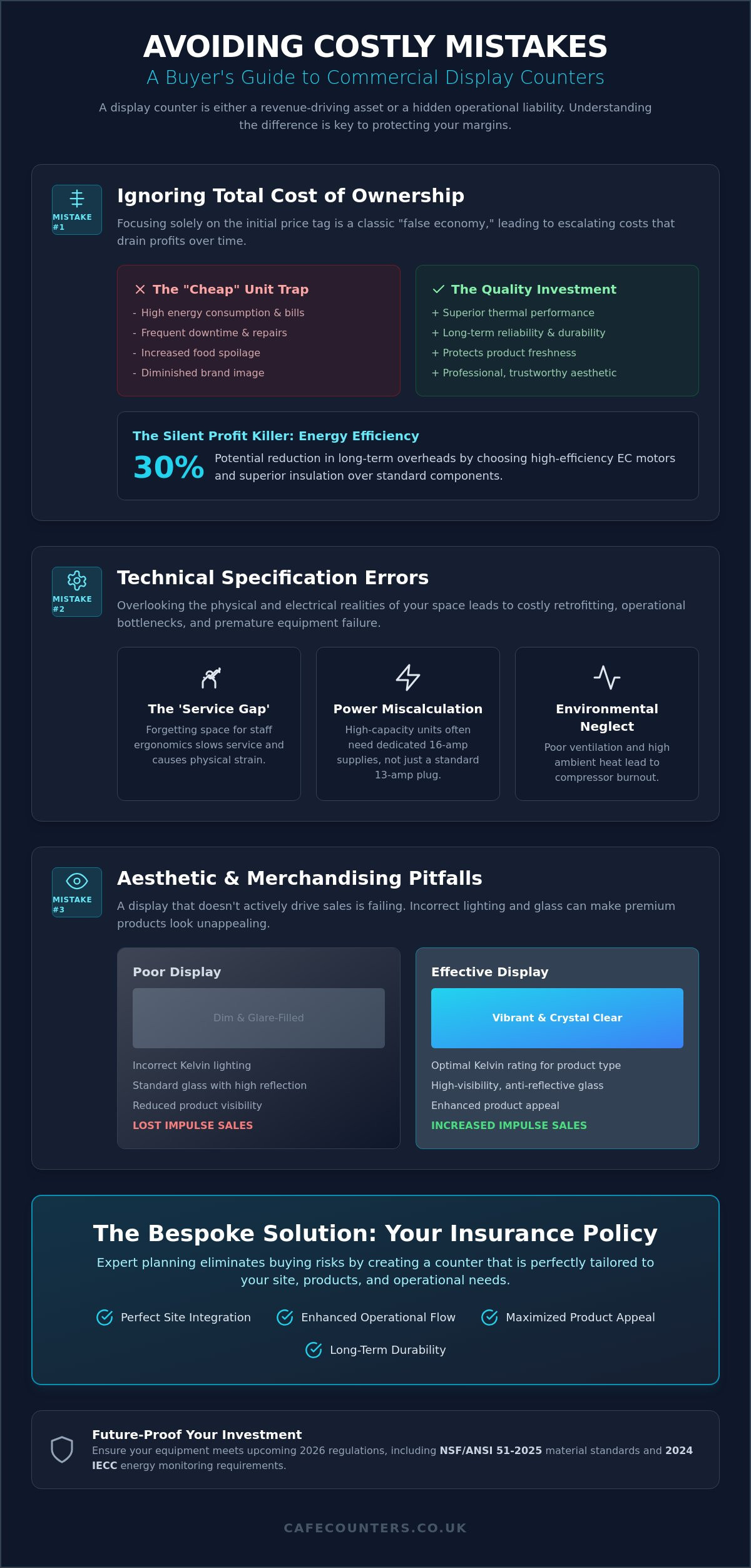
- Understand the total cost of ownership by evaluating long-term energy efficiency and maintenance requirements rather than focusing solely on the initial purchase price.
- Avoid the “Service Gap” by accurately measuring for staff ergonomics and ensuring your electrical infrastructure supports the specific load requirements of commercial units.
- Enhance product appeal and impulse sales by selecting the correct Kelvin lighting ratings and high-visibility anti-reflective glass for your patisserie or deli displays.
- Protect your investment by choosing units designed for ease of maintenance, where hygienic surfaces and accessible components prevent the cleaning difficulties typical of standard equipment.
- Discover why bespoke planning serves as a critical insurance policy to eliminate common mistakes when buying display counters, ensuring a perfect fit for your specific site and operational needs.
The True Cost of Buying Cheap: Why Price-First Decisions Often Fail
Procuring equipment based solely on the lowest initial quote is one of the most frequent common mistakes when buying display counters. While a budget-friendly off-the-shelf unit might look acceptable on a spreadsheet today, it often hides a “false economy” that manifests within months of installation. High-quality British manufacturing prioritizes structural integrity and thermal efficiency. In contrast, mass-produced alternatives often rely on thinner materials and substandard insulation. This structural weakness doesn’t just impact longevity; it directly affects your bottom line through increased food spoilage and a diminished brand image.
A counter is more than a storage box. It’s a critical tool for visual merchandising principles. When a unit looks flimsy or develops condensation due to poor seals, customers instinctively question the freshness of the food inside. Investing in robust stainless steel fabrication ensures your deli or patisserie remains a professional focal point for years. It protects customer trust by ensuring your products look as good as they taste.
Initial Savings vs. Long-Term Reliability
Choosing a lower upfront price often results in significantly higher operational costs over a three-year period. Non-bespoke units are rarely built for the specific rigours of your unique site. This leads to frequent downtime that stops sales in their tracks. We’ve seen how the lifespan of stainless steel counters far exceeds plastic-heavy alternatives. A bespoke unit acts as a stable foundation for your business, whereas off-the-shelf models often become a maintenance liability. Reliability is a quiet asset; you only notice its value when it’s gone.
Energy Efficiency: The Silent Profit Killer
Inefficient compressors and deteriorating seals are primary drivers of inflated UK energy bills. Units that fail to exceed minimum energy standards force cooling systems to run constantly. This accelerates wear and tear on every internal component. It’s a cycle that leads to early equipment failure and unpredictable repair costs. High-efficiency EC motors reduce long-term overheads by up to 30%. By selecting a unit with superior thermal performance, you convert a potential “silent profit killer” into a predictable, manageable expense. Total cost of ownership includes every penny spent on electricity and repairs, not just the check you write on day one. Avoiding common mistakes when buying display counters means looking past the price tag to the true cost of the unit’s lifespan.
Technical Specification Errors: Dimensions, Power, and Environment
Technical precision is the bedrock of a successful installation. One of the most frequent common mistakes when buying display counters is overlooking the “Service Gap”, which is the vital space behind the unit required for staff movement and ergonomics. If you prioritise display volume over the comfort of your team, you create a congested workspace that slows down service and leads to physical strain. A professional layout ensures that staff can move, reach, and serve with efficiency, which directly impacts your daily operational speed and customer satisfaction.
Electrical requirements are equally critical and often misunderstood. Many operators assume a standard 13-amp plug is sufficient for any refrigerated or heated unit. However, high-capacity patisserie displays or integrated heated gantries often require dedicated power supplies or 16-amp connections. Failing to plan for this during the early stages of a project leads to expensive rewiring costs or tripped circuits during peak trading hours. It’s essential to review your electrical infrastructure against the manufacturer’s load requirements before committing to a specific model.
Environmental factors like ambient temperature and ventilation are often ignored until the first heatwave of the year. If a unit’s compressor is tucked into a tight corner without adequate airflow, it will struggle to maintain temperature and eventually fail. Ensuring your unit is rated for the specific climate of a busy commercial kitchen is a necessary step in avoiding compressor burnout. Proper airflow planning is not just a recommendation; it’s a requirement for the longevity of your equipment.
The Crucial Role of Professional Site Surveys
Measuring a space yourself is a high-risk strategy that often leads to installation failure. A professional site survey identifies more than just width and depth. It uncovers uneven floor levels, narrow access points, and hidden drainage requirements that a standard tape measure might miss. These details determine whether a unit can be installed seamlessly or if it will require costly on-site modifications. We believe a steady, methodical approach to site assessment is the only way to guarantee a perfect fit on delivery day.
CAD Modelling and Visualisation
Visualising the customer journey is essential before any manufacturing begins. By using CAD modelling, we ensure your bespoke cafe counter integrates perfectly with your existing kitchen infrastructure and floor plan. This process allows you to see how the flow of the room works, preventing clashes with doors, pillars, or other fixed equipment. It’s a meticulous way to bring your vision to life while ensuring technical compliance. If you’re unsure about your layout, an expert site assessment can clarify your requirements before you invest.
Merchandising and Aesthetic Pitfalls: When Displays Don’t Drive Sales
A display counter is the stage upon which your products perform. One of the most subtle yet damaging common mistakes when buying display counters is failing to account for the sensory experience of the customer. If your lighting is harsh or your glass is reflective, you create a physical and psychological barrier between the shopper and the product. We believe every technical choice should serve a merchandising purpose. Your investment must translate directly into increased impulse purchases and long-term customer loyalty through superior presentation.
Glass selection is a prime example of where meticulous details yield significant returns. Standard tempered glass often creates glare from overhead shop lights, which obscures the view of your goods. High-visibility anti-reflective glass makes the barrier nearly invisible. It allows the textures of a flaky pastry or the vibrant colours of a fresh salad to take centre stage. When you pair this with a focused “hero” product strategy, rather than over-cluttering every square inch, you guide the customer’s eye exactly where you want it to go. A well-designed counter reflects your brand’s artisanal identity and proves that you value quality as much as your customers do.
Lighting for Freshness and Appeal
Lighting is a technical science, not just an aesthetic choice. Choosing the wrong Kelvin rating can make even the finest food look unappealing. Warm LED temperatures, typically around 2700K to 3000K, enhance the golden hues of baked goods and bread. Conversely, cooler temperatures of 4000K and above make deli meats and crisp salads look fresh and vibrant. It’s also vital to avoid heat-emitting bulbs that compromise food safety in refrigerated units. Integrated gantry lighting eliminates shadows, ensuring every item is visible even on the lower shelves. This level of precision ensures your display remains both safe and enticing throughout the trading day.
Choosing the Right Format: Grab & Go vs. Serve-Over
Operational failure often stems from choosing a format that doesn’t match your service model. Buying a deli counter when your site requires a high-volume grab-and-go unit is a mistake that kills impulse sales. In high-traffic UK environments, customers often prefer frictionless shopping where they can select an item without waiting for staff interaction. Conversely, a serve-over counter is essential for building rapport and offering expert advice in an artisanal setting. Your counter design must balance this need for speed with the personal touch your brand identity demands. Getting this right prevents the frustration of a mismatched floor plan and ensures your equipment supports your specific sales goals.
Operational Oversight: Maintenance, Cleaning, and Longevity
The long-term success of your procurement project depends on daily operational practicality. While an elegant design captures attention, it’s the ease of maintenance that determines your unit’s true value. Identifying potential cleaning hurdles early helps avoid one of the most frustrating common mistakes when buying display counters. Units with sharp, inaccessible internal corners or non-removable deck plates quickly become a “cleaning nightmare” that harbours bacteria and compromises food safety. We believe that a counter should be as easy to sanitise as it is to stock, ensuring your team spends less time scrubbing and more time serving.
Serviceability is another critical factor that buyers frequently overlook. Many operators fail to ask a simple question: Can a technician reach the motor or compressor without dismantling the entire cafe? If your equipment requires a full teardown for a routine filter change, your maintenance costs will skyrocket. Many operators overlook the ease of service, which remains one of the most expensive common mistakes when buying display counters over the life of the unit. A well-engineered unit features accessible service panels, protecting your business from extended downtime during peak trading periods.
Material selection directly impacts your brand’s visual longevity. Low-grade countertops or porous surfaces can stain and scratch within months, making even a new shop look dated and unhygienic. High-quality stainless steel and engineered stone offer the durability required for high-traffic environments. Planning for modular upgrades also ensures your counter can adapt to future menu changes without requiring a complete replacement. This methodical approach to durability safeguards your initial investment for years to come.
Food Hygiene and Ease of Sanitisation
Food-grade stainless steel is the industry standard for a reason; it’s non-porous and resistant to the harsh chemicals used in commercial cleaning. Drop-in units are often preferred for their streamlined profiles, as they eliminate the floor-level gaps where dust and debris typically collect. Seamless welding is essential for preventing bacterial growth in food environments by eliminating the microscopic crevices where pathogens typically thrive. These technical details ensure your site remains compliant with UK food hygiene standards with minimal effort.
After-Sales Support and Part Availability
The risk of buying imported units often manifests when a critical component fails. If spare parts have to travel across continents, your business could face weeks of lost revenue. UK-based manufacturing eliminates this risk by providing faster technical support and immediate part availability. We design our counters for a 10-year lifespan, supported by a steady schedule of professional servicing. For a solution that balances hygiene with long-term reliability, explore our professional counter design services to ensure your equipment is built to last.
The Bespoke Solution: How Expert Planning Eliminates Buying Risks
Approaching a counter installation as a coordinated engineering project rather than a simple furniture purchase is the most effective way to secure your investment. We view bespoke design as a technical insurance policy. It systematically addresses the common mistakes when buying display counters by ensuring that every variable, from airflow requirements to electrical loads, is calculated before manufacturing begins. By partnering with a manufacturer that manages the journey from initial CAD drawings to final commissioning, you eliminate the friction often found when coordinating multiple third-party contractors.
One of the most significant advantages of a custom-built solution is the ability to integrate heated, refrigerated, and ambient sections into a single, seamless counter. Off-the-shelf units often result in a disjointed “patchwork” aesthetic that wastes floor space and confuses the customer journey. A unified design allows for precise thermal separation, ensuring that your patisserie remains crisp while your heated gantries maintain safe, consistent temperatures. This level of integration requires a steady, methodical planning phase where your specific menu and service speed dictate the final form of the equipment.
To ensure your vision matches the technical reality, a clear brief is essential. We encourage our partners to share their peak foot traffic data and full product range early in the process. This allows us to design a counter that isn’t just a display, but a high-performance tool tailored to your operational rhythm. When you work with an expert partner, you move away from the guesswork of catalogues and toward a professional environment built on precision and regional artisanal pride. This dedication to quality spaces is found across all premium sectors; for those interested in high-standard facilities, you can learn more about The Fur Seasons.
Custom Engineering for Unique Spaces
Standard units rarely account for the architectural quirks of historic UK buildings or modern, high-density retail units. We solve the “awkward corner” problem by creating bespoke cafe counters that utilise every available millimetre of your floor plan. Whether you require specific material matching, such as integrating natural stone, reclaimed wood, or marine-grade stainless steel, custom engineering ensures the unit complements your interior design perfectly. This meticulous focus on space ensures that every inch of the counter is a revenue-generating asset rather than a dead corner. This philosophy of precision engineering is equally valuable when protecting your products in transit, where you can explore Foam Packaging for custom-fit solutions that prevent damage to delicate items.
The TFSE Manufacturing Advantage
Our internal production facilities provide a level of quality control that imported alternatives cannot match. The peace of mind provided by our comprehensive UK-based commissioning service ensures that your unit is calibrated to your site’s specific environment on day one. For operators managing hot food, our Vision Heated Counters solve common hot-hold temperature issues through superior thermal engineering and consistent heat distribution. You can take the first step toward a risk-free installation by requesting a professional site survey to eliminate guesswork and define your technical requirements with total confidence.
Securing Your Commercial Vision for 2026
Executing a successful commercial fit-out requires a partner who values precision as much as you value your craft. By prioritising technical specifications and long-term operational efficiency over initial costs, you transform your serving area into a high-performance asset. We’ve explored how avoiding common mistakes when buying display counters, such as ignoring service gaps or settling for inadequate lighting, ensures your products remain the focal point of your business. A well-planned installation doesn’t just display food; it protects your margins and streamlines your daily service.
Since 1991, TFSE Products has provided authoritative guidance and UK-based manufacturing to the retail and hospitality sectors. Our approach includes comprehensive CAD modelling and a dedicated national installation team to ensure your project moves seamlessly from concept to commissioning. We invite you to share your vision with a team that understands the unique pressures of your industry. Book your professional site survey with TFSE Products today to eliminate guesswork and build a space that is truly fit for the future. Your next successful project starts with a single, methodical step toward quality.
Frequently Asked Questions
What is the most common mistake when measuring for a new display counter?
The most frequent error is failing to account for the physical constraints of the delivery route, such as door widths and internal corridors. While a unit may fit the floor plan, it must first navigate the building’s entrance and any narrow turns. We recommend a professional site survey to identify these obstacles and uneven floor levels early. This methodical approach prevents one of the most frequent common mistakes when buying display counters during the installation phase.
Should I choose a refrigerated grab-and-go unit or a serve-over deli counter?
Your choice depends entirely on your service volume and the level of staff interaction your brand requires. Grab & Go Displays are ideal for high-traffic environments where speed and frictionless shopping are the priorities. Deli counters or patisserie displays are better suited for artisanal settings where staff expertise adds value to the sale. Balancing these formats within a single bespoke counter often provides the most efficient operational flow for modern retail spaces.
How do I know if my cafe floor can support the weight of a bespoke counter system?
A structural assessment is essential when installing large bespoke counters, especially those featuring heavy materials like natural stone or thick stainless steel fabrication. We provide detailed weight specifications during the CAD modelling phase to help your architect or builder confirm floor load capacities. This level of technical detail is a hallmark of a professional manufacturing process, ensuring your site remains safe and stable for the long term.
Why is energy efficiency so important for commercial food displays in the UK?
Energy efficiency is critical due to high commercial electricity costs and stricter 2024 IECC energy monitoring requirements. Inefficient units force compressors to work harder, which increases bills and accelerates equipment failure. Choosing units with high-efficiency EC motors can reduce long-term overheads by up to 30%. This proactive choice protects your margins and aligns your business with modern environmental standards while avoiding common mistakes when buying display counters.
Can I customise the materials used in my display counter to match my cafe’s brand?
Yes, bespoke manufacturing allows you to integrate a wide variety of materials including engineered stone, timber, and specialized metal finishes. We match these materials to your interior design requirements to ensure the counter acts as a natural extension of your brand identity. This flexibility ensures that your technical equipment doesn’t just function well but also enhances the visual impact of your artisanal retail space through high-end customisation.
What electrical requirements should I check before buying a heated gantry?
You must verify whether your unit requires a standard 13-amp plug or a more powerful 16-amp dedicated circuit. Heated gantries and large refrigerated displays often have high start-up loads that can trip standard commercial circuits if not planned for correctly. Checking these requirements during the planning stage avoids the need for expensive last-minute rewiring. We provide clear electrical load schedules for every bespoke unit we manufacture to ensure your site is ready.
How long does it typically take to manufacture and install a bespoke counter?
The manufacturing process for a bespoke counter typically takes between six to ten weeks, depending on the complexity of the design and material availability. This timeline includes the journey from initial CAD visualisation through to final factory testing in our UK facility. We coordinate the installation to minimise downtime, ensuring a steady, methodical progression from your initial idea to a finished, revenue-generating physical space.
Is it worth paying more for anti-reflective glass in a patisserie display?
Investing in high-visibility anti-reflective glass is highly recommended for patisserie displays where visual clarity is the primary driver of sales. It eliminates the glare from overhead lighting that often obscures the view of delicate products. By removing this visual barrier, you enhance the customer’s sensory experience and encourage impulse purchases. This technical upgrade is a proven way to maximise the merchandising potential and visual impact of your professional display.