
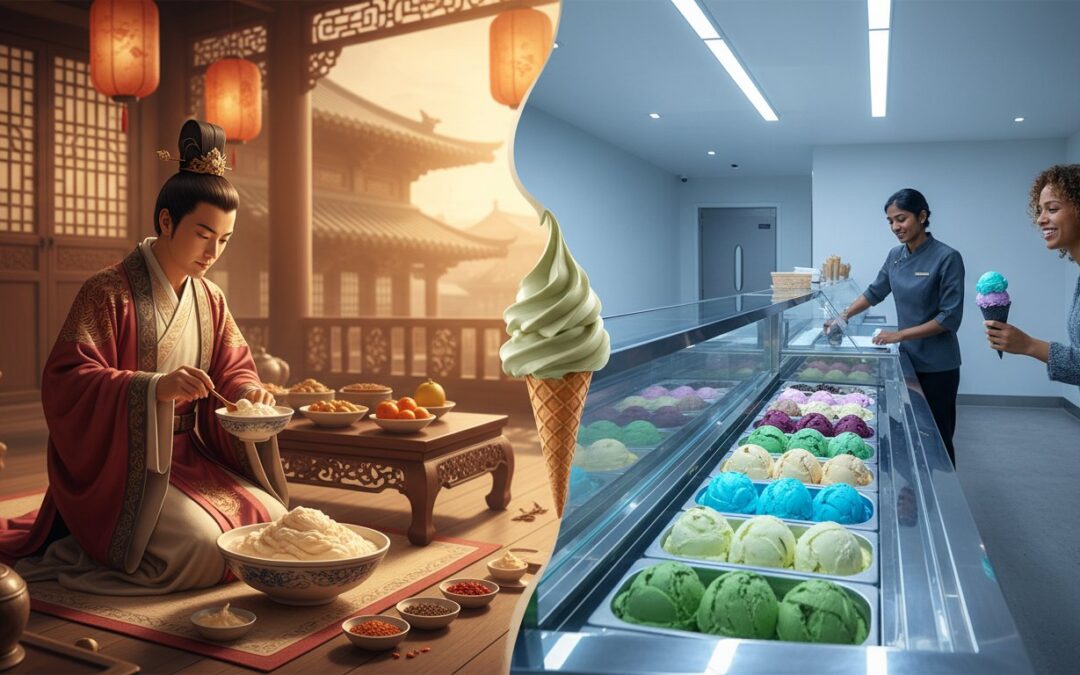
Did you know that the popular tale of Marco Polo discovering frozen desserts in 13th-century China is largely a 20th-century fabrication? While the myth persists in many culinary textbooks, the true answer to who first made ice cream is found much earlier in the buffalo milk concoctions of the Tang Dynasty around 618 AD. You likely understand that providing a rich back-story adds value to every scoop you serve, yet the historical record is often clouded by conflicting legends and marketing fluff.
We promise to clear the fog by providing a definitive timeline of frozen confectionery, moving from the saltpetre cooling methods of ancient empires to the bespoke British display counters of 2026. You’ll gain authentic insights to share with your customers and see how centuries of innovation led to the robust, temperature-precise technology we use today. We’ll explore the evolution of the trade, demonstrating how the transition from primitive ice houses to our meticulous concept-to-completion manufacturing ensures your product remains pristine from the first serve to the last.
Key Takeaways
- Journey back to the Tang Dynasty to uncover the true story of who first made ice cream using buffalo milk and exotic flavourings.
- Debunk long-standing historical myths regarding Marco Polo and Catherine de’ Medici to understand how frozen treats actually reached European shores.
- Examine the industrial shift from harvested ice to mechanical refrigeration and how Nancy Johnson’s 1843 invention democratised ice cream production.
- Trace the evolution of the British ice cream parlour, exploring the influence of Italian “Penny Ice” men and the curious etymology of the “Hokey Pokey.”
- Understand the critical role of modern display technology in driving impulse sales by transitioning from “blind” storage to prestigious, glass-fronted bespoke counters.
The Ancient Origins: Who First Made Ice Cream in China and Persia?
Tracing the lineage of the world’s most popular dessert requires a journey back to the courts of the Tang Dynasty and the arid plains of ancient Persia. Identifying who first made ice cream depends entirely on how we define the treat; whether as a refreshing water ice or a rich, dairy-based confection. At Cafe Counters, we value the intersection of precise engineering and culinary art, a tradition that began over a millennium ago with the earliest attempts to master temperature control.
The distinction between early chilled treats and the creamy product we recognise today is vital. While humans have consumed snow mixed with honey for thousands of years, the technical leap to a milk-based frozen dessert was a sophisticated process. It required a deep understanding of ingredients and a robust infrastructure for ice storage, long before the advent of modern commercial refrigeration.
The Tang Dynasty: The First True Milk-Based Frozen Dessert
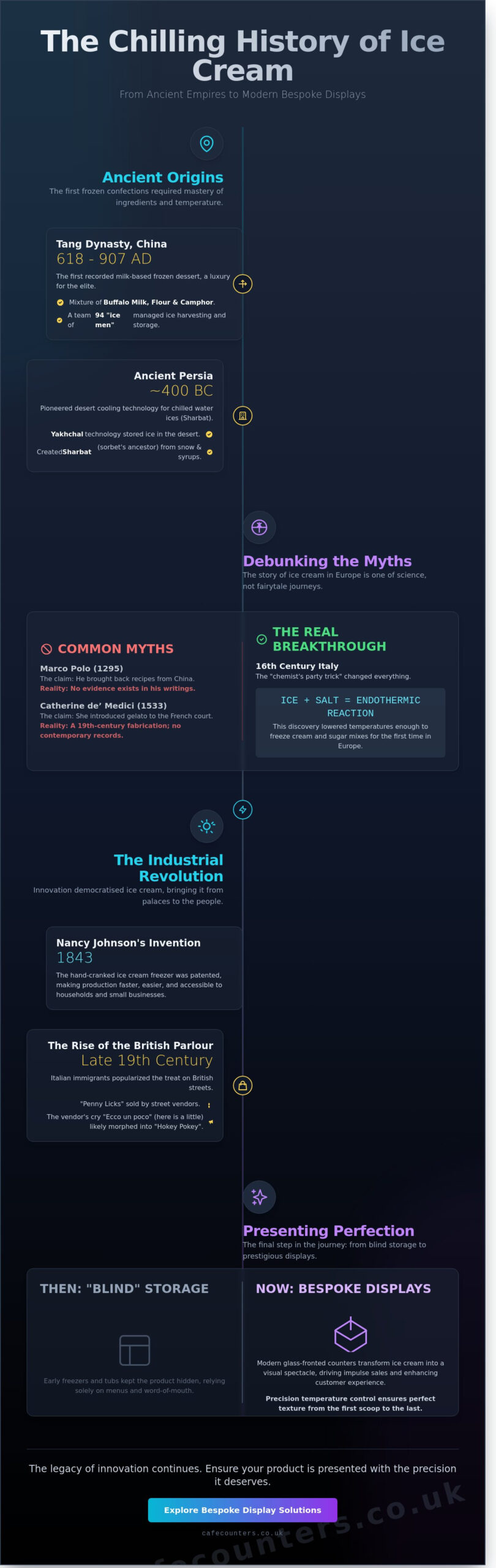
Between 618 and 907 AD, Chinese innovators developed what many historians consider the direct ancestor of modern ice cream. This was a bespoke creation reserved for the elite, involving a complex mixture of buffalo, cow, or goat milk. To achieve the desired consistency, the milk was heated with flour to create a thickened base, which was then reinforced with camphor. This plant-derived resin provided a unique, aromatic profile that complemented the richness of the dairy. The Tang Dynasty recipe stands as the first recorded instance of a milk-and-flour frozen confection.
The logistics behind this production were immense. Records show that King Tang of Shang utilised a dedicated team of 94 “ice men” who managed the cooling process. These specialists were responsible for harvesting ice during winter months and maintaining its integrity in deep pits to ensure the court could enjoy frozen delicacies during the summer heat. This methodical approach to food production mirrors the turnkey solutions we provide today, where every technical detail is managed to ensure a seamless final result.
Persian Innovation: The Sharbat and Early Sorbet
Centuries before the Tang Dynasty, around 400 BC, Persian engineers mastered the art of desert cooling. For those researching a comprehensive history of ice cream, the Persian “Yakhchal” is a landmark of functional design. These conical structures functioned as evaporative coolers, allowing ice to be stored in the middle of the desert. This stored ice allowed for the creation of “Sharbat,” a chilled delicacy made from mountain snow mixed with rose water, saffron, and fruit syrups.
- Yakhchal technology: Used thick, heat-resistant walls and wind catchers to keep interiors at sub-zero temperatures.
- Sharbat: The linguistic and culinary root of the modern word “sorbet.”
- Cultural Transition: These techniques migrated through the Middle East into the Mediterranean, influencing European frozen desserts.
Understanding who first made ice cream reveals a legacy of innovation. From the aromatic milk mixtures of China to the architectural marvels of Persia, these early pioneers proved that creating a luxury frozen product requires both high-end ingredients and meticulous technical expertise. This heritage of craftsmanship continues to inform how we design and manufacture high-performance spaces for the hospitality sector today.
The European Renaissance: Debunking the Myths of Catherine de’ Medici
The history of who first made ice cream is often obscured by romanticised legends rather than historical records. For decades, popular lore suggested Marco Polo returned from China in 1295 with recipes for water ices. However, there is no primary evidence in Polo’s writings to support this claim. Similarly, the story that Catherine de’ Medici introduced gelato to the French court upon her marriage to Henry II in 1533 is a 19th-century myth. No contemporary accounts mention frozen desserts at the wedding feast. The real breakthrough came through the “chemist’s party trick” discovered by 16th-century Italian scientists. They found that mixing salt with ice creates an endothermic reaction, lowering the temperature enough to freeze cream and sugar. According to The History of Ice Cream, these technical advancements paved the way for the first published recipes in the late 17th century.
Separating Fact from Victorian Fiction
Victorian historians frequently invented grand origin stories to give everyday luxuries a sense of prestige. They preferred the image of a royal bride or a world explorer over the reality of anonymous street vendors and technical innovators. During the 17th century, Italian “limonadiers” in Paris were the true pioneers. These skilled artisans transitioned from selling chilled lemonade to experimenting with frozen dairy. Their work was not a royal secret but a burgeoning trade. If you are planning a modern space to continue this culinary tradition, our team provides bespoke shopfitting services to ensure your layout is as efficient as it is beautiful.
The Birth of Gelato: Italy’s Culinary Gift
The transition from a private delicacy to a public commodity culminated in 1686. Francesco Procopio dei Coltelli, a Sicilian chef, opened Café Procope in Paris. He used a refined technique that distinguished gelato from the heavier, airier styles that would later emerge in America. By using less milk fat and a slower churning speed, he created a dense, intense flavour profile. Café Procope turned ice cream from a royal secret into a public luxury.
This shift from private kitchens to public service required robust, reliable equipment. The development of the industry relied on several key milestones:
- 1686: The opening of Café Procope, the first establishment to serve gelato to the public.
- 1692: Antonio Latini published the first official recipe for a milk-based sorbet in his book, Lo Scalco alla Moderna.
- 1718: Mary Eales’s Receipts, published in London, contained the first known English-language ice cream recipe.
These early recipes were often flavoured with orange flower water, mace, or ambergris. They required intense manual labour and a constant supply of harvested ice. While the question of who first made ice cream remains complex, the Italian influence on the 17th-century European market is undeniable. Their mastery of the freezing process transformed a scientific curiosity into a global phenomenon.
The Industrial Revolution: How Refrigeration Changed the Game
For centuries, the question of who first made ice cream pointed toward royal chefs and elite confectioners. This narrative shifted during the mid-19th century. The transition from harvested lake ice to mechanical refrigeration transformed a seasonal luxury into a global staple. Before the 1840s, ice was a precious commodity, cut from frozen ponds and stored in insulated pits. The arrival of industrial cooling provided the precision required for large-scale production. It allowed manufacturers to move away from the unpredictable nature of the seasons and toward a controlled, reliable manufacturing process.
From Hand-Cranked Churns to Continuous Freezers
In 1843, Nancy Johnson revolutionised the trade by patenting the hand-cranked ice cream churn. This mechanical device used a centre paddle to agitate the mixture, creating a smoother texture than previous hand-mixed methods. Her invention made the treat accessible to the middle classes for the first time. By 1851, Jacob Fussell, recognised as the “Father of the Ice Cream Industry,” established the first wholesale factory. He realised that surplus cream could be turned into profit through mass production. The technology evolved again in 1926 with the invention of the continuous freezer. This allowed for a constant flow of product rather than slow batch processing. Industrial freezers introduce controlled amounts of air, known as overrun, resulting in the soft, consistent texture we expect today. This differs significantly from the dense, icy profile of 19th-century hand-churned varieties.
The Rise of Commercial Refrigeration
The shift from salt-and-ice tubs to ammonia-based compressors marked the birth of the modern cold chain. Early manufacturers relied on a messy, labour-intensive mix of salt and ice to lower freezing points. The introduction of electric compressors allowed businesses to maintain stable temperatures, ensuring every batch met safety and quality standards. Understanding this delicious history of ice cream helps us appreciate the engineering required to produce a safe commercial product.
Modern operators now depend on high-performance equipment to manage inventory and eliminate waste. Today, commercial refrigerators are the backbone of the modern cafe, providing the robust cooling needed for high-volume service. These systems allow for the seamless storage of dairy products, ensuring that the question of who first made ice cream is followed by the reality of who can serve it most efficiently. Precision temperature control remains the most critical factor in professional food service, ensuring that the final product is as safe as it is enjoyable.
- 1843: Nancy Johnson patents the hand-cranked churn.
- 1851: Jacob Fussell opens the first wholesale factory.
- 1926: The continuous freezer allows for mass production.
The Evolution of the British Ice Cream Parlour
While historians continue to debate exactly who first made ice cream, its commercial journey in the United Kingdom began in earnest during the 19th century. This era saw the arrival of Italian immigrants who introduced the “Penny Ice” to the British public. These vendors sold small portions of frozen cream for a single copper coin, making a luxury product accessible to the working classes for the first time. The term “Hokey Pokey,” which became synonymous with street-sold ice cream, is widely believed to be a corruption of the Italian phrase “O che poco,” meaning “Oh, how little.” This referred to the small price or the small size of the serving, depending on the vendor’s pitch.
The Italian Influence on the UK High Street
Between 1880 and 1920, thousands of Italian families migrated to the UK, bringing their deep-seated gelato heritage to coastal towns and industrial cities. What started as humble street carts quickly evolved into permanent, prestigious parlour locations. These establishments became the heart of British seaside culture, where the “Sunday treat” became a ritual for families. By the mid-20th century, the British high street had fully embraced this “Cafe Culture,” replacing the utilitarian aesthetic of early shops with elegant, social spaces designed for comfort and community.
Modern Standards: The Ice Cream Alliance and Hygiene
The industry reached a turning point in 1944 with the formation of the Ice Cream Alliance (ICA). This body was instrumental in professionalising the trade and establishing rigorous safety standards. Following the Second World War, the UK government introduced the Food Standards (Ice Cream) Regulations in 1959. These rules dictated the exact composition of the product, ensuring consumers received a safe, high-quality treat. In the 21st century, the market has shifted again, with a 15% increase in demand for artisanal products since 2018.
Modern parlour owners now focus on transparency and quality, often using high-specification deli counters to showcase bespoke inclusions and locally sourced toppings. This shift towards premium presentation requires a layout that is both ergonomic for staff and visually stunning for customers. When considering who first made ice cream, we see a lineage that moves from ancient traditions to the highly regulated, artisanal British industry we see today.
Creating a successful ice cream parlour requires a balance between heritage and modern functionality. At Cafe Counters, we specialise in bringing these visions to life through our bespoke design and manufacturing services. If you’re planning a new build or a renovation, partner with our expert team to ensure your space is built to the highest standards of British craftsmanship.
Presenting Perfection: Why Modern Display Technology Matters
Understanding who first made ice cream helps us appreciate the journey from royal banquet halls to the high-street parlours of today. For centuries, frozen desserts were a “blind” product, hidden away in heavy pewter pots or deep metal tubs to keep them from melting. Customers couldn’t see the product until it was served. This changed with the advent of high-performance glass-fronted displays. Modern technology has turned a hidden delicacy into a visual spectacle, shifting the focus from simple storage to high-impact retail theatre.
Visual appeal is now the primary driver for impulse purchases in the UK dessert market. Industry data suggests that over 70 percent of retail decisions are made at the point of sale. When a customer sees the vibrant colours of a pistachio gelato or the rich texture of a chocolate ganache, the desire to buy is immediate. However, creating this visibility involves a significant technical challenge. A professional display must maintain a consistent temperature of -14°C to ensure the perfect scooping consistency, while simultaneously preventing condensation from clouding the glass. Achieving this balance requires precision engineering and high-quality thermal breaks.
Bespoke counter design does more than just hold a temperature. It reflects the prestige of a dessert that was once reserved for the tables of Charles I and Catherine de’ Medici. A well-crafted display signals quality and hygiene, reassuring the customer that the product is as premium as its history suggests.
The Art of the Visual Sell
The psychology of the “Grab and Go” model relies on removing friction between the customer and the product. In a busy environment, clear sightlines are vital. You can explore how refrigerated grab and go display units maximise customer visibility by using low-profile frames and high-clarity glazing. Lighting is equally critical. Using LED arrays with a high Colour Rendering Index (CRI) ensures that fruit flavours look natural and appetising rather than washed out under harsh overhead lights.
Bespoke Solutions for Modern Parlours
During a peak summer rush, the speed of service is determined by the ergonomics of the counter. A counter that is too deep or poorly positioned leads to staff fatigue and slower queues. TFSE Products Ltd continues the long tradition of British craftsmanship by manufacturing counters that prioritise both the server’s comfort and the customer’s experience. Every unit is built to withstand the rigours of a high-volume commercial environment. Turnkey solutions are the modern way to bring a historical cafe vision to life in 2026, providing a seamless process from the initial design to the final installation. For businesses that want to diversify their menu, view our range of Vision Heated Counters for those offering a mix of hot desserts and cold treats.
While we may never have a single name for who first made ice cream, we know exactly what makes a modern ice cream business successful. It’s the combination of a quality product and a display that treats that product like the historical treasure it is.
Elevating the Future of Your Ice Cream Service
The journey from ancient snow-chilled delicacies to the sophisticated treats of today reveals a fascinating evolution in taste and technology. While scholars continue to investigate exactly who first made ice cream, the transition from 7th-century Chinese buffalo milk mixtures to the high-tech parlours of the modern UK highlights an enduring passion for frozen desserts. Success in today’s competitive hospitality sector requires more than just a great recipe; it demands a functional, stunning environment that preserves product quality while attracting customers.
TFSE Products Ltd has been a leader in British manufacturing since 1991, providing the technical expertise needed to transform your vision into a physical reality. Our team uses advanced CAD modelling for every project to ensure a seamless fit and ergonomic workflow. We provide a comprehensive Concept to Completion service for the UK hospitality industry, managing everything from the initial design to the final installation of your bespoke counter.
Contact TFSE Products Ltd today for a bespoke cafe counter consultation and let’s build a space that honours the long history of this world-favourite treat. We’re ready to help you create something truly prestigious.
Frequently Asked Questions
Who is credited with the first ice cream recipe?
Lady Anne Fanshawe is credited with recording the first known English recipe for “icy cream” in her 1665 memoir. Her version used cream, sugar, and orange flower water to create a chilled dessert. This predates Antonio Latini’s 1692 publication in Naples, which described a milk-based sorbet. These historical records show how techniques evolved from simple chilled creams to the structured recipes used in modern professional catering.
Did the Romans eat ice cream?
The Romans didn’t eat dairy-based ice cream, but Emperor Nero is recorded in 62 AD as consuming mountain snow flavoured with honey and fruit. This practice focused on chilled refreshments rather than the churned, creamy textures we recognise today. While it wasn’t technically ice cream, it laid the groundwork for the temperature-controlled dessert displays that are now essential for high-street retail spaces across the UK.
What is the oldest ice cream company in the world?
Bassetts Ice Cream, established in 1861 in Philadelphia, holds the title of the oldest ice cream company in the world. In the UK, family-run brands like Rossi’s of Southend have been manufacturing since 1932. These long-standing businesses demonstrate the enduring demand for quality frozen treats. Our bespoke counter designs often incorporate advanced refrigeration to honour this heritage while ensuring modern operational efficiency for every client.
How was ice cream made before electricity?
Before electricity, ice cream was produced using a pot-cranking method that relied on an endothermic reaction between salt and ice. Nancy Johnson patented the first hand-cranked freezer in 1843, which improved the texture and speed of production. This manual process required robust equipment and significant physical effort. Today, we replace those labour-intensive methods with seamless, high-performance machinery integrated into professional, turnkey kitchen layouts.
When did ice cream become popular in the UK?
Ice cream became popular in the UK during the mid-19th century after Carlo Gatti opened the first ice cream stand in London in 1851. He sold “penny licks” to the public, making a treat previously reserved for the elite accessible to everyone. Understanding who first made ice cream available to the masses helps us track the evolution of the British high street from simple stalls to prestigious dessert parlours.
Is there a difference between gelato and ice cream history?
Gelato history dates back to the 16th century when Bernardo Buontalenti served a frozen cream dessert to the Medici court in Florence. Unlike traditional ice cream, which often has a higher fat content and more incorporated air, gelato is churned slowly for a denser texture. This distinction is vital for operators when designing ergonomic service areas, as gelato requires specific storage temperatures to maintain its characteristic silkiness and quality.