
With 78% of UK consumers now identifying as quality-led when making food-to-go choices, the visual and operational standards of your shop floor have never been more critical. It’s a common frustration to see a beautiful display undermined by the clutter of standalone scales or the slow service caused by a poorly planned layout. Achieving a truly professional custom deli counter design requires moving beyond off-the-shelf solutions; it demands the precise engineering of weighing technology directly into the fabric of your serving area.
We know that maintaining a high-end aesthetic while meeting the strict requirements of the Weights and Measures Act 1985 can be a significant source of stress for retailers. This guide demonstrates how integrating precision scales into bespoke counters optimises service speed, improves hygiene, and protects your profit margins. You’ll learn how to create a streamlined workspace that complies with the latest 2026 digital traceability regulations while ensuring your team can handle peak-time crowds with absolute confidence. We’ll outline the journey from initial CAD modelling to the installation of a durable, British-made serving solution that reflects the artisanal pride of your brand.
Key Takeaways
- Learn how flush-mounting weighing technology eliminates countertop clutter to create a more professional, streamlined customer experience.
- Understand the critical role of CAD modelling in custom deli counter design to ensure millimetre-perfect integration and long-term load cell accuracy.
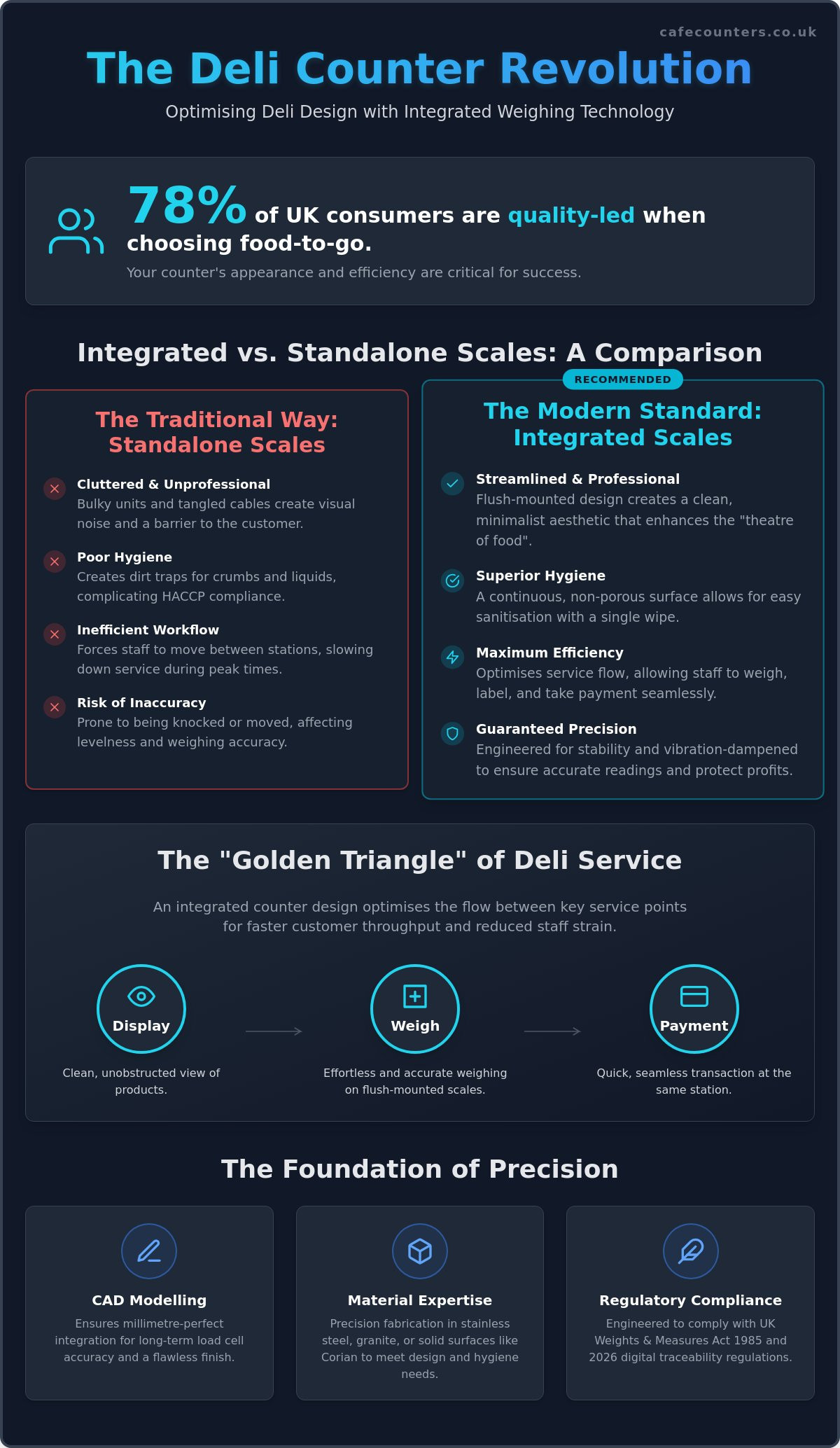
- Discover the “Golden Triangle” of deli service to optimise the flow between displaying, weighing, and payment for faster customer throughput.
- Identify how specific ergonomic placements reduce staff strain while ensuring total compliance with the latest UK weights and measures regulations.
- Explore the operational benefits of end-to-end project management from a UK-based manufacturer to guarantee durability and precision in your final installation.
The Evolution of Modern Custom Deli Counter Design with Integrated Scales
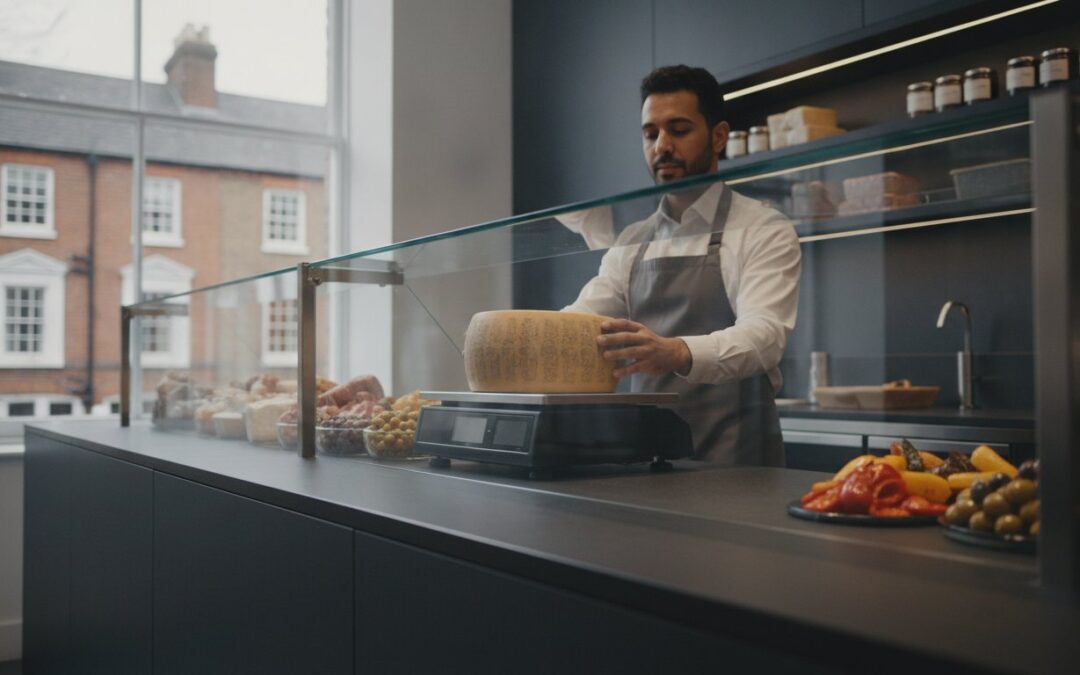
The modern deli is no longer just a place of transaction; it’s a stage for culinary expertise. We define the integrated deli counter as a bespoke serving unit where weighing technology is flush-mounted directly into the work surface. This shift represents a significant departure from traditional layouts where bulky, standalone scales often dominated the countertop. In a high-end custom deli counter design, every millimetre of space is curated to enhance the “theatre of food,” a trend that has become the primary driver for UK retail spaces in 2026.
Traditional setups often suffer from visual noise and physical obstructions. Large scale bases and tangled cables create a barrier between the artisan behind the counter and the customer. By contrast, integrated designs offer a minimalist aesthetic that prioritises the product over the equipment. To understand how far we’ve come, one only needs to look at the history of retail weighing scales; the industry has moved from simple balances to sophisticated digital systems that disappear into the counter itself. This allows for a seamless service flow where the act of weighing becomes an effortless part of the customer interaction.
Why Integration is the New Standard for UK Retailers
UK retailers, particularly those in the farm shop and artisanal deli sectors, are moving towards multi-functional service points. These areas must handle weighing, labelling, and payment without forcing the operator to move between different stations. Integrated units remove the physical “wall” created by equipment, fostering a more transparent relationship with the customer. When a customer sees a clean, unobstructed counter, their perception of freshness and quality improves instantly. It’s about projecting total competence through a workspace that’s as refined as the produce it holds; if you want to extend this level of curated precision to your personal appearance, learn more about Fehu and their guide to finding the perfect silhouette.
Hygiene and HACCP: The Hidden Benefit of Flush Mounting
One of the most overlooked advantages of integration is the impact on food safety. Standalone scales are notorious for creating dirt traps. Crumbs, liquids, and debris inevitably collect underneath and around bulky equipment, making deep cleaning a laborious task. In a busy environment, these areas can quickly become breeding grounds for bacteria, complicating your HACCP (Hazard Analysis and Critical Control Points) management.
Flush-mounting the scale creates a continuous, non-porous surface, whether you’re using high-grade stainless steel or bespoke stone. This engineering choice allows staff to sanitise the entire counter with a single wipe. Meeting stringent UK food safety standards becomes a natural part of the daily routine rather than a constant struggle against equipment design. It’s a practical benefit that ensures your operation remains as hygienic as it is visually impressive.
Technical Engineering: How Precision Scales are Integrated into Bespoke Counters
Engineering a high-end custom deli counter design with integrated scales requires a deep understanding of structural stability. It isn’t simply about aesthetics; it’s about the physics of weighing. The load cell, which is the heart of any precision scale, detects minute changes in pressure to calculate weight. If a counter frame isn’t sufficiently rigid, the vibrations from a nearby refrigeration compressor can cause the reading to drift. This leads to inaccurate pricing and potential issues with UK Weights and Measures compliance. We ensure every unit is perfectly level and vibration-dampened to protect your profit margins.
Material choice plays a vital role in this technical integration. While stainless steel is the industry standard for its durability and ease of fabrication, we also work with granite and solid surfaces like Corian. Each material requires a different approach to aperture cutting and edge finishing. Proper engineering also supports CDC food safety practices by ensuring that the housing for the scale does not allow food debris or liquids to seep into the internal counter structure. Our team provides detailed site surveys and planning services to ensure these technical requirements are met long before fabrication begins at our UK facility.
CAD Modelling and Precision Fabrication
Advanced CAD modelling allows us to map the scale aperture with sub-millimetre precision before a single piece of steel is cut. This process includes designing structural reinforcement directly beneath the scale’s mounting point to prevent the material from flexing over years of heavy use. We account for the specific dimensions of the scale hardware to ensure a true flush-mount finish that won’t catch cleaning cloths or food particles. CAD modelling prevents costly on-site installation errors.
Connectivity and POS Integration
A modern deli scale isn’t an island; it’s a data hub that must communicate with your Point of Sale (POS) system. We design bespoke counters with dedicated, internal cable management routes that keep power and data lines organised and protected from moisture. This integration supports real-time inventory tracking and ensures pricing accuracy across your entire retail operation. We also look ahead by designing access panels that allow for easy tech upgrades, ensuring your counter remains functional as weighing technology evolves.
Integrated Scales vs. Standalone Units: A Comparative Analysis for Retailers
Choosing between standalone equipment and integrated technology is a pivotal decision in any retail fit-out. Standalone scales offer the benefit of being easily moved or replaced, but they occupy a significant footprint on what’s often the most valuable real estate in your shop: the serving surface. In a high-volume custom deli counter design, every square inch counts. Integrated scales are engineered to withstand the rigours of a busy environment without the risk of being knocked or misaligned, which is a common issue with portable units.
There’s a persistent myth that integrated tech is difficult to maintain or service. In reality, modern bespoke engineering uses drop-in frames that allow the scale to be lifted out of its housing in seconds. This ensures that calibration or hardware updates don’t require dismantling the entire counter. By choosing an integrated solution, you’re investing in a permanent, stable platform that maintains its accuracy far longer than a unit that’s constantly shifted for cleaning or repositioned by different staff members.
Space Optimisation and Customer Flow
Freeing up the counter surface allows for strategic placement of high-margin impulse items or dedicated space for garnishing and wrapping. A cluttered counter signals chaos to a queuing customer; a streamlined one signals precision and speed. When the weighing process is part of the counter’s physical flow, it feels more natural and less like a technical hurdle. For a deeper look at choosing the right configuration for your specific floor plan, refer to our Ultimate Guide to Deli Counters.
Investment and ROI: Looking Beyond the Initial Cost
While the initial outlay for a bespoke unit is higher, the return on investment is found in operational efficiency. Faster transaction times lead to higher customer throughput during those critical peak hours. Consistent weighing also reduces “giveaway,” those small amounts of extra product that staff often add when they’re rushing or struggling with awkward equipment. Over a year, these saved grams can amount to hundreds of pounds in reclaimed profit. Additionally, the time saved on cleaning a flush-mounted surface compared to lifting heavy scales to scrub underneath translates to lower daily labour costs, making the custom deli counter design a financially sound choice for the long term.
Planning Your Custom Deli Layout for Maximum Operational Efficiency
The “Golden Triangle” of deli service; display, weigh, and pay; forms the backbone of a high-performing retail environment. In a successful custom deli counter design, these three points must be positioned to allow for a fluid movement that prevents staff from crossing paths or backtracking. When we plan a layout, we treat the integrated scale as the pivot point of this triangle. It should sit exactly where the selection process ends and the transaction begins, ensuring the transition from choosing a product to receiving a price is instantaneous and professional.
Efficiency also means considering how the scale interacts with other functional zones. If your counter includes salad bars or soup wells, the weighing station must be accessible without obstructing access to these hot or cold drop-in units. We often position the scale at the end of a long display run, creating a natural terminus that guides the customer toward the till point. To start mapping out your own floor plan, you can book a site survey and planning session with our design team.
Ergonomics and Staff Wellbeing
Staff fatigue is a major contributor to slow service during peak times. We meticulously plan the height and depth of integrated scales to minimise repetitive reaching or twisting movements that lead to long-term strain. The scale hardware should be flush-mounted at a height that allows the operator to maintain a neutral posture while interacting with both the product and the touchscreen interface. For those considering a wider retail fit-out, our Bespoke Cafe Counters Guide offers further insights into ergonomic planning for professional environments. It’s about protecting your team’s health while maintaining a steady, methodical service rhythm.
Customer Interaction and Transparency
Transparency is a cornerstone of the artisanal deli experience. While the scale hardware is integrated for a clean look, the customer-facing display must remain a prominent feature. This builds trust at the point of sale, allowing the customer to see the weight and price as the transaction happens. We view the act of weighing as part of the visible craft; it’s the moment where the quality of the produce is quantified. By planning for a dedicated wrap and label station immediately adjacent to the scale, you ensure the server never has to turn their back on the customer. This layout choice preserves the personal connection that defines high-end retail.
Bespoke British Manufacturing: The TFSE Approach to Integrated Deli Solutions
Choosing a UK-based manufacturer offers more than just geographic convenience; it provides a direct line to the artisans responsible for your counter’s creation. At TFSE Products Ltd, we believe that a custom deli counter design should be a physical manifestation of your brand’s commitment to quality. Unlike international technology providers who ship generic, mass-produced units, we offer a hands-on partnership that begins in our own manufacturing facility. This local oversight ensures that the high-grade stainless steel fabrication and integrated technology meet our exacting standards before the unit ever reaches your shop floor.
This commitment to excellence and local craftsmanship is a value shared by many boutique UK businesses. If you appreciate the same level of artisanal care when it comes to capturing your family’s most important moments, check out Just Tina Photography for luxury newborn, maternity, and family portraiture in Essex.
Our approach is rooted in the belief that total competence in manufacturing alleviates the stress of complex commercial projects. We don’t just supply equipment; we manage the entire lifecycle of the installation. This end-to-end project management acts as a conceptual anchor, providing a steady hand from the initial idea to the final physical space. By keeping production within the UK, we guarantee a level of quality control and after-sales responsiveness that global competitors struggle to match. It’s a methodical process that values precision over speed, ensuring your investment remains durable for years to come.
From CAD Concept to Physical Installation
The journey begins with a collaborative design phase where your vision meets our technical expertise. We use advanced CAD modelling to help you choose materials and layouts that complement your specific décor. A vital part of this process is the site survey. Our experts visit your premises to take precise measurements, ensuring the finished counter fits the physical environment without the need for on-site adjustments. This planning stage also allows us to integrate energy-efficient refrigeration technologies, reducing your long-term operational costs while maintaining the perfect temperature for your produce. It’s a transparent process designed to bring your vision to life with absolute accuracy.
Comprehensive After-Sales and Commissioning
Installation is only part of the story. The commissioning phase is where we ensure every component of your integrated counter operates at peak performance. Our technicians carefully calibrate the integrated scales and refrigeration systems to ensure they meet all UK regulatory requirements, including the Weights and Measures Act. This meticulous attention to detail provides the peace of mind that your business is compliant and efficient from day one. We remain a reliable partner long after the initial setup, offering maintenance and support that keeps your retail space running smoothly. If you’re ready to transform your service area, Contact TFSE Products Ltd for a bespoke counter consultation and discover the difference of British-made quality.
Investing in the Future of Your Retail Space
Transitioning to a high-performance serving area is a strategic move that pays dividends in both customer trust and daily efficiency. We’ve explored how a modern custom deli counter design removes physical barriers and hygiene risks by flush-mounting weighing technology directly into the work surface. This isn’t just an aesthetic choice; it’s a commitment to precision that aligns with 2026 digital traceability standards and the Weights and Measures Act. By prioritising the “Golden Triangle” of service, you ensure your team can handle peak-time crowds with absolute confidence and speed.
Success relies on the meticulous planning and structural integrity that only expert British fabrication can provide. Our dedicated fabrication facility uses advanced CAD modelling to ensure your hardware fits perfectly, while our full installation and commissioning service guarantees that your scales and refrigeration are calibrated for immediate use. We take the stress out of complex commercial projects by managing every detail from the initial survey to the final physical space.
Design your perfect deli counter with integrated scales today. We’re ready to act as your expert partner, bringing your vision to life with the durability and artisanal pride your business deserves. Let’s build a space that works as hard as you do.
Frequently Asked Questions
Can I integrate any brand of scale into a bespoke deli counter?
Most professional-grade retail scales, such as those from Avery Berkel or Bizerba, are suitable for integration. The success of the project relies on the initial CAD modelling phase where we match the counter’s aperture to the specific dimensions of your chosen hardware. We work closely with your equipment suppliers to ensure the structural housing provides a millimetre-perfect fit for a true flush-mount finish.
Are integrated deli scales difficult to service or replace if they break?
Integrated scales are designed for rapid removal using a drop-in frame system. If a unit requires off-site repair or a hardware upgrade, it can be lifted out of the counter in seconds without disturbing the surrounding structure. This design ensures that your custom deli counter design remains functional and adaptable throughout its long operational life, preventing extended downtime during busy periods.
Do integrated scales need special calibration compared to standalone models?
The calibration standards remain the same as standalone units, but the environment we create is far more stable. Because the counter is engineered to be perfectly level and vibration-free, the scale’s load cell is protected from the external interference that often causes standalone models to drift. Our commissioning service includes a final check to ensure the unit is performing accurately within its permanent housing.
What materials are best for a deli counter with integrated weighing scales?
High-grade 304 stainless steel is the preferred choice for its durability and hygienic properties. For retailers seeking a more premium aesthetic, we also integrate scales into granite, marble, or solid surfaces like Corian. Regardless of the surface material, we always provide heavy-duty structural reinforcement beneath the mounting point to ensure the weight of the scale doesn’t cause the material to flex or warp over time.
How much extra space do I need under the counter for an integrated scale unit?
You typically need between 150mm and 200mm of vertical clearance beneath the work surface to accommodate the load cell housing and cable management. This space must be kept clear of other equipment to allow for adequate ventilation and easy access for technicians. We map these requirements during the site survey to ensure your under-counter storage or refrigeration isn’t compromised.
Are integrated scales compliant with UK Weights and Measures regulations?
Yes, all scales we integrate are trade-approved and fully compliant with the Weights and Measures Act 1985 and the latest 2026 metrology standards. Compliance is a legal requirement for any business selling goods by weight in the UK. By choosing a professional installation, you ensure that your equipment is verified and stamped correctly, protecting you from the legal risks of using non-compliant scales.
Can I have both heated and refrigerated sections in a counter with integrated scales?
Bespoke manufacturing allows us to combine multiple thermal zones within a single unit. We use advanced thermal breaks to isolate refrigerated decks from heated gantries or soup wells, ensuring that temperature transfer doesn’t affect food safety or scale accuracy. This versatility allows you to create a comprehensive “one-stop” serving point that handles everything from chilled charcuterie to hot rotisserie items.
How long does it take to manufacture and install a bespoke integrated deli counter?
The typical lead time for a custom deli counter design is between 6 and 10 weeks from the moment the final CAD drawings are approved. This period allows for precision fabrication in our UK facility and the sourcing of specific materials. Installation and commissioning usually take one to two days on-site, depending on the complexity of the integration and the number of scales being fitted.