

Could a simple lapse in maintenance be costing your business hundreds of pounds in spoiled stock and inflated energy bills? For many UK retailers, the sudden failure of a patisserie display or deli counter is more than just a technical glitch; it’s a direct threat to your daily operations and artisanal reputation. You’ve likely felt that spike of anxiety when a unit starts humming too loudly or the digital display shows a rising temperature, making troubleshooting commercial display fridge problems an essential skill for any professional operator.
We understand that your refrigeration is the backbone of your commercial space. This guide provides the technical clarity you need to diagnose faults accurately and restore temperature stability without unnecessary delay. We’ll walk you through identifying common mechanical issues, navigating the strict 2026 F-Gas regulations regarding high-GWP refrigerants, and implementing a maintenance rhythm that extends the lifespan of your equipment. By following this methodical approach, you can protect your inventory, reduce your carbon footprint, and ensure your displays continue to reflect the high quality of your brand.
Key Takeaways
- Learn to identify critical temperature deviations and visual cues like condensation that signal immediate risks to food safety and stock integrity.
- Master the process of troubleshooting commercial display fridge problems by focusing on the condenser and airflow, which are the most frequent points of failure in bespoke installations.
- Discover how to resolve common mechanical issues, such as frost build-up and blocked drains, through simple daily and weekly maintenance routines.
- Understand the impact of 2026 UK energy standards and how professional commissioning ensures long-term operational efficiency and regulatory compliance.
- Recognise when to transition from basic fixes to professional support, leveraging the superior serviceability of UK-manufactured stainless steel components.
Common Symptoms: Why Your Commercial Display Fridge is Losing Temperature
Maintaining a precise climate is the foundation of food safety in the UK. For chilled products, the “Danger Zone” exists between +8°C and +63°C, where bacteria multiply most rapidly. To remain compliant with local health regulations and ensure the longevity of your stock, your display units must consistently operate between +1°C and +5°C. When these levels fluctuate, troubleshooting commercial display fridge problems becomes a priority to prevent significant financial loss. A unit that drifts even slightly above this range can compromise the texture of delicate pastries or the safety of pre-packed meats.
Visual cues often provide the first warning of a system under stress. Condensation forming on the external glass panels or “sweating” around the door gaskets usually indicates a compromised seal or an internal temperature that is struggling to stabilise. In Grab & Go units, the most frequent cause of failure is overstocking. These displays rely on a continuous “air curtain” to keep heat out. If products are pushed against the back vents or stacked too high, this curtain breaks, allowing cold air to escape and forcing the compressor to work twice as hard. Identifying whether your unit is integral, with all components housed within the cabinet, or remote, with a condenser located outside, is vital. Integral units often show symptoms through excessive heat discharge at the base, while remote systems might show cooling failure without any audible change in the shop floor environment.
Thermostat and Sensor Calibration
Your digital controller provides a convenient readout, but it isn’t always accurate. You should regularly verify these readings by placing a calibrated independent probe in the centre of the unit for at least ten minutes. Sensors in high-humidity environments are prone to “drift” or total failure due to moisture ingress, leading to erratic cooling cycles. Understanding how refrigeration works at a fundamental level helps in diagnosing these electronic faults. Temperature hysteresis is the programmed differential between the temperature at which the thermostat triggers the compressor to start and the point at which it switches off to maintain stability.
The Role of Ambient Room Temperature
The environment surrounding your fridge is just as important as the components inside. UK summer heatwaves can push kitchen or retail temperatures beyond the “Climate Class” rating of standard equipment, causing them to fail under the load. When choosing the perfect patisserie display for your cafe, positioning is a critical factor for long-term reliability. Placing a unit directly next to an oven or in the path of a drafty front door forces the system to fight constant temperature spikes. Managing the humidity in your shop through proper ventilation is the most effective way to prevent unsightly condensation and ensure your artisanal products remain the focus of the customer’s attention.
Airflow and Condenser Issues: The Impact of Poor Ventilation
The condenser is effectively the engine of your refrigeration system. It’s responsible for dispelling the heat pulled from the cabinet, making it a critical focus when troubleshooting commercial display fridge problems. In a busy UK kitchen or retail environment, this component is the most frequent point of failure. If the condenser can’t “breathe”, the entire system starts to fail, leading to rapid temperature spikes and potential stock loss. It’s a mechanical reality that is often overlooked until the unit stops cooling entirely.
Many retailers encounter a ‘hidden’ problem with bespoke installations. While a custom-built counter looks seamless, it often restricts the vital airflow required for the refrigeration unit to function. If you notice excessive heat radiating from the kick-plate or base of your unit, your compressor is likely struggling to stay cool. Grease and dust are the primary enemies here. They act as an insulating blanket on the coils, forcing the motor to run longer and hotter than intended. This increased strain doesn’t just risk a breakdown; it significantly shortens the lifespan of the most expensive part of your fridge.
Troubleshooting Ventilation in Integrated Units
Integrated units require a specific “path of least resistance” for air to enter and exit. You should start by checking for any physical blockages near the intake and exhaust grilles of your bespoke counter. A simple way to verify if your fans are pulling enough air is the ‘Paper Test’. Hold a single sheet of paper against the intake grille while the unit is running. If the suction isn’t strong enough to hold the paper in place, your airflow is compromised. This is why CAD-led design is essential for preventing ventilation-related motor burnouts. Our bespoke serving counters are engineered with these specific airflow tolerances in mind, ensuring that aesthetic beauty never comes at the cost of operational durability.
Cleaning and Maintaining Condenser Coils
Maintaining the efficiency of your unit requires a methodical approach to cleaning the condenser coils. First, always isolate the power supply to the unit. Use a soft-bristled brush or a vacuum cleaner with a narrow nozzle to gently remove debris from the delicate aluminium fins. Be careful not to bend them, as this can permanently restrict airflow. In flour-heavy environments like bakeries, you should perform this task monthly. In standard retail spaces, every three months is usually sufficient.
The long-term cost of neglecting this simple task is substantial. Dirty coils can increase your energy bills by up to 20%, which is a significant overhead in the current UK market. Ensuring your equipment operates within high-efficiency parameters is part of a broader commitment to UK Manufacturing and Support standards. Regular cleaning keeps the compressor running in its optimal cycle, reducing wear and tear and preventing the loud, clattering noises that disrupt your customer environment.
Mechanical Faults: Dealing with Ice Build-up, Leaks, and Noise
Troubleshooting commercial display fridge problems often requires moving past external airflow to investigate the internal mechanical components that manage moisture and frost. When your unit begins to resemble an arctic landscape, it’s a clear indication that the automatic defrost cycle has failed. Most professional units are programmed to run a defrost cycle several times a day, melting ice from the evaporator coils to ensure efficient heat exchange. If the defrost timer or the heater element fails, ice builds up, eventually blocking all cold air from entering the cabinet and leading to a rapid rise in temperature.
Puddles on the floor are another common frustration, yet they are rarely caused by a major pipe failure. A blocked drain hole is usually the culprit. In a busy retail environment, small fragments of food or packaging can find their way into the drainage system. Strange noises also serve as an early warning system for mechanical distress. The noise is unmistakable. While a gentle hum from the circulation fans is a sign of a healthy system, a high-pitched squeal or a repetitive clicking sound usually points toward failing motor bearings or an obstructed fan blade. Lighting failures are more than a minor annoyance. Flickering LEDs in a deli display counter can cast an unappealing shadow over your fresh produce, directly impacting your daily sales figures and the perceived quality of your brand.
Managing Condensate and Drainage
Locating and clearing the evaporator drain line is a fundamental part of professional unit maintenance. In most integral displays, the water flows into a condensate vaporiser tray located near the compressor, where heat from the motor evaporates the liquid. If this tray overflows, it’s often because the ‘slime’ build-up, a biological film common in damp environments, has restricted the flow. You should regularly inspect these lines to ensure they remain clear, preventing hygiene issues and potential water damage to your bespoke flooring.
Identifying Gasket and Seal Failures
The integrity of your door seals is paramount for maintaining a stable internal climate. You can perform the ‘Banknote Test’ by closing the door on a note; if it slides out without resistance, the magnetic pull of your gasket has weakened. Split or brittle gaskets allow warm, humid air to enter the cabinet, which is a primary cause of evaporator icing. Cleaning these seals weekly with warm, soapy water prevents them from ‘sticking’ and tearing during the high-pressure environment of a busy lunch service, ensuring a perfect seal every time.
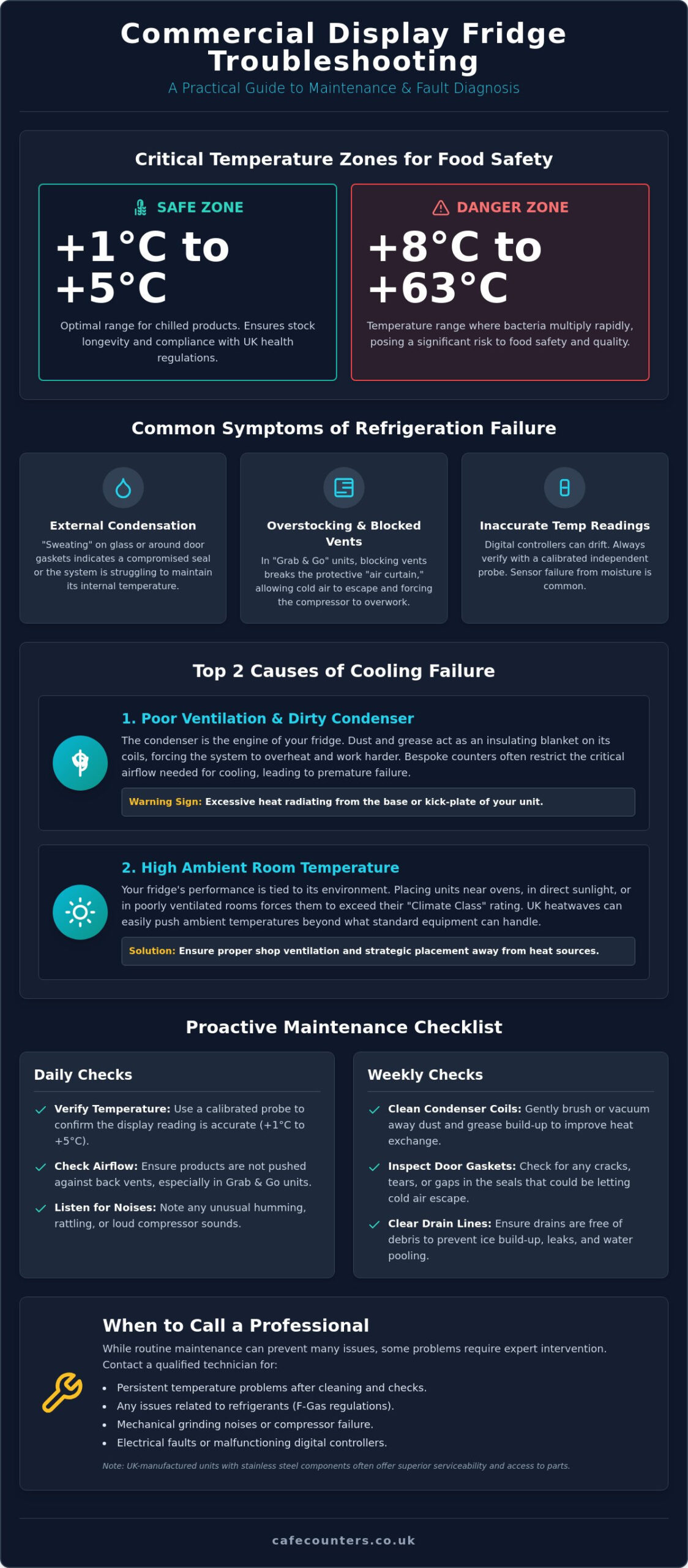
A Practical Maintenance Checklist for Cafe and Retail Operators
Proactive management is the most effective way to minimise the need for troubleshooting commercial display fridge problems. By implementing a structured maintenance rhythm, you transition from reactive repairs to a state of total operational competence. Your staff should be your first line of defence, trained to recognise the subtle shifts in equipment performance before they escalate into critical failures. A well-maintained unit doesn’t just protect your stock; it projects an image of reliability and quality to every customer who walks through your door.
To maintain this high standard across all your business assets, you can visit The CFS Group for tailored facilities management that ensures your entire operation runs seamlessly.
- Daily checks: Log internal temperatures at the start and end of every shift to ensure HACCP compliance. Perform a quick visual inspection of the glass panels for condensation and verify that all LED lighting is crisp and flicker-free.
- Weekly tasks: Wipe down door gaskets with a damp cloth to remove debris that could compromise the seal. Check that no stock or promotional signage is obstructing the intake or exhaust grilles.
- Monthly focus: Conduct a deep clean of the condenser coils as described in previous sections. Inspect the condensate drainage trays for any signs of overflow or biological build-up.
Staff training is perhaps the most overlooked element of refrigeration care. It is vital that your team understands the mechanics of the “air curtain”. When stock is piled too high or pushed against the rear vents, the refrigerated air cannot circulate, leading to “hot spots” and unnecessary compressor strain. If you are looking to upgrade your front-of-house, our team can provide bespoke serving counters designed with intuitive loading zones to prevent these common user errors.
Optimising for Energy Efficiency
Correct loading patterns do more than just protect food; they significantly lower your operational costs. A stable internal temperature is far cheaper to maintain than one that constantly fluctuates due to poor airflow. For businesses using open-front refrigerated grab and go display units, the use of night blinds is essential. Deploying these during closing hours can reduce energy consumption by preventing cold air from spilling into the empty shop, ensuring the compressor doesn’t run unnecessarily through the night.
Preparing for a Professional Service Call
When internal checks fail and you require an engineer, being prepared can reduce both labour time and costs. Always have the model number and SKU of your unit ready before making the call. If the digital controller is displaying an error code, or if you can describe a specific noise, such as a grinding fan or a clicking relay, the engineer may be able to provide a remote diagnosis or ensure they arrive with the correct spare parts. Ensure the area around the unit is clear of stock and equipment. Providing easy access to service panels allows the technician to begin troubleshooting commercial display fridge problems immediately, rather than spending billable time clearing a path to the compressor.
When to Call a Professional: UK Manufacturing and Support
Troubleshooting commercial display fridge problems often reaches a point where basic maintenance must yield to professional technical expertise. While daily cleaning and airflow management are within an operator’s control, internal refrigerant issues or complex electrical faults require a certified engineer. It’s critical to distinguish between a minor maintenance task and a major mechanical failure. If you suspect a refrigerant leak, often evidenced by an oily residue near pipework or a complete loss of cooling despite a running compressor, you must isolate the unit and call for support immediately. Under 2026 UK regulations, handling F-gases is strictly a professional task that requires specific certification.
The TFSE Products Ltd advantage lies in our manufacturing philosophy. We believe that ‘built-in’ shouldn’t mean ‘locked-in’. Our units, including our specialised Vision Heated Counters and refrigerated displays, are engineered with removable service panels. This design choice ensures that when troubleshooting commercial display fridge problems, technicians have immediate access to critical components like the compressor and evaporator. This accessibility reduces labour time and minimises the disruption to your retail environment, ensuring your business returns to peak efficiency without delay.
The Benefits of British-Made Durability
We utilise high-grade stainless steel in our production to prevent the corrosion and structural leaks that often plague cheaper, mass-produced alternatives. Because we have maintained in-house UK manufacturing since 1991, we hold a comprehensive inventory of spare parts. You won’t face the weeks of downtime associated with waiting for components to ship from overseas. Every bespoke counter we produce meets current British safety and energy standards, ensuring your installation is as compliant as it is durable.
Getting Expert Advice for Your Next Project
Many common ‘Day 1’ failures are prevented through professional commissioning. This process ensures that the unit is perfectly integrated into your space with the correct airflow tolerances and electrical loads. Whether you need a site survey to assess your current equipment or you’re planning a completely new installation, our team is ready to act as your expert partner. We provide the technical expertise required to bring your vision to life while ensuring long-term operational reliability.
Ensuring operational reliability also extends to the backup power systems that protect your stock during electrical failures. For managers of facilities with industrial generators, learn more about Representaciones BURG SpA and their inventory of critical spare parts for brands like Perkins and Caterpillar.
Contact TFSE Products Ltd for professional counter support or bespoke design and ensure your display refrigeration remains a reliable asset for years to come.
Securing the Future of Your Commercial Display
Success in the UK food and retail sector depends on the absolute reliability of your equipment. By mastering the fundamental steps of troubleshooting commercial display fridge problems, you protect your inventory and your reputation for quality. Most cooling failures stem from simple airflow obstructions or neglected maintenance cycles. Establishing a consistent cleaning rhythm and ensuring your staff understand the mechanics of the air curtain will significantly reduce the risk of emergency repairs and inflated energy costs.
When your project requires a more permanent solution, the value of an expert partner becomes clear. We have been leaders in UK-based manufacturing since 1991, using full CAD design to ensure every unit features optimal ventilation from the outset. From initial concepts to expert installation and nationwide commissioning, we provide the steady hand needed to navigate complex commercial projects. Discuss your display refrigeration requirements with our UK experts today to ensure your next installation is engineered for durability and peak performance. You’ve built a vision for your space; let us provide the technical excellence to sustain it.
Frequently Asked Questions
Why is my display fridge not getting cold enough?
A display fridge failing to reach the required +1°C to +5°C range is frequently caused by obstructed air vents or a failing air curtain. If you overstock the shelves or block the rear return vents, the cold air cannot circulate effectively, leading to internal hot spots. Troubleshooting commercial display fridge problems often starts with checking these loading patterns before assuming a mechanical failure.
How often should I clean the condenser coils on a commercial unit?
You should clean your condenser coils every three months in a standard retail environment, though flour-heavy bakeries require monthly attention. Dust and grease act as insulation on the aluminium fins, forcing the compressor to run hotter and longer. Regular vacuuming or brushing prevents these efficiency drops and protects the motor from premature burnout.
Why is there water leaking from the bottom of my refrigerated counter?
Water pooling at the base of a unit typically indicates a blocked evaporator drain line or a biological “slime” build-up in the condensate tray. In busy UK kitchens, debris can easily enter the drainage system, causing the vaporiser tray to overflow. Regularly flushing the drain line with warm water ensures that moisture is directed safely to the heating element for evaporation.
What causes the glass on my patisserie display to fog up?
Fogging or “sweating” on the glass is usually a result of high ambient humidity or a failure in the unit’s thermal seal. If the shop temperature is too high or the unit is placed in a draft, moisture in the air condenses on the cold glass surface. Maintaining a stable room temperature and checking the integrity of the gaskets are the most effective ways to restore visual clarity.
Why is my commercial fridge making a loud buzzing or vibrating noise?
Excessive buzzing or vibration often signals that the fan motor bearings are starting to fail or that a component has vibrated loose. While a steady hum is expected, high-pitched or erratic sounds require immediate investigation to prevent a total fan failure. Checking for obstructions like loose packaging near the fan blades can often resolve these noises without an engineer.
How do I know if the door gaskets on my display fridge need replacing?
You can identify failing gaskets by performing the “Banknote Test” or checking for visible splits and stiffness in the material. If a note slides out easily when the door is closed, the magnetic seal is no longer airtight. This allows warm air to enter the cabinet, which is a primary cause of excessive frost build-up on the evaporator coils.
Can I fix a commercial fridge that has stopped cooling entirely?
If a unit stops cooling entirely, you should first verify the power supply and digital controller settings before calling a technician. Total cooling failure often points to a compressor issue or a refrigerant leak, both of which require a F-Gas certified professional. Early diagnosis of these major faults can prevent complete stock loss and more expensive secondary damage.
Are integrated drop-in units harder to troubleshoot than standalone fridges?
Integrated drop-in units are not necessarily harder to manage if they are engineered with serviceability in mind. Our CAD-led design ensures that all bespoke counters include removable service panels for easy access to the internal machinery. While standalone units are more mobile, a well-designed integrated unit offers the same ease for troubleshooting commercial display fridge problems while maintaining a seamless aesthetic.