
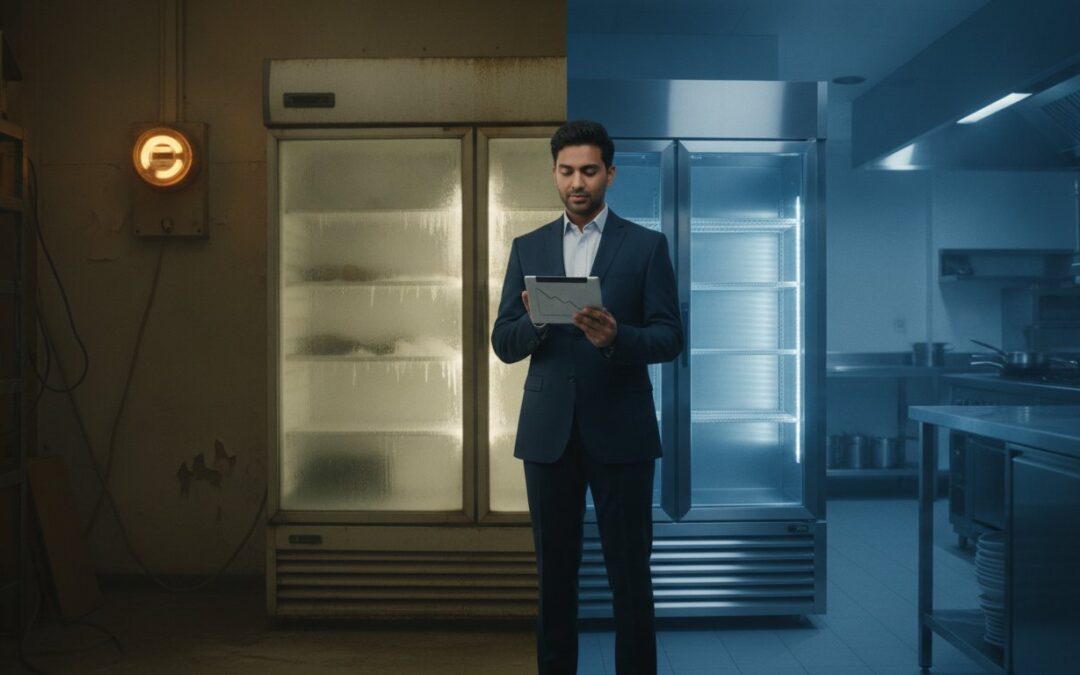
The most expensive piece of equipment in your facility is often the one that cost the least to purchase. While a low initial price tag feels like a win for the budget, the hidden costs of commercial refrigeration quickly surface through skyrocketing energy bills and the relentless cycle of repair call-outs. You likely already feel the pressure of rising electricity rates, which are projected to reach up to £240 per MWh in 2026, alongside stricter F-Gas regulations that make maintaining older units significantly more expensive. We know that equipment downtime isn’t just a minor inconvenience; it represents lost revenue and wasted stock that directly hits your bottom line.
This guide provides a clear, professional framework for calculating the Total Cost of Ownership (TCO), helping you identify the specific engineering features that slash long-term running costs. We’ll explore how strategic manufacturing choices and bespoke design protect your profitability by ensuring your cooling systems remain efficient and compliant with evolving UK standards. From understanding the impact of new EPC metrics to the value of precision-engineered British manufacturing, you’ll gain the insight needed to transform your refrigeration from a financial drain into a reliable, high-performance asset.
Key Takeaways
- Master the Total Cost of Ownership (TCO) framework to look beyond the sticker price and account for long-term energy, maintenance, and disposal expenses.
- Uncover the hidden costs of commercial refrigeration by identifying how poor insulation and low-quality glazing lead to excessive motor run-times and higher bills.
- Evaluate the benefits of bespoke UK manufacturing, where precision CAD modelling ensures equipment fits perfectly and operates reliably in high-pressure environments.
- Protect your revenue by understanding the link between equipment build quality and the prevention of costly food spoilage and operational downtime.
- Learn why professional installation and commissioning are essential investments to avoid the common setup errors that often plague standard off-the-shelf units.
Beyond the Sticker Price: Defining Total Cost of Ownership (TCO)
When you invest in professional cooling, the invoice for the equipment is merely the visible tip of the financial iceberg. Below the waterline lie the hidden costs of commercial refrigeration that can quietly erode your margins over a decade of service. Choosing a unit based solely on a low acquisition price often ignores the reality of long-term operational expenses. We view procurement as a strategic decision rather than a one-time transaction. By adopting a framework of Total Cost of Ownership (TCO), you can account for every penny spent from the day of installation to the final decommissioning of the unit. Our UK-based manufacturing heritage informs our belief that durability is the truest form of economy, prioritising long-term profitability over short-term budget fixes.
The Three Pillars of Refrigeration Lifecycle Costs
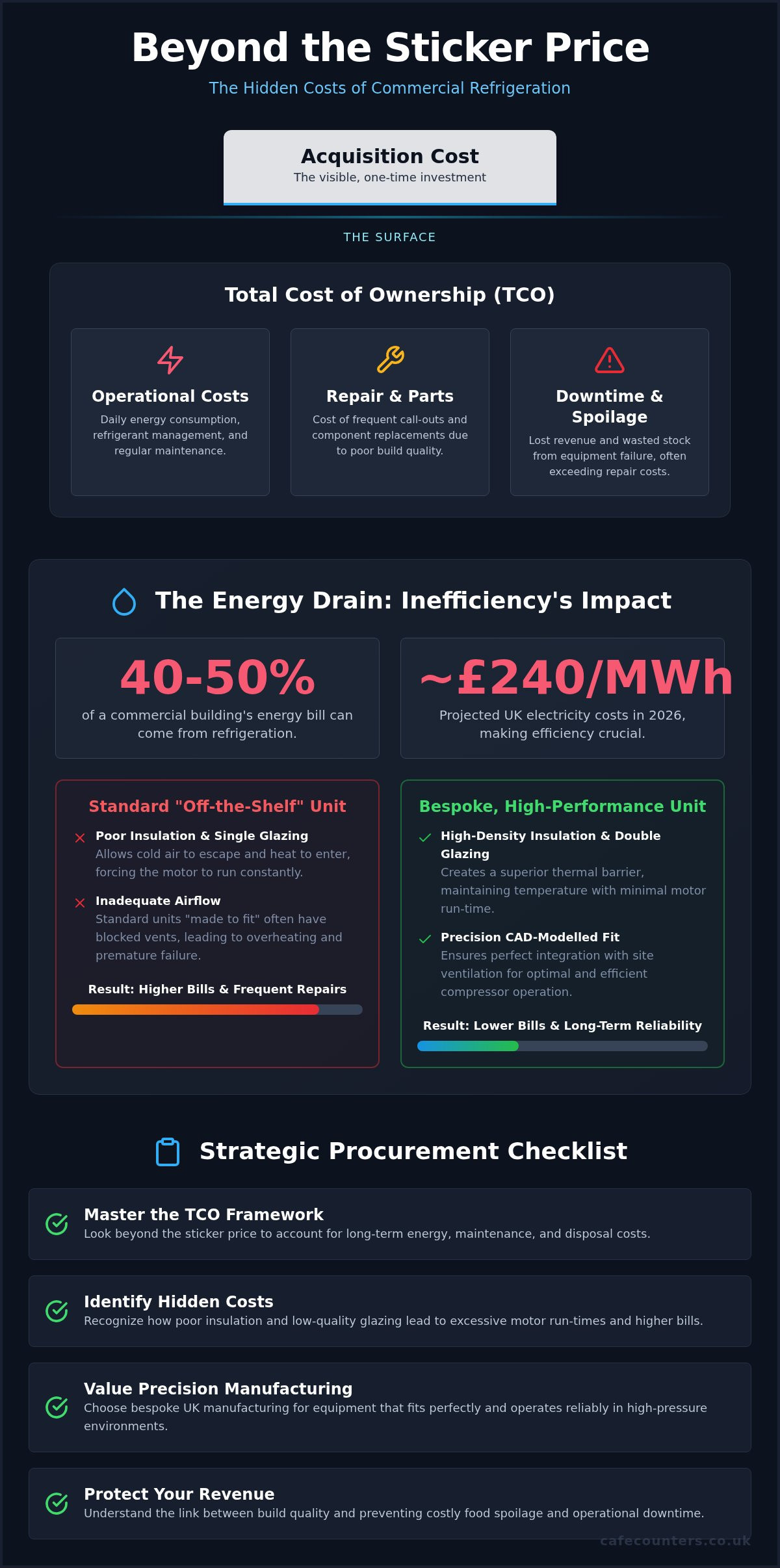
A reliable TCO calculation balances three distinct areas of expenditure. First, acquisition costs encompass more than just the hardware; they include bespoke design fees and secure delivery to your premises. Second, operational costs represent the daily drain on your resources, primarily through energy consumption and necessary refrigerant management. Finally, risk-based costs account for the unpredictable but devastating financial hits of equipment downtime and food spoilage. For instance, the cost of clearing out a deli counter due to a midnight compressor failure often exceeds the price of a superior component. Strategic procurement in the hospitality sector means acknowledging these risks before they become balance-sheet liabilities.
Why Initial Site Surveys Prevent Expensive Mistakes
The habit of “making it fit” is one of the most common drivers of early equipment failure. When a standard unit is forced into a space without adequate airflow, the compressor works harder, consumes more power, and eventually burns out. We utilise advanced CAD modelling to ensure every bespoke counter integrates perfectly with your floor plan and ventilation requirements. A comprehensive site survey identifies ambient temperature risks before installation, ensuring the system operates within its engineered thermal limits. This meticulous approach to planning eliminates the expensive retrofitting and premature replacements that plague poorly planned projects. Precision engineering at the outset is the most effective way to safeguard your investment against the hidden costs of commercial refrigeration caused by poor setup.
The Energy Drain: How Inefficient Units Quietly Erase Profits
For many food businesses, refrigeration isn’t just another utility; it’s the single largest contributor to the monthly overhead. Government estimates indicate that cooling can account for up to 40% of a commercial building’s total energy consumption. In high-intensity retail environments like grocery stores, this figure often climbs to 50%. With total electricity costs projected to reach between £220 and £240 per MWh in 2026, every watt wasted represents a direct hit to your net profit. To mitigate these rising utility expenses, many hospitality and commercial facilities are exploring integrated renewable energy; for example, First Energy Systems provides solar solutions and demand charge control to help businesses manage their power consumption more effectively. One of the primary hidden costs of commercial refrigeration is the performance gap between a unit’s lab-tested energy rating and its actual consumption in a busy, humid kitchen or shop floor.
Thermal Efficiency and Material Choice
Maintaining a stable core temperature requires more than just a powerful compressor; it demands superior thermal barriers. High-density insulation and precision-fitted seals ensure that cold air remains trapped where it belongs. While single-glazed units often appear attractive for their lower entry price, they lack the thermal resistance needed for long-term economy. We recommend double-glazed displays to significantly reduce heat gain and motor run-times. Investing in equipment that is life cycle cost-effective ensures that the energy savings eventually pay back the initial capital expenditure. You can find more detail on these performance standards in our commercial refrigerators guide.
The Cost of Refrigerant Leakage
System efficiency drops sharply when the refrigerant charge is compromised. Industry data shows that even a modest 10% loss in refrigerant can force a system to consume 20% more energy to maintain the same temperature. These hidden costs of commercial refrigeration are compounded by the 2026 F-Gas regulation updates, which enforce a 40% reduction in the HFC supply quota. As high-GWP refrigerants become scarcer and more expensive to source, the financial burden of maintaining an old, leaky system grows exponentially. Environmental levies and the indirect carbon tax on inefficient systems further penalise businesses that fail to upgrade to modern, natural refrigerant solutions.
Beyond the cooling circuit, internal components like lighting play a subtle role in energy waste. Older lighting systems emit heat directly into the refrigerated space, forcing the motor to work harder to compensate. Modern LED solutions eliminate this internal heat gain while enhancing the visual impact of your products. If you’re concerned about your current energy spend, our team can help you review your existing layout to identify where bespoke engineering could improve your efficiency and lower your daily standing charges.
Design Flaws and Poor Build Quality: The Hidden Drivers of Repair Bills
While many operators attribute equipment failure to poor maintenance, the reality is that many faults are designed-in from the factory. Low-cost manufacturers often cut corners on essential internal components like evaporator fans and thermostats, which struggle to survive the high humidity and grease-laden air of a busy professional kitchen. When these cheap parts fail, the resulting repair bill and emergency call-out fee often negate any initial savings. Choosing robust, British-made equipment ensures that every internal component is specified for the rigours of a commercial environment, protecting you from the hidden costs of commercial refrigeration that arise from inferior build quality.
A common pitfall is the “standard unit” trap. Attempting to slot an off-the-shelf fridge into a custom-built counter gap frequently leads to restricted airflow. Without the precision of CAD-modelled ventilation, the compressor operates under constant strain, leading to premature failure. Furthermore, poor weld quality in cheaper stainless steel alternatives can lead to structural sagging and hygiene issues, as gaps open up to harbour bacteria. High-quality construction isn’t just about aesthetics; it’s about the structural integrity that prevents panels from warping and joints from failing under the daily pressure of a high-volume service environment.
Bespoke Engineering vs. Mass Production
Our bespoke cafe counter design process prioritises both performance and serviceability. We use advanced modelling to ensure optimal airflow around all refrigerated components, preventing the heat build-up that kills compressors. A critical aspect of this design is “service access”. If a technician must dismantle half the counter just to access a simple filter or sensor, the labour cost for a routine check-up can double. We design our units with the engineer in mind, ensuring that maintenance is quick, unobtrusive, and cost-effective. This meticulous attention to detail at the design stage eliminates many of the hidden costs of commercial refrigeration that plague mass-produced units.
The Spare Parts Lottery
Relying on imported equipment often leads to the “spare parts lottery”. If a non-UK unit fails, you may face a three-week lead time for a specialised component to clear customs and arrive at your door. The cost of a display being “out of order” for nearly a month far outweighs the price of a premium unit. Using standardised UK components significantly reduces long-term maintenance overheads by ensuring parts are readily available and easily replaced by any qualified engineer. This reliability is a cornerstone of our manufacturing philosophy, providing a steady, dependable hand in a complex field where downtime is simply not an option.
Operational Downtime and Food Waste: The True Cost of Reliability
Reliability is often a silent partner in a successful food business, only drawing attention when it vanishes. When a cooling system fails, the financial impact extends far beyond the immediate repair invoice. The true hidden costs of commercial refrigeration manifest as a cascade of operational disruptions that can cripple a week’s profitability in a single afternoon. From the frantic relocation of stock to the permanent loss of high-value inventory, the price of choosing an unreliable unit is paid daily through increased risk. We believe that a refrigeration unit should be a steady, dependable hand in your business, not a source of constant anxiety.
Quantifying the hit of a major equipment failure requires looking at more than just the bin. Clearing out a deli counter involves significant labour costs as staff are diverted from serving customers to salvaging what they can. There is also the “empty shelf” effect to consider. Reputational damage occurs the moment a customer sees an out-of-order sign where their favourite lunch should be. These lost sales are rarely recovered. Additionally, emergency call-out premiums for weekend or evening repairs often cost double the amount you might have saved by opting for a cheaper, standard unit at the start.
The Spoilage Multiplier
The financial stakes are highest where precision is most required. In specialized patisserie display counters, even minor temperature fluctuations can ruin the texture and safety of delicate creams and chocolates. A failed component worth £500 can easily lead to over £2,000 in lost high-value stock. This spoilage multiplier proves that the most expensive refrigerator is the one that fails when you are at your busiest. Consistent cooling doesn’t just prevent waste; it maintains the “Visual Promise” of your food, ensuring that every item looks as fresh as the moment it was prepared.
Display Quality and Sales Conversion
One of the most overlooked hidden costs of commercial refrigeration is the loss of sales due to poor display quality. Condensation on the glass is a common symptom of inferior thermal engineering. If a customer cannot clearly see your products, they simply won’t buy them. Similarly, poor lighting in grab and go displays significantly reduces impulse purchases. Effective cooling must be invisible to the customer, providing a crystal-clear window into your offerings without the distraction of fogged glass or dim interiors. To ensure your products always look their best, we invite you to explore our bespoke display solutions that balance technical precision with high-end aesthetics.
Strategic Procurement: Mitigating Risk with UK Manufacturing
Strategic procurement is the final safeguard against the hidden costs of commercial refrigeration. While previous sections detailed the technical and operational drains on your budget, the solution lies in a steady, reliable hand that manages the project from initial CAD modelling to final installation. Choosing British-made equipment, manufactured in our own facilities since 1991, ensures that every component meets the rigorous 2026 HFC quota reduction standards. This internal production capability simplifies F-Gas compliance and documentation, removing the stress of navigating complex environmental regulations alone. High-quality counters also represent a durable asset; they are designed for refurbishment rather than disposal, offering significant resale potential that cheaper imports lack.
End-to-end project management acts as a conceptual anchor for your investment. By maintaining total quality control from the initial site survey to the finished physical space, we reduce the “handover” errors that typically occur when multiple third-party contractors are involved. This methodical approach ensures that the technical features we’ve discussed, such as precision-engineered airflow and high-density insulation, are correctly integrated into your specific environment. It is the difference between a generic purchase and a collaborative partnership that values precision and quality over speed.
The Role of Professional Commissioning
Professional installation and commissioning is a non-negotiable investment in the longevity of your cooling system. A certified setup ensures that your units are set to the specific requirements of your menu, whether you are holding delicate patisserie or high-volume deli items. This process validates manufacturer warranties and prevents the user-error costs that often plague new equipment from day one. We include staff training as part of our comprehensive service, ensuring your team understands how to maintain optimal performance and avoid the hidden costs of commercial refrigeration caused by simple operational mistakes.
Future-Proofing Your Investment
The landscape of the UK hospitality sector is constantly evolving, and your equipment should be capable of adapting to those changes. Choosing modular integrate drop-in units allows for easier future upgrades or layout reconfigurations without the need for a total refit. This flexibility is backed by the advantage of local technical support and site-specific knowledge that only a UK-based manufacturer can provide. By partnering with a seasoned professional who understands your unique pressures, you transform a complex construction project into a methodical, transparent journey toward long-term profitability. If you’re ready to secure the future of your professional cooling, we invite you to contact us for a bespoke counter consultation to discuss your vision.
Securing Your Long-Term Profitability through Precision Engineering
Protecting your business from the hidden costs of commercial refrigeration requires looking beyond the initial purchase price to the total lifecycle value of your equipment. By prioritising thermal efficiency and superior build quality, you safeguard your margins against the relentless drain of energy waste and frequent emergency repairs. A strategic approach to procurement ensures that your cooling systems remain a reliable asset rather than a financial liability. It’s about making choices today that preserve your profitability for the next decade.
We’ve been specialists in UK-based manufacturing since 1991, utilising advanced CAD modelling to bring your specific vision to life with total precision. Our comprehensive national installation and commissioning services ensure that every bespoke unit operates at peak performance from day one. When you partner with a manufacturer that maintains full control over internal production, you gain a steady, dependable hand for your project. We invite you to contact TFSE Products Ltd for a bespoke counter consultation to discuss how we can support your vision. We’re ready to help you build a more efficient, profitable future.
Frequently Asked Questions
What are the most common hidden costs in commercial refrigeration?
Energy consumption, maintenance call-outs, and food spoilage are the primary financial drains on your budget. While the initial purchase price is visible, daily operational electricity and regular refrigerant top-ups often exceed the capital expense over its lifespan. Poorly engineered units also incur higher labour costs for cleaning and servicing. We focus on CAD-modelled precision to ensure these expenses remain predictable and manageable throughout the equipment’s long-term service.
How much can I save on energy bills by choosing a bespoke unit?
Bespoke units can reduce energy consumption by up to 30% compared to poorly fitted standard models. This saving is achieved through precision CAD modelling that ensures optimal airflow and high-density insulation tailored to your specific environment. When a unit fits perfectly, the compressor runs less frequently, directly lowering your monthly electricity overheads. This efficiency is vital as UK electricity costs are projected to reach up to £240 per MWh in 2026.
Does poor installation really void my manufacturer warranty?
Correct installation is a frequent requirement for validating manufacturer warranties. If a unit is placed in an area with restricted ventilation or is commissioned without proper technical calibration, any subsequent component failure is often deemed a result of environmental misuse rather than a manufacturing defect. Our national installation services ensure that every counter is set up to exact specifications, protecting your investment and ensuring you have total competence in your warranty coverage.
What is F-Gas compliance and why does it cost money?
F-Gas compliance refers to the UK regulations governing the use and leakage of fluorinated greenhouse gases. As of 2026, stricter quotas mean that high-GWP refrigerants are becoming scarce and more expensive to purchase for repairs. Compliance involves mandatory leak checks and eventually upgrading to natural refrigerant systems. Staying ahead of these regulations prevents the hidden costs of commercial refrigeration associated with non-compliance fines and the rising price of legacy chemicals.
How does equipment downtime affect my long-term ROI?
Downtime acts as a multiplier of loss, impacting stock, labour, and reputation. A single day of failure in a high-value patisserie display can result in over £2,000 in wasted inventory. When you factor in the staff time spent moving stock and the loss of customer loyalty due to empty shelves, the return on investment for an unreliable unit quickly turns negative. Reliability is the cornerstone of long-term profitability and sustainable growth for any hospitality business.
Why is UK-manufactured equipment often cheaper in the long run?
British-made equipment offers superior lifecycle value through easier access to spare parts and local technical support. If a component fails, you won’t wait weeks for imported parts to clear customs, which significantly reduces the hidden costs of commercial refrigeration caused by extended downtime. Since we’ve been manufacturing in the UK since 1991, our units use standardised components that any qualified engineer can service quickly and cost-effectively without specialised international shipping.
Can bespoke design actually reduce my initial installation costs?
Bespoke design reduces initial costs by eliminating the need for expensive on-site modifications that occur when standard units don’t fit your space. By using advanced CAD modelling, we identify structural or ventilation challenges before the equipment arrives. This precision ensures a first-time fit, reducing the hours spent by installation teams and preventing the need for secondary remedial work to accommodate ventilation, plumbing, or electrical requirements in your facility.
How often should commercial refrigeration be serviced to avoid hidden costs?
Professional servicing should occur at least twice a year to maintain peak efficiency and identify potential component wear. Regular maintenance includes cleaning condenser coils and checking door seals, which prevents the motor from overworking and consuming excess energy. This proactive approach is a steady, methodical way to avoid the emergency call-out premiums and catastrophic failures that typically occur when equipment is neglected in a high-pressure commercial environment. Additionally, to protect external hardware from physical damage or theft, you can check out Wombat Cages for examples of robust security solutions.