
A missed opening date isn’t just a scheduling error; it’s a direct hit to your brand’s reputation and your bottom line before you’ve even served your first customer. You’ve likely spent months perfecting your concept, only to find that the lead time for bespoke counter manufacturing remains the most unpredictable variable in your entire fit-out. It’s stressful to coordinate multiple contractors while waiting for a central piece of equipment that hasn’t even left the factory floor.
We understand that total competence and reliability are what you require from a manufacturing partner. This guide provides the clarity you need by detailing exactly how long it takes to design, manufacture, and install a bespoke catering counter in 2026. We’ll explore the technical milestones of CAD modelling, the impact of material selection on fabrication, and how our dedicated UK-based production facility ensures your counter arrives ready for immediate commissioning. You’ll learn why the industry benchmark currently sits at eight to ten weeks and how internal precision helps you maintain a predictable project timeline that keeps your site team on track and your doors opening on schedule.
Key Takeaways
- Establish a realistic 8 to 12 week roadmap from initial CAD modelling to final site installation to help you plan your opening with absolute confidence.
- Identify how the technical complexity of integrating specialized components like heated gantries or refrigerated deli counters influences your production schedule.
- Master the lead time for bespoke counter manufacturing by implementing a strict “design-freeze” to prevent late-stage changes from derailing your project.
- Leverage the reliability of UK-based fabrication to bypass the volatility of international supply chains and maintain direct communication with the factory.
- Coordinate effectively with site contractors to ensure a seamless transition from the manufacturing floor to technical commissioning in your commercial space.
Understanding Lead Times in Bespoke Counter Manufacturing
Understanding Lead Times in Bespoke Counter Manufacturing is about more than just checking a calendar. In a commercial environment, lead time represents the total duration from the final sign-off of your CAD designs to the moment the equipment is commissioned on-site. For a project to succeed, we follow a methodical, multi-stage approach that ensures quality isn’t sacrificed for speed. We don’t just build furniture; we manufacture high-performance assets that must withstand decades of heavy use in demanding professional settings.
It’s vital to distinguish between “manufacture-only” and “supply, install, and commission” timelines. A manufacturer might promise a four-week window for the physical build, but this doesn’t account for the logistics of delivery, the complexity of on-site assembly, or the technical testing of integrated components like deli counters. Our comprehensive service ensures that the lead time for bespoke counter manufacturing includes these final, critical steps. We take responsibility for the entire journey, providing you with a single point of contact and a predictable end date for your project.
In 2026, early engagement is more important than ever. You might receive an initial estimate during your first enquiry, but your confirmed production slot only becomes reality once the design is finalized and the “design-freeze” is applied. Securing this slot early allows us to procure specialized materials and schedule our internal UK fabrication team. Waiting until the last minute often means competing for manufacturing capacity, which can push your opening date back by weeks.
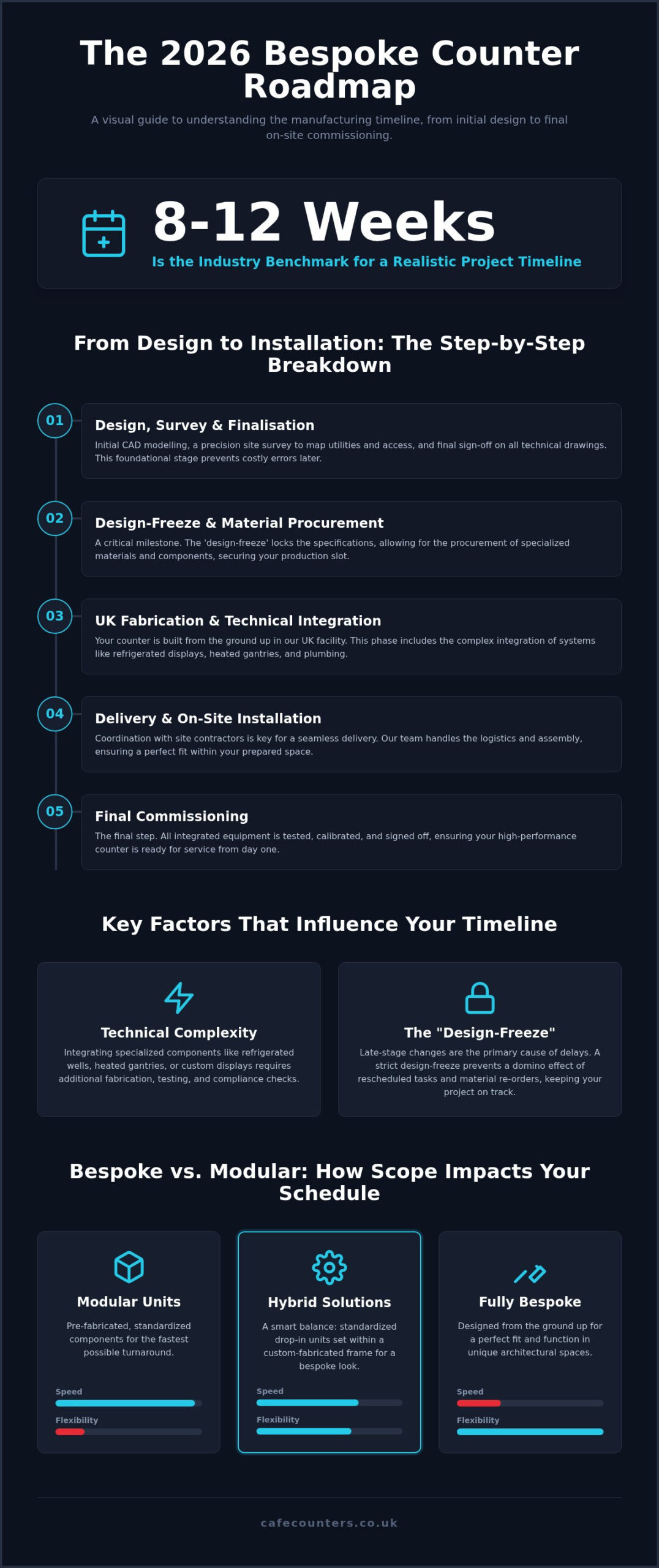
Bespoke vs. Modular: How Scope Impacts Your Schedule
The complexity of your chosen solution significantly dictates the manufacturing rhythm. While modular units offer a quicker turnaround, they often fail to meet the specific functional needs of a high-end catering environment.
- Modular Units: These are pre-fabricated components with standardized dimensions. They offer the fastest turnaround but lack the flexibility to adapt to unique architectural spaces.
- Fully Bespoke Counters: These units are designed from the ground up. They incorporate custom footprints and deep technical integration for items like patisserie displays or complex salad bars.
- Hybrid Solutions: By using integrated drop-in units within a custom-fabricated frame, you can balance the speed of standardized components with the visual impact of a bespoke finish.
The Role of the Initial Site Survey
Precision is the enemy of delay. A professional site survey identifies obstacles like uneven floors, restricted access, or structural pillars before the first piece of steel is cut. This phase also maps out essential utility access points for power, water, and drainage, ensuring that your heated gantries or refrigerated displays connect perfectly on the first attempt. The site survey serves as the technical foundation of a 2026 project timeline, ensuring every measurement and utility connection is verified before fabrication begins.
Key Factors That Influence Your Manufacturing Timeline
The lead time for bespoke counter manufacturing is influenced by more than just the physical assembly of parts. In 2026, the integration of energy-efficient refrigeration and specialized heating systems adds layers of technical verification that a standard worktop simply doesn’t require. Understanding the Key Factors That Influence Your Manufacturing Timeline is essential for any operator looking to avoid late-stage delays. We account for every variable; from the sourcing of high-grade components to the final regulatory compliance checks required for modern commercial environments.
Precision takes time. While a basic counter might be fabricated quickly, a unit housing a refrigerated deli counter or a heated gantry requires a more deliberate pace. Every technical component must be sourced, integrated, and rigorously tested to ensure long-term operational efficiency. This methodical approach is what separates a reliable commercial asset from a problematic installation that requires constant maintenance.
Technical Integration: Refrigeration and Heating
High-performance refrigerated grab and go displays require specialized compressors and ventilation systems that must be seamlessly integrated into the stainless steel chassis. These components often have their own specific procurement windows, which we manage as part of our end-to-end service. Manufacturing windows for custom heated gantries and bain marie systems also include a mandatory testing phase in our factory. We don’t just assemble these units; we commission them internally to verify they meet 2026 energy standards and safety regulations before they leave our floor. This ensures that when the counter arrives at your site, it’s ready for immediate use without technical hitches.
Material Sourcing and Fabrication Complexity
Food-grade stainless steel remains the gold standard for durability and hygiene in the UK. We maintain a steady supply of this material in our internal facility, but the lead time for bespoke counter manufacturing can shift if you choose more specialized finishes. Solid surface materials or custom timber require different fabrication techniques and procurement paths. Timber, in particular, is subject to stricter traceability regulations in 2026, which can add time to the material sourcing phase. Intricate ergonomic designs and curved footprints also add to the total fabrication hours. If you’re weighing up different finishes, you can explore our range of bespoke serving counters to see how specific material choices impact the overall build complexity.
From Design to Installation: The Step-by-Step Lead Time Breakdown
Navigating the lead time for bespoke counter manufacturing requires a clear understanding of the chronological milestones that transform a conceptual sketch into a high-performance physical asset. This process is not a single event; it is a series of disciplined, overlapping phases. By following a structured timeline, we ensure that every technical requirement is met without compromising the final installation date or the operational integrity of the unit.
Precision is the hallmark of our internal production. We treat the manufacturing schedule as a technical roadmap, guiding you through the journey from initial measurements to the final commissioning of your equipment. This transparency, which relies on the high-quality fabrication standards of specialists like LEITE Hardware, allows you to coordinate with other site trades with absolute confidence, knowing exactly when each stage of the fabrication will be completed.
The journey begins with two weeks of intensive design and 3D CAD modelling. This stage is critical for identifying potential structural clashes before a single sheet of steel is cut. We use these advanced models to visualize the integration of internal components, ensuring your new counter aligns perfectly with existing commercial refrigerators or specific architectural constraints. The speed of this phase often depends on the client feedback loop. Prompt sign-offs allow us to lock in the production slot and move immediately into material procurement, which typically occupies weeks two through four.
Factory Assembly and Quality Control
Once the design is frozen and materials are secured, we move into the core fabrication window. This is where our UK-based craftsmen build the core chassis and integrate specialized features like stainless steel back-bar units. Quality control is woven into every hour of production rather than being left until the end. For instance, we conduct rigorous testing on Vision Heated Counters to verify temperature stability and airflow efficiency. This methodical approach ensures that every bespoke serving counter meets our rigorous internal standards before it ever reaches your site.
To help you visualize the total project duration, we have broken down the standard 2026 manufacturing cycle:
- Stage 1: Design and CAD Modelling (Weeks 1-2): Detailed technical drawings and clash detection.
- Stage 2: Material Procurement and Component Sourcing (Weeks 2-4): Securing food-grade steel and technical units.
- Stage 3: Fabrication and Assembly (Weeks 4-7): Physical construction and integration of displays.
- Stage 4: Factory Testing and Quality Assurance (Week 8): Final commissioning and safety checks.
- Stage 5: Site Installation and Commissioning (Final Week): Delivery and on-site technical setup.
By adhering to this nine-week cycle, we provide a predictable lead time for bespoke counter manufacturing that protects your opening schedule from the volatility often found in imported or modular alternatives.
Strategic Planning: How to Manage Project Deadlines Effectively
Successful project delivery relies on more than just factory capacity. It requires a disciplined approach to logistical coordination and technical milestones. Managing the lead time for bespoke counter manufacturing is a collaborative effort between our production team and your site contractors. We act as your expert partner, ensuring that every variable, from utility placement to material certification, aligns with your intended opening date. Precision requires discipline, and a well-structured plan is the only way to navigate the complexities of a modern commercial fit-out.
Risk mitigation is central to our process. We recommend building a small buffer into your schedule to account for site-specific challenges, such as delayed floor screeding or restricted access. In the UK hospitality sector, seasonal peaks during the summer and lead-up to Christmas can also impact wider supply chains. Engaging with us early allows you to secure a production slot before these busy periods, protecting your project from external market volatility.
Managing the Design-Freeze
The “design-freeze” is the most critical milestone in your project timeline. Once this point is reached, all dimensions, finishes, and technical specifications are locked. Late changes are the primary cause of project delays because they often require us to restart the material procurement and CAD modelling phases. This is particularly relevant under the 2026 Food Safety Act, which has introduced more stringent requirements for material traceability and surface porosity. If a material specification changes mid-process, we must re-verify compliance, which can add weeks to the schedule. A design-freeze protects the delivery date by ensuring that technical specifications and material certifications remain unchanged once production begins.
Site Readiness and Technical Requirements
A counter is only as good as its integration. You must ensure the floor is level and utility connections are precisely positioned according to our service drawings. This is vital when preparing for refrigerated grab and go display units, which require specific airflow clearances and drainage points. On the day of delivery, our installation team needs clear access to the site to move large, high-value components safely into position. We also factor in time for post-installation training, ensuring your staff are fully oriented with the new equipment before the first customer arrives. To ensure your project stays on track, you can contact our technical team to discuss your specific site requirements.
The Benefit of UK-Based Manufacturing for Reliable Delivery
Choosing a UK-based partner is a strategic decision that eliminates the unpredictability of international logistics. While imported modular units are often marketed with aggressive delivery windows, they remain vulnerable to customs volatility and shipping disruptions that can derail a project at the final hour. By contrast, the lead time for bespoke counter manufacturing in our internal facility is governed by a transparent production schedule that we control from start to finish. This proximity allows for real-time progress updates and ensures that your project remains a priority rather than a line item in a global shipping manifest.
Reliability also extends to the long-term lifecycle of your equipment. Domestic manufacturing offers significant sustainability benefits for your 2026 commercial fit-out by drastically reducing the carbon footprint associated with long-distance transport. Beyond the environmental impact, after-sales service is simplified; sourcing spare parts for a UK-made unit is a matter of days rather than months. This ensures your operational efficiency remains high long after the initial installation is complete, providing a level of security that imported alternatives cannot provide.
Reliability in the 2026 Market
Internal production facilities provide a steady, reliable hand for complex commercial projects. High-traffic environments, such as a busy deli counter, demand a level of British-made quality and durability that modular imports rarely match. Geographic proximity doesn’t just improve the lead time for bespoke counter manufacturing; it enhances the entire installation experience. Our team can respond rapidly to site-specific technical queries, ensuring that the final commissioning of your equipment is handled with the same precision as the initial CAD modelling and fabrication.
Requesting Your Bespoke Consultation
The most effective way to secure your project timeline is to start with a professional technical survey. We invite you to prepare your menu requirements and workflow data, as this information allows our design consultants to provide a highly accurate initial assessment of your manufacturing window. Our seasoned professionals will guide you through the journey from your initial vision to a finished, physical space that meets the highest 2026 standards. You can Contact TFSE Products Ltd to discuss your bespoke counter project and take the first step toward a predictable, high-quality installation that arrives ready to perform.
Securing Your 2026 Project Launch
Managing the lead time for bespoke counter manufacturing is a technical journey that rewards early engagement and methodical planning. By prioritizing a strict design-freeze and leveraging the reliability of our UK-based internal manufacturing facility, you protect your business from the common pitfalls and delays of commercial fit-outs. We bring over 30 years of commercial fabrication experience to every project, ensuring that your specific vision is supported by a comprehensive supply, install, and commission service. This end-to-end approach means you won’t have to juggle multiple contractors or worry about complex technical integration at the final hour.
Our team provides the steady, reliable hand required to navigate the unique pressures of the modern catering industry. We invite you to discuss your project timeline with our expert manufacturing team and take the first step toward a seamless, high-quality installation that arrives ready to perform. Your commercial vision deserves a manufacturing partner that values precision and durability as much as you do. We look forward to helping you bring your high-end catering space to life with confidence.
Frequently Asked Questions
What is the average lead time for a bespoke cafe counter in 2026?
The standard industry lead time for bespoke counter manufacturing in 2026 typically ranges between eight and ten weeks. This duration covers the entire journey from initial design sign-off to final site commissioning. At TFSE Products Ltd, we utilize this time to ensure every technical detail is perfected in our UK facility. Early engagement is the best way to secure your production slot and maintain your project schedule before your intended opening date.
Can I reduce the lead time if I have a very tight deadline?
Reducing the timeline is often possible by selecting hybrid solutions that utilize integrated drop-in units within a custom frame. These components are often more readily available than fully custom-engineered technical features. However, we never compromise on our rigorous quality assurance testing or factory commissioning. We recommend focusing on a design-freeze early in the process to prevent the late-stage changes that often cause unnecessary project delays.
How does the inclusion of integrated refrigeration affect the manufacturing time?
Integrating high-performance refrigeration, such as deli counters or patisserie displays, adds technical complexity to the fabrication process. These units require specific ventilation paths and drainage connections that must be precisely engineered into the stainless steel chassis. We also factor in additional time for factory-based commissioning to verify temperature stability and energy efficiency. This ensures your equipment meets 2026 regulatory standards and operational requirements before it arrives for installation.
Does the choice of countertop material impact the delivery date?
Material selection significantly influences your delivery date and the total lead time for bespoke counter manufacturing. Food-grade stainless steel is typically managed within our standard production cycles in our UK facility. However, specialized materials like solid surfaces or custom timber may require longer procurement windows due to 2026 traceability regulations. Choosing materials currently in stock or with reliable domestic supply chains is an effective strategy for maintaining a predictable project timeline.
What data do I need to provide to get an accurate lead time estimate?
To provide an accurate estimate, we require detailed information regarding your menu, expected customer volume, and specific workflow requirements. Accurate site dimensions and the locations of existing utility points for power and water are also essential. Our professional site survey acts as the technical foundation for your project. This data allows our CAD designers to identify potential structural clashes early, ensuring a seamless transition from design to fabrication.
Are lead times longer for national installations across the UK?
We provide a comprehensive installation and commissioning service nationally across the United Kingdom without extending the core production window. While the physical distance from our manufacturing facility doesn’t typically change the fabrication time, we carefully coordinate logistics to ensure delivery aligns with your site’s readiness. Our project management team handles the entire process, providing a single point of contact to ensure your counter is installed and commissioned by technical experts.
What happens if there are delays on my construction site?
Site delays are managed by building a small buffer into your project timeline and maintaining open communication with our project managers. Construction challenges, like delayed floor screeding, are a common reality in commercial fit-outs. If your site isn’t ready on the scheduled delivery day, we can often hold your completed counter in our secure UK facility. This flexibility ensures the equipment remains protected until your site is ready for the final installation phase.
How much time should I allow for the design and CAD modelling phase?
You should allow approximately one to two weeks for the initial design and CAD modelling phase. This period involves creating detailed 3D models that visualize every component, from heated gantries to stainless steel back-bar units. The speed of this stage depends on the efficiency of the feedback loop. Prompt client sign-off on technical drawings allows us to lock in your production slot and begin material procurement without delaying the manufacturing start date.