
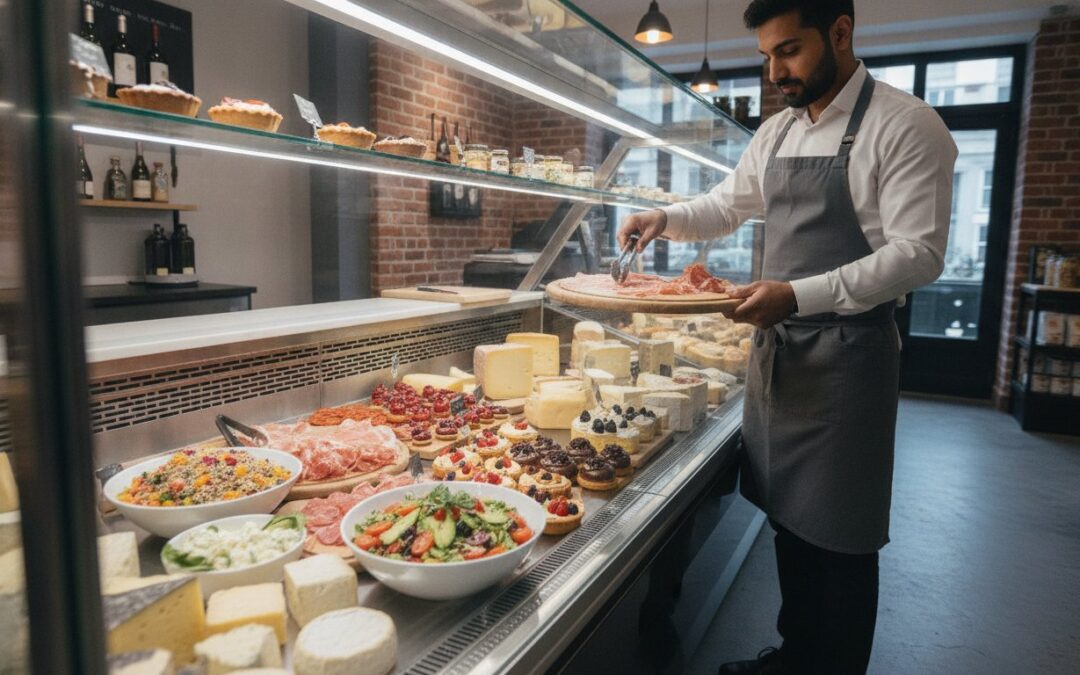
What if your most popular deli selection was losing half of its appeal simply because of the bulbs above it? It’s a common frustration for retailers; you’ve perfected your craft, yet standard illumination often makes fresh produce look dull and uninviting while generating heat that compromises your cooling system. At TFSE Products Ltd, we specialise in engineering the best lighting for food display counters to ensure your display attracts impulse buys while meeting strict UK safety standards.
This guide explores how to optimise your food presentation through expert lighting strategies that enhance visual appeal and protect food quality. You’ll learn how to leverage high Color Rendering Index (CRI) LEDs and smart thermal management to protect your margins and your stock. We’ll walk you through the essential specifications required for modern commercial environments, from engineering efficiency to selecting the exact colour temperatures that make your specific offerings shine.
Key Takeaways
- Understand how colour temperature (Kelvin) and high CRI ratings directly influence customer psychology to drive higher impulse sales at the point of purchase.
- Discover why the best lighting for food display counters must utilise “cold-light” LED technology to prevent heat-induced spoilage and extend the shelf life of fresh produce.
- Learn how to tailor the light spectrum to specific food categories to highlight natural textures while avoiding light-induced oxidation in sensitive deli and patisserie items.
- Identify why planning your illumination during the initial CAD modelling phase is essential for eliminating distracting glare and ensuring a seamless finish for bespoke units.
- Gain clarity on how UK-manufactured displays integrate energy-efficient lighting to meet rigorous safety standards while maintaining a high-end, artisanal aesthetic.
The Science of Visual Appeal: Kelvin, CRI, and Merchandising
Effective merchandising relies on more than just the quality of your ingredients. It’s about how those ingredients are perceived the moment a customer looks at your display. Lighting serves as the primary driver of “eye-appeal” in commercial food retail, acting as a silent salesman that highlights texture, freshness, and quality. Finding the best lighting for food display counters requires a technical understanding of the light spectrum to ensure your products look authentic rather than artificial. When lighting is engineered correctly, it reduces the visual barrier created by glass, making the food appear within reach rather than tucked away behind a pane.
Understanding Colour Temperature (Kelvin) for Food
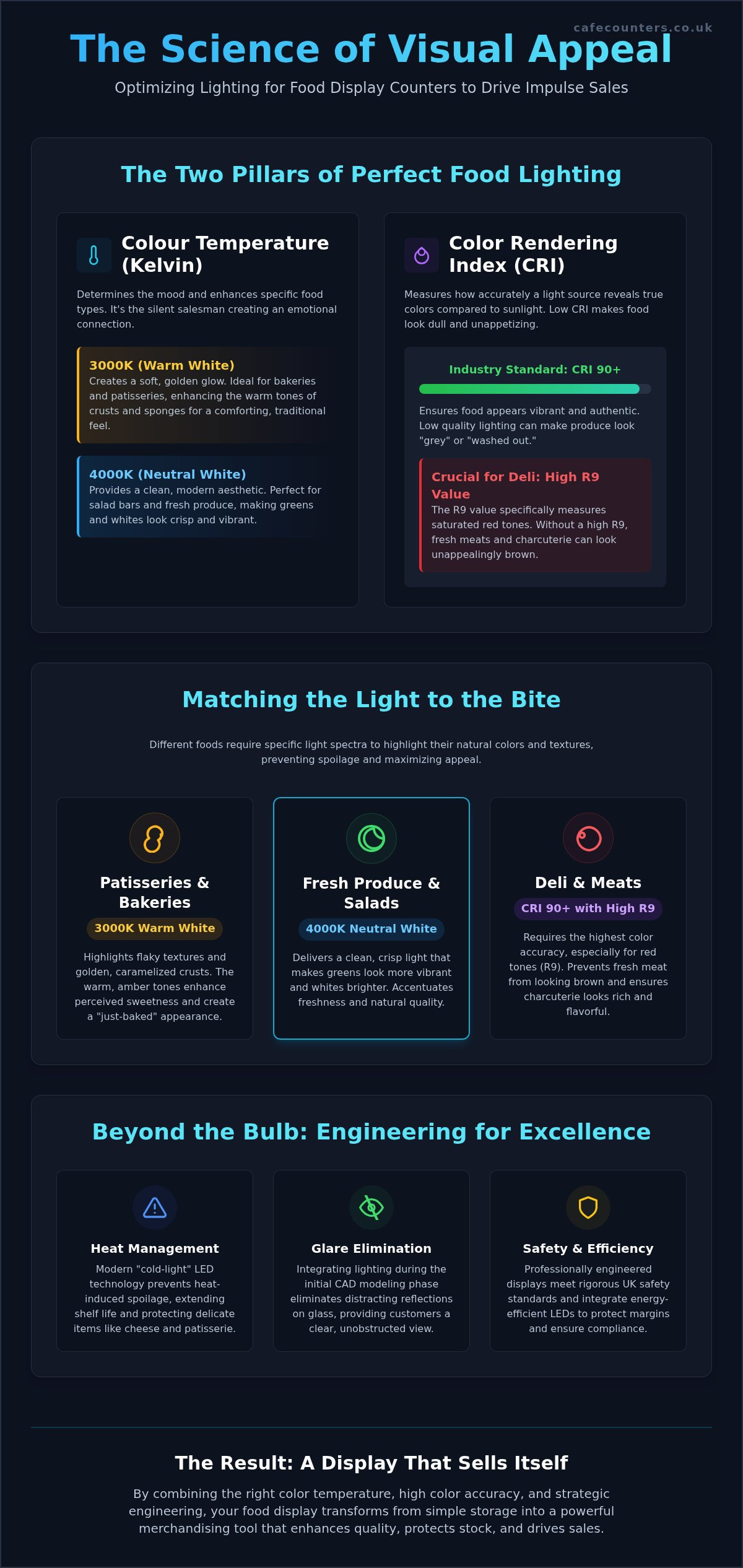
Colour temperature, measured in Kelvin (K), dictates the emotional and psychological atmosphere of your retail space. For artisanal bakeries and patisseries, 3000K (Warm White) is the preferred choice. This temperature emits a soft, golden glow that enhances the browns and yellows of crusts and sponges, creating a sense of comfort and traditional craftsmanship. It invites customers to linger and browse.
In contrast, 4000K (Neutral White) provides a clean, modern, and almost clinical aesthetic. It’s the ideal setting for salad bars or fresh produce counters where you want greens and whites to look crisp and vibrant. For mixed-use grab-and-go units, the “sweet spot” often sits between these two. When we design the best lighting for food display counters, we often utilise a balanced spectrum to ensure that a sandwich looks just as appetising as the fruit pot sitting beside it.
Why CRI 90+ is the Industry Standard for Food
The Color Rendering Index (CRI) is a measure of how accurately a light source reveals colours compared to natural sunlight. In the food industry, a CRI of 90 or higher is essential. Low-quality lighting often makes food look “grey” or “washed out” because it lacks the full spectral range needed to reflect the food’s true pigments. This is particularly problematic in deli counters where the R9 value is critical. The R9 value specifically measures the rendering of saturated red tones. Without a high R9 rating, fresh meats and charcuterie can look unappealingly brown under standard lights.
At TFSE Products Ltd, we’ve spent 35 years refining how we integrate these technical specifications into our designs. We don’t just add lights as an afterthought. We treat them as a precision engineering component. By planning the light placement at the CAD modelling stage, we can eliminate distracting reflections and glare. This ensures that the only thing your customer sees is the vibrant, authentic colour of your food, presented exactly as you intended.
Tailoring the Light Spectrum to Specific Food Categories
A common misconception in retail design is that generic bright light is sufficient for all food types. In reality, the best lighting for food display counters is highly specialised, with spectral peaks tailored to the chemical composition and colour profile of the specific products on show. Using the wrong light doesn’t just make food look unappealing; it can lead to light-induced oxidation. This process occurs when UV rays and heat accelerate the spoilage of sensitive fats and proteins, shortening your shelf life. To ensure safety and visual excellence, operators should refer to established guidelines like the FDA Food Code lighting standards, which specify minimum intensity levels for safe food handling and display.
Balancing high-intensity accent lighting with your shop’s ambient illumination is a delicate task. If the counter is too bright compared to the surrounding room, it creates uncomfortable glare. If it’s too dim, your premium products look flat and lose their “buy me” appeal. Our team focuses on this synergy during the CAD design phase to ensure your display remains the focal point of the room without overwhelming the customer’s senses.
Patisseries and Bakeries: The Warmth of Gold
Pastry merchandising relies on the interplay of shadow and light to highlight flaky textures and golden, caramelised crusts. Integrating precision lighting into patisserie display counters allows you to use warm, amber-leaning tones that enhance the perceived sweetness and richness of cakes. These warm spectra make glazes shimmer and give doughs a “just-baked” appearance that attracts impulse buyers. It’s about creating an emotional connection with the product through visual warmth, making every croissant look as though it’s just left the oven.
Deli and Meat Displays: Vibrancy and Freshness
Deli products require a vastly different approach. For fresh meats, specialised LEDs with a subtle pink spectrum are often used to naturally enhance the redness of the protein without making the fat appear yellow or aged. When designing deli display counters, we also consider the specific needs of salad bars and sushi sections, where cool-white lighting is essential. This cooler light makes greens look crisper and ensures that white seafood appears clean and fresh. Consistency across these bespoke sections is vital to prevent jarring visual transitions that can distract a customer from the quality of your offering.
Achieving this level of detail requires a partner who understands both the physics of light and the practicalities of food service. If you are planning a new layout, exploring our range of bespoke serving counters can help you find the right technical balance for your specific menu and brand identity.
Engineering Efficiency: Heat Management and LED Technology
The shift to LED technology represents one of the most significant advancements in commercial food display. While the energy savings are well-documented, the primary benefit for high-end retail lies in thermal management. Halogen bulbs, once the industry standard, convert roughly 90% of their energy into heat. This creates a microclimate within the display that can compromise the delicate balance of moisture and temperature required for fresh food. By selecting the best lighting for food display counters, operators can eliminate this unwanted heat source, ensuring that the visual presentation doesn’t come at the cost of product integrity.
LEDs and Refrigeration Performance
In a chilled environment, every degree matters. “Cold-light” LEDs emit almost no infrared radiation, which means they don’t warm the surface of the food they illuminate. This is vital for commercial refrigerators, as it significantly reduces the strain on compressors. When your lighting isn’t fighting against your cooling system, the equipment runs more efficiently and experiences less mechanical wear over time. Additionally, LED components thrive in cold environments, often lasting longer than they would in ambient temperatures, which reduces maintenance cycles for your bespoke units.
Heated Displays and Gantry Lighting
The engineering requirements change when dealing with Vision Heated Counters. In these environments, heated gantries must perform a dual role: providing high-quality illumination while assisting in temperature maintenance. The challenge lies in selecting bulbs and fixtures that can withstand high ambient temperatures without flickering or losing their colour accuracy. We focus on the psychology of food lighting to ensure that hot food looks succulent and fresh, rather than dried out under harsh beams. Strategic light placement ensures even heat distribution across the gantry, preventing cold spots that could compromise food safety.
Investing in professional-grade lighting is a decision that impacts long-term operational profit. Lower energy consumption is the immediate benefit, but the true value is found in reduced food waste and extended shelf life. By integrating these energy-efficient technologies into our UK-based manufacturing process, we provide a steady, reliable hand for businesses aiming for both sustainability and visual excellence. This methodical approach to design ensures that every physical space we build is as practical as it is beautiful.
Strategic Integration in Bespoke Counter Design
The physical integration of illumination is where high-end design meets long-term durability. At TFSE Products Ltd, we don’t treat lighting as a final accessory or an afterthought. Instead, it’s a structural component that must be planned from the very first sketch. The best lighting for food display counters is only effective if it’s positioned to illuminate the product without creating distracting reflections on the glass. By considering the angles of the shelving and the curvature of the glass fronts during the design phase, we can ensure a clear line of sight that makes your products the undisputed hero of the display.
CAD Modelling and Light Placement
Using advanced 3D modelling, we can predict exactly how light will interact with the physical surfaces of the unit. This allows us to identify potential “hot spots” or areas of deep shadow before a single piece of steel is cut in our UK facility. Custom brackets are often engineered for specialised lighting gantries to ensure the fixtures remain stable and discreet, even in high-traffic environments. By accounting for electrical routing within the stainless steel fabrications at the design stage, we maintain a clean, professional aesthetic where no wires are visible to the customer. This methodical approach ensures that the internal production of your unit is as tidy as the outward presentation.
Ergonomics and Customer Experience
Ergonomics play a vital role in the commercial success of any retail space. We angle our fixtures with precision to avoid blinding customers or staff, ensuring the light stays focused entirely on the food. Creating “visual paths” through the display helps manage the customer journey and encourages upselling at the point of purchase. Zoning with light acts as a silent guide, directing the customer’s eye towards high-margin items or new seasonal specials. This level of detail is standard in our bespoke cafe counters, where every millimetre is designed for both visual impact and operational performance.
Choosing between under-shelf lighting and gantry-mounted options depends on the specific needs of your menu. Under-shelf LEDs provide a subtle, premium glow that emphasizes the depth of a patisserie selection, while gantry-mounted lights offer the direct intensity required for deli or heated sections. If you’re looking to elevate your retail space with a custom solution that balances technical expertise with artisanal quality, explore our full range of bespoke serving counters and displays today.
Implementing Professional Lighting with TFSE Products
UK Standards and Quality Assurance
Adhering to UK electrical safety and food hygiene regulations is non-negotiable in professional environments. Off-the-shelf lighting kits often lack the durability required for high-traffic retail spaces and may not meet the rigorous IP ratings needed for refrigerated or humid displays. Our bespoke solutions are engineered to withstand daily cleaning and constant operation, providing a reliable hand for your business for years to come. We select professional-grade components that are tested for long-term performance, ensuring your investment remains protected against the rigours of a busy commercial kitchen or storefront.
Planning Your Lighting Strategy
Before commissioning a new counter build, you should evaluate your current shop floor lighting environment. Ambient light from windows or overhead fixtures can significantly impact how your display appears to customers. Think about the specific “zoning” of your shop and identify where you want to draw the most attention. Our team provides expert guidance during this phase, helping you understand the technical requirements and what to ask for in a bespoke build to ensure the best lighting for food display counters is achieved.
If you’re ready to transform your food presentation, the first step is a professional assessment. We invite you to contact us for a comprehensive site survey and consultation. Our experts will walk you through the technical details, from spectral peaks to thermal management, ensuring your vision is brought to life with precision and quality.
Elevating Your Retail Presentation with Precision Engineering
Mastering the best lighting for food display counters requires a meticulous balance of visual psychology and thermal management. You’ve seen how specific colour temperatures and high CRI ratings can transform standard produce into vibrant, appetising displays that capture customer attention at the point of sale. By utilising “cold-light” LED technology, you don’t just reduce energy costs; you actively protect the shelf life of your stock and ensure your refrigeration systems operate at peak efficiency. These technical considerations are most effective when they’re woven into the fabric of your display during the initial design phase.
At TFSE Products, we combine 35 years of industry experience with a CAD-led bespoke design process to bring your vision to life. Our UK-based manufacturing facility ensures that every unit meets the highest standards of quality and electrical safety. From the initial site survey through to full installation and commissioning, we act as your expert partner in creating a high-performance retail environment. If you’re ready to optimise your food presentation and drive operational profit, we invite you to request a bespoke counter consultation from TFSE Products Ltd. We look forward to helping you build a space that reflects the true quality of your artisanal offerings.
Frequently Asked Questions
What is the best Kelvin temperature for a bakery display?
3000K (Warm White) is the industry standard for bakery displays because it enhances the golden, caramelised tones of fresh bread and pastries. This warmer spectrum creates an inviting, artisanal atmosphere that resonates with customers. While cooler temperatures can make dough look pale or unappealing, 3000K provides a rich glow that emphasizes texture and perceived sweetness. It’s the ideal choice for showcasing traditional craftsmanship in a retail environment.
Does LED lighting produce heat that can damage refrigerated food?
LED lighting emits negligible infrared radiation, meaning it doesn’t warm the surface of your products like traditional halogen bulbs do. This “cold-light” characteristic is vital for maintaining the core temperature of refrigerated goods and preventing premature spoilage. By using the best lighting for food display counters, you reduce the thermal load on your compressors. This leads to more stable cooling cycles and significantly better energy efficiency across your entire display.
What does CRI stand for and why does it matter for food?
CRI stands for Colour Rendering Index, a scale from 0 to 100 that measures how accurately a light source reveals an object’s true colours compared to natural sunlight. For food displays, a CRI of 90 or higher is essential to prevent products from looking dull or grey. High CRI lighting ensures that the deep reds of a deli counter or the vibrant greens of a salad bar look authentic and appetising to the customer’s eye.
Can I retrofit LED lighting into my existing food counters?
You can retrofit LED strips into many existing units, though professional integration during the manufacturing phase yields far superior results. Retrofitting often requires careful consideration of electrical safety, moisture resistance, and heat dissipation within the old housing. While it’s a viable way to improve energy efficiency, a bespoke build allows for precise light placement and hidden wiring. This ensures a seamless, professional finish that off-the-shelf kits often fail to provide.
How does lighting affect impulse sales in grab-and-go units?
Effective lighting acts as a visual magnet that directs the customer’s attention toward specific products, significantly increasing impulse sales in grab-and-go units. By using high-intensity accent lighting, you can create “visual paths” that guide shoppers toward high-margin items. When food looks vibrant and fresh under the best lighting for food display counters, customers feel more confident in the quality of their purchase. This psychological trigger is a key driver for quick retail decisions.
Are there specific UK regulations for lighting in food displays?
Lighting in UK food displays must adhere to BS 7671 electrical safety standards and general food hygiene regulations regarding cleanability and shatter protection. Fixtures should be easy to sanitise and designed to prevent the accumulation of dust or debris. In refrigerated environments, using correctly rated IP (Ingress Protection) lighting is also a requirement to ensure the electronics remain safe in humid conditions. Our UK-based manufacturing process ensures every unit meets these rigorous professional standards.
What is the difference between accent lighting and ambient lighting in a cafe?
Ambient lighting refers to the general illumination of your cafe, which sets the overall mood and ensures safe movement for customers. Accent lighting is highly targeted and much more intense, focusing exclusively on the products within your display counters. The goal is to create a contrast that makes the food stand out as the focal point of the room. Balancing these two layers prevents glare while ensuring your premium offerings are never lost in the shadows.