

Did you know that the initial sticker price of a new deli counter or patisserie display represents just 20% of its lifetime cost? For UK operators, understanding the total cost of ownership commercial refrigeration involves looking far beyond the showroom floor to the decade of operation that follows. It’s a stressful time to manage a food business, especially with average commercial electricity prices sitting between 22p and 30p per kWh in 2026. You’re likely tired of seeing profits evaporate into high utility bills or, worse, into the bin when a poorly constructed unit fails and spoils your stock.
This guide promises to show you how to optimise the long-term profitability of your food display equipment by selecting assets built for durability rather than just a low entry price. We’ll examine the impact of energy-efficient technologies, the benefits of UK-based manufacturing for reducing downtime, and how advanced CAD modelling prevents the hidden costs of fitment failure. By the end, you’ll have a clear roadmap to securing reliable equipment with a high-quality aesthetic that lasts for a decade or more.
Key Takeaways
- Learn why the initial purchase price is merely the tip of the iceberg and how to account for the 80% of expenses that occur after your equipment is installed.
- Discover how to use EcoDesign labels and energy data to calculate a true payback period, ensuring your monthly utility bills remain manageable.
- Understand the strategic role of advanced CAD modelling and UK-based manufacturing in eliminating “fitment failure” and reducing long-term maintenance costs.
- Develop a professional evaluation framework to assess the total cost of ownership commercial refrigeration across different equipment bids.
- Identify the functional benefits of partnering with a manufacturer that provides end-to-end project management, from initial design through to technical commissioning.
Understanding Total Cost of Ownership (TCO) in Commercial Refrigeration
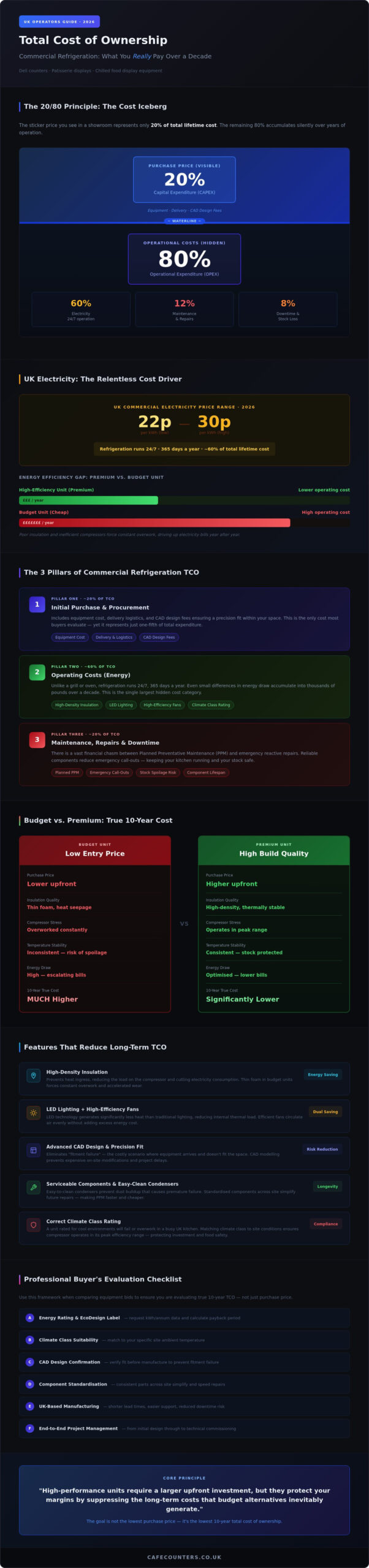
When you invest in a new Deli Counter or Patisserie Display, the initial invoice often feels like the final hurdle. However, savvy UK operators recognise that the purchase price is merely the visible tip of a much larger financial iceberg. To manage a profitable kitchen or retail space, your procurement team must shift focus from Capital Expenditure (CAPEX) to Operational Expenditure (OPEX). This transition requires a deep dive into the Total Cost of Ownership (TCO), which accounts for every penny spent over the machine’s functional life.
Industry data suggests a clear 20/80 principle; the initial acquisition typically accounts for only 20% of the lifetime cost, while the remaining 80% is consumed by energy, maintenance, and repairs. For a modern UK hospitality business, this reality dictates the health of your Profit and Loss (P&L) statement. High-performance units might require a larger upfront investment, but they protect your margins by suppressing the long-term costs that budget alternatives inevitably generate. TCO is the comprehensive financial impact of an asset from acquisition to decommissioning.
The Components of Commercial Refrigeration TCO
Evaluating the total cost of ownership commercial refrigeration requires looking at three distinct pillars that define your long-term success. Our internal production facilities focus on these details because we understand that precision manufacturing leads to more reliable business operations.
- Initial Purchase and Procurement: This stage includes the equipment cost, delivery logistics, and the critical CAD design fees that ensure a precision fit within your space.
- Operating Costs: Unlike a grill or oven, refrigeration runs 24/7, 365 days a year. Even small differences in energy draw accumulate into thousands of pounds over a decade.
- Maintenance and Repairs: There is a vast financial chasm between Planned Preventative Maintenance (PPM) and emergency reactive repairs. Reliable components reduce the frequency of the latter, keeping your kitchen running without interruption.
The Hidden Cost of “Cheap” Equipment
Budget-oriented units often hide their true cost behind poor insulation and inefficient compressors. These components struggle to maintain thermal stability, leading to excessive energy draw and accelerated wear. Beyond the electricity bill, inconsistent temperature control poses a severe risk to your stock. The financial impact of food spoilage can quickly outweigh any savings made during the initial purchase. Choosing equipment with superior build quality ensures your aesthetic remains high-end while your operational costs stay grounded.
The Major Cost Drivers: Energy, Maintenance, and Downtime
Understanding the total cost of ownership commercial refrigeration requires a clear-eyed look at the daily expenses that follow the initial installation. Energy costs are relentless. With UK businesses paying between 22p and 30p per kWh in 2026, the 24/7 nature of refrigeration makes it one of the largest line items on your utility bill. Roughly 60% of a unit’s lifetime cost is consumed by electricity alone. This is why selecting energy-efficient commercial refrigeration isn’t just a sustainability choice; it’s a vital financial strategy to protect your margins.
Energy Consumption: The 24/7 Utility Burden
Efficient thermal integrity starts with high-density insulation. Cheap units often use thinner foam that allows heat to seep in, forcing the compressor to work harder. We focus on technical precision by integrating high-efficiency fans and LED lighting, which significantly reduce the heat load within the unit. It’s also essential to check Climate Class ratings; a unit designed for a cool environment will fail or overwork in a busy UK kitchen or high-traffic retail space. By matching the equipment to your specific site conditions, you ensure the compressor operates within its peak efficiency range.
Maintenance and Longevity
High-quality components are built for serviceability. Easy-to-clean condensers are a hallmark of professional design because they prevent the dust buildup that causes premature failure. When you standardise components across your site, future repairs become simpler and faster. Some industry professionals report that regular preventative maintenance reduces emergency call-out fees by up to 50% over the life of the asset. Our UK-based manufacturing facility ensures that replacement parts are readily available, which is a significant advantage over waiting for international shipments during a breakdown. If you’re looking to upgrade, you can consult with our design team to see how precision fitment reduces these long-term burdens.
The cost of downtime is perhaps the most painful driver. If your deli counter goes offline on a Saturday afternoon, the repair bill is only the beginning. You face immediate revenue loss from missed impulse sales and the potential waste of expensive fresh stock. Beyond total failure, poor merchandising performance also costs you money. Fogged glass or dim lighting in a display unit discourages customers and reduces the perceived value of your products. A high-quality aesthetic that remains clear and bright for a decade is a fundamental part of the total cost of ownership commercial refrigeration equation.
How Bespoke Design and UK Manufacturing Lower Long-Term Costs
Standardised, off-the-shelf units often present an attractive entry price, but they frequently lead to “fitment failure”—a scenario where equipment doesn’t quite align with site services or architectural constraints. When you opt for bespoke cafe counters, you eliminate the hidden costs of site rework and modification. These last-minute adjustments on-site are expensive and often compromise the unit’s structural integrity. By contrast, precision engineering ensures the equipment performs exactly as intended from day one, directly influencing the total cost of ownership by preventing early-stage remedial work.
The Role of CAD Modelling in Cost Reduction
Our design process relies on advanced CAD modelling to bridge the gap between a conceptual vision and a physical space. This technical foresight allows us to identify potential issues before a single sheet of stainless steel is cut. By visualising the workflow, we prevent ergonomic inefficiencies that slow down your staff and inflate labour costs over time. Precision planning is a fundamental tool for managing the total cost of ownership commercial refrigeration.
- Workflow Visualisation: We design layouts that minimise staff movement, reducing fatigue and improving service speed.
- Technical Integration: CAD allows for the seamless placement of refrigerated and heated components within a single counter, ensuring thermal barriers are perfectly placed.
- Reduced Installation Time: Detailed site surveys mean our teams arrive with equipment that fits to the millimetre, minimising business disruption.
Logistical Advantages of British Manufacturing
Operating a UK-based manufacturing facility provides a level of supply chain resilience that imported alternatives cannot match. When a component eventually requires replacement, the speed of response determines your ultimate loss. UK-made equipment significantly lowers the total cost of ownership commercial refrigeration by simplifying the repair cycle and ensuring your display remains operational during peak periods.
- Spare Parts Availability: We hold components in stock, eliminating the weeks of lead time often associated with overseas shipping.
- Expert Support: You gain direct access to manufacturer-trained engineers who understand the specific nuances of your bespoke build.
- Environmental Efficiency: Sourcing locally reduces transport costs and the overall carbon footprint of your project, aligning with modern sustainability targets.
Durability is the final pillar of cost reduction. We select high-grade stainless steel and robust finishes designed to withstand the rigours of a high-traffic commercial environment. These material choices ensure your investment maintains its aesthetic appeal and functional performance for a decade, rather than requiring a costly refresh after just a few years of service. It’s about building for the long term, ensuring every component justifies its place on your balance sheet.
Evaluating Equipment: A Framework for Professional Buyers
Professional procurement requires a structured scorecard to assess the total cost of ownership commercial refrigeration. Looking at a quote’s bottom line is a starting point, but it rarely reflects the true financial impact over a ten-year cycle. You should weigh initial costs against projected energy usage and the robustness of the after-sales support provided by the manufacturer. A thorough evaluation ensures that your investment supports long-term profitability rather than becoming a recurring drain on your maintenance budget.
Comparing the “Cheap” vs. “Premium” Investment
Comparing a budget patisserie display counter with a high-efficiency UK-manufactured unit reveals a stark difference in long-term value. While the entry price of a mass-produced unit is lower, factoring in even a single major repair outside the warranty period often erases those initial savings. You must also consider “Merchandising Value”. A premium unit with superior lighting and glass clarity drives higher impulse sales, contributing to the unit’s payback period in ways a basic technical datasheet might miss. If a unit looks dated or performs poorly within three years, the cost of a premature replacement destroys your original ROI.
Questions to Ask Your Equipment Manufacturer
Before committing to a project, probe the technical depth of your partner. Ask about the expected lifespan of the compressor and fans under your specific site conditions. It’s vital to know if spare parts are non-proprietary or readily available within the UK to avoid weeks of downtime. Our display range incorporates high-density insulation and low-energy fans to ensure thermal integrity while minimising daily electricity draw. You should also verify what is actually included in the service agreement; a comprehensive after-sales package should offer manufacturer-trained engineers who can provide commissioning and technical support.
Finally, consider the end-of-life responsibilities and decommissioning costs. UK F-gas regulations require meticulous record-keeping for at least five years for equipment containing 5 tonnes CO2 equivalent or more. A reliable partner will guide you through this process, ensuring environmental compliance and manageable disposal costs when the unit eventually reaches the end of its service life. If you need assistance building your own evaluation framework, you can contact our technical consultants for a detailed site survey and TCO analysis.
Strategic Investment: Choosing the Right Partner for Your Fit-Out
Selecting the right partner is the final, most critical step in managing the total cost of ownership commercial refrigeration. A transactional purchase often leaves operators stranded once the equipment arrives at the kerbside, leading to unnecessary stress and potential installation errors. In contrast, an Expert Partner manages the entire lifecycle, from the initial CAD survey through to the final commissioning. This end-to-end oversight ensures that your refrigerated grab and go display units aren’t just standalone assets; they’re integrated components of a cohesive customer flow that maximises revenue. Our internal production facilities allow us to maintain total control over quality, providing you with a steady, reliable hand in a complex field.
Installation and Commissioning
Technical excellence during the installation phase is non-negotiable for long-term reliability. Professional commissioning is vital for maintaining warranty validity, as it confirms the unit is operating within the manufacturer’s specified parameters. Our engineers pay meticulous attention to airflow and ventilation. If a compressor is starved of air due to poor positioning, it will run hot, consume more energy, and fail prematurely. Professional commissioning includes several critical checks:
- Verification of refrigerant charge levels to ensure optimal cooling capacity.
- Assessment of local ventilation to prevent heat buildup around the condenser.
- Testing of digital controllers to match the specific thermal needs of your stock.
We also believe in empowering your team through knowledge. Training staff on basic maintenance, such as cleaning condensers and checking door seals, significantly extends the life of the equipment and prevents the hidden costs of neglect.
Bespoke Solutions for Unique Spaces
Every site has unique challenges, from high ambient temperatures in busy kitchens to awkward architectural footprints in historic buildings. Standard units often struggle in these environments, leading to higher operational costs and frequent breakdowns. By tailoring equipment to the specific ambient conditions of your site, we ensure peak performance year-round. Our custom Vision Heated Counters or refrigerated units are designed to solve these specific space constraints. This level of customisation protects your total cost of ownership commercial refrigeration by eliminating the need for expensive future modifications or remedial site work.
The relationship shouldn’t end at the point of sale. A long-term partnership provides the technical expertise required to bring your vision to life and keep it running efficiently for a decade. Consult with our experts to design your high-efficiency counter solution.
Securing Long-Term Profitability through Precision Engineering
Managing the total cost of ownership commercial refrigeration is a strategic necessity for any UK food operator looking to protect their bottom line. By shifting your focus from the initial invoice to the long-term operational impact, you ensure that your display equipment remains a high-performing asset rather than a recurring liability. We’ve explored how energy efficiency, UK-based manufacturing, and precision CAD modelling work together to suppress overheads and eliminate the hidden costs of equipment failure. These elements are the foundation of a resilient business model.
Our team is ready to help you navigate these complexities with total confidence. We combine our regional artisanal pride with advanced technical expertise to deliver high-performance, energy-efficient display units tailored to your unique space. From initial site surveys to professional commissioning, we act as your expert partner throughout the entire process. Contact TFSE Products for a Bespoke Counter Consultation and let’s bring your vision to life with equipment built to last a decade. Your path to a more profitable and reliable retail environment starts with a single, well-informed choice.
Frequently Asked Questions
What is the 20/80 rule in commercial refrigeration TCO?
The 20/80 rule states that the initial purchase price of your equipment typically represents only 20% of its lifetime financial impact. The remaining 80% is consumed by ongoing operational expenses like energy bills, maintenance, and repairs over a decade of use. Understanding this principle is vital for calculating the total cost of ownership commercial refrigeration accurately. It encourages operators to invest in higher-quality units that lower the 80% portion through better efficiency and reliability.
How much can energy-efficient refrigeration save my business?
Energy-efficient models can reduce electricity consumption by 30% to 50% compared to older or budget units. With UK commercial electricity prices averaging between 22p and 30p per kWh in 2026, these savings directly impact your monthly overheads. Choosing an A-rated unit protects your margins against rising utility costs. Over a ten-year lifespan, the reduction in energy draw often pays back the initial investment premium several times over through lower utility bills.
Does a bespoke counter always have a higher TCO than a standard unit?
Not necessarily, as bespoke design often results in a lower lifetime cost by preventing fitment failure. Standard units frequently require expensive site modifications or remedial work to integrate with existing services. A custom-built counter is engineered specifically for your site’s ambient conditions and workflow, reducing compressor strain and staff inefficiency. By avoiding these hidden installation and operational costs, a bespoke solution often proves more economical than a seemingly cheaper off-the-shelf alternative.
Why is British manufacturing important for commercial refrigeration TCO?
British manufacturing provides a significant logistical advantage by ensuring faster access to engineers and replacement parts. When a unit fails, the cost of downtime and food waste can be catastrophic for a hospitality business. Sourcing from a UK facility eliminates the weeks of lead time associated with importing specialised components from overseas. This regional resilience keeps your equipment operational and minimises the expensive revenue losses that occur during prolonged repair cycles.
What is the typical lifespan of a professional food display counter?
A high-quality professional food display counter is typically designed to last for a decade or more when properly maintained. While budget units might show signs of structural or mechanical fatigue within three to five years, premium equipment utilizes more durable materials like high-grade stainless steel. The longevity of the asset is a core component of the total cost of ownership commercial refrigeration. Investing in durability ensures you don’t face the premature cost of a full replacement.
How does CAD modelling help reduce the total cost of ownership?
CAD modelling reduces costs by identifying technical conflicts before the manufacturing process begins. It allows our designers to verify that refrigerated and heated components fit perfectly within your architectural constraints, preventing expensive on-site rework. This precision planning also optimises staff ergonomics and customer flow, which improves operational speed. By ensuring a right-first-time installation, CAD surveys eliminate the wasted labour and material costs often associated with poorly planned equipment fit-outs.
Can preventative maintenance really lower my long-term costs?
Yes, planned preventative maintenance can reduce emergency call-out fees by up to 50% over the life of the unit. Regular servicing ensures that condensers remain clean and fans operate efficiently, preventing the compressor from overworking and failing prematurely. While a reactive repair involves high attendance fees and potential stock loss, a scheduled contract provides predictable costs. This proactive approach extends the functional life of your equipment and maintains its peak energy efficiency.
What should I look for on an EcoDesign energy label?
Focus on the energy efficiency class and the annual energy consumption figure, which allows for a direct comparison between different models. You should also check the Climate Class rating to ensure the unit can maintain temperatures in your specific environment. A unit rated for a lower climate class will struggle in a hot UK kitchen, leading to excessive energy draw and potential component failure. These labels provide the data necessary to forecast long-term utility expenses accurately.