
What if the bespoke counter designed to showcase your finest products is the very thing putting your business at risk during a health inspection? It’s a stressful reality for many operators who find that a surface chosen for its aesthetic appeal is actually a porous trap for bacteria and stubborn stains. You shouldn’t have to choose between a premium front-of-house look and the uncompromising demands of food safety. We understand that balancing high-end style with the harsh reality of daily commercial cleaning is one of the most difficult aspects of designing a professional space.
This guide explores the essential hygienic materials for food service that bridge the gap between artisanal design and practical durability. You’ll learn how to select surfaces that are compliant with the latest NSF/ANSI 51-2025 standards and engineered for long-term operational efficiency. We provide a clear framework for choosing materials that protect your reputation, streamline your cleaning routines, and give you total confidence in your facility’s hygiene. From Grade 304 stainless steel back-bar units to precision-engineered display cases, discover how the right design choices turn your counter into a foundation for safety and success.
Key Takeaways
- Learn why non-porous, corrosion-resistant surfaces are essential for maintaining long-term food safety and passing health inspections.
- Understand the technical advantages of Grade 304 stainless steel and how its self-healing properties ensure a durable, sterile environment.
- Discover how to select hygienic materials for food service that perfectly balance a high-end visual style with the practicalities of deep cleaning.
- Identify the specific design features, such as internal radius corners and sealed kick-plates, that prevent debris accumulation in hidden areas.
- Explore how precision CAD modelling and bespoke UK manufacturing create gap-free installations for maximum hygiene control.
The Foundation of Food Safety: Why Material Choice Matters
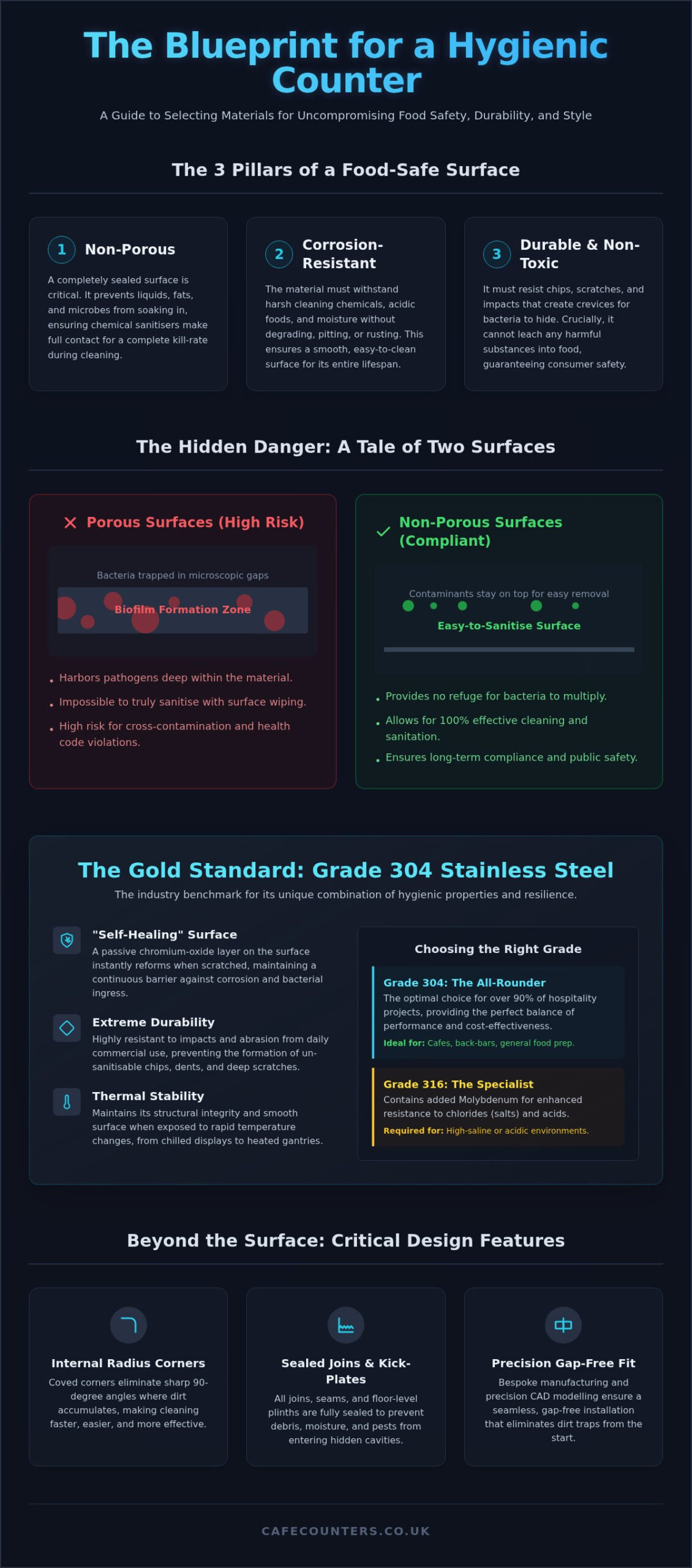
Food safety starts at the molecular level. For a material to be classified as food-grade, it must satisfy three core criteria: it must be non-porous, non-toxic, and resistant to corrosion. In the UK, the Food Standards Agency (FSA) provides the regulatory framework that dictates how these surfaces should perform. They require that any area where food is prepared or served must be maintained in a sound condition and be easy to clean. Selecting the right hygienic materials for food service isn’t just a matter of following the rules; it’s about preventing the formation of biofilms. These are complex colonies of bacteria that adhere to surfaces, creating a protective layer that resists standard wiping. If your material choice allows these colonies to take root, no amount of surface spray will truly sanitise your environment.
Choosing between different Countertop materials requires an understanding of how they interact with liquids and microbes. While natural wood or low-grade laminates might offer a rustic charm, their microscopic structure is often their downfall in a commercial setting.
Non-Porous vs. Porous Surfaces
Porous materials contain microscopic gaps that act as reservoirs for moisture, fats, and proteins. Untreated wood is a primary offender here. Even if it looks clean to the naked eye, the internal grain can harbour pathogens that multiply rapidly. High-quality hygienic materials for food service are engineered to have high surface tension. This physical property ensures that liquids stay on the surface rather than soaking in. It allows chemical sanitisers to make full contact with every millimetre of the material, ensuring a complete kill-rate during cleaning cycles. This resistance is vital when your staff are performing rapid turnarounds between service periods.
Durability and Food Safety Compliance
True food safety is inseparable from durability. In a high-traffic commercial environment, surfaces are subjected to constant impact, heat, and abrasive cleaning. This is where domestic-grade materials fail. A small chip in a laminate edge or a deep scratch in a soft resin isn’t just an eyesore. It’s a new, un-sanitisable crevice where bacteria can thrive undisturbed. We focus on materials that offer superior impact resistance to prevent these structural failures. By choosing commercial-grade fabrication, you ensure your counters remain smooth and impermeable for years. This longevity is the hallmark of a professional installation that respects both the budget and the safety of the end consumer. It’s about building a space that remains compliant from the first day of service to the thousandth.
Stainless Steel: The Gold Standard for Hygienic Food Service
Stainless steel has long been the industry benchmark for a reason. Its unique atomic structure makes it one of the most reliable hygienic materials for food service available today. Specifically, Grade 304 stainless steel is the preferred choice for commercial environments due to its high chromium and nickel content. This composition creates a passive, chromium oxide layer on the surface. If the metal is scratched or abraded, this layer reacts with oxygen to reform almost instantly. This “self-healing” property ensures that the material remains protected against corrosion and bacterial ingress even under heavy daily use. It’s a level of resilience that domestic materials simply cannot match.
The thermal resistance of quality steel is equally vital. In a busy kitchen or front-of-house service area, surfaces must handle the transition from chilled displays to heated gantries without warping or degrading. Because stainless steel is non-porous and thermally stable, it supports the FDA’s foundational four simple steps: clean, separate, cook, and chill by providing a surface that is easy to sanitise at any temperature. This durability makes it a sustainable long-term investment, as a well-maintained counter can last for decades without requiring replacement.
Grade 304 vs. Grade 316 Stainless Steel
While Grade 304 is the standard, certain environments require the added molybdenum found in Grade 316. This grade offers enhanced resistance to chlorides, making it essential for high-saline environments or kitchens that process large amounts of acidic ingredients. However, for the vast majority of hospitality projects, the 300-series provides the perfect balance of performance and value. Due to its exceptional balance of durability and cost-effectiveness, Grade 304 is the optimal choice for most stainless steel back-bar units.
Fabrication Excellence: Seamless Welding
The hygiene of a counter is determined as much by its construction as its material. At TFSE, we emphasise the importance of continuous, polished welds. Unlike “flat-pack” equipment that relies on mechanical fixings and gaskets, bespoke fabrication eliminates the tiny gaps where food debris and bacteria accumulate. Our UK-based manufacturing facility uses advanced techniques to ensure every joint is smooth to the touch and easy to wipe clean. Beyond the functional benefits, this level of craftsmanship allows for a range of finishes. You might choose a brushed finish to hide fingerprints in high-traffic areas or a mirror-polished edge to enhance the premium feel of your bespoke serving counters.
Evaluating Counter-top Materials: Style Meets Sanitation
Thermal stability is a critical factor when integrating equipment like Vision Heated Counters. If a surface cannot handle the localised heat from a display unit or a hot plate, it may develop microscopic stress fractures. These tiny cracks quickly become reservoirs for bacteria, compromising your entire hygiene protocol. For those seeking the organic look of timber, we recommend encapsulated finishes rather than raw wood. These systems seal the wood within a professional-grade, non-porous barrier. This approach allows you to maintain a rustic atmosphere while meeting every regulatory standard for sanitation.
Solid Surfaces and Seamless Integration
Acrylic-based solid surfaces provide a unique advantage: they can be joined with inconspicuous seams. This allows our team to create integral sinks and coved splashbacks that form a single, continuous unit. Without the silicone beads or mechanical joins found in traditional installations, there are simply no places for grime to collect. Because the colour runs through the entire thickness of the material, minor scratches can be professionally sanded out. This ability to refresh the surface ensures it remains perfectly smooth and hygienic throughout its long operational life.
Engineered Stone and Quartz
Engineered quartz has become a staple for the modern deli counter due to its incredible density. Unlike natural marble or granite, which are surprisingly porous and prone to staining, engineered stone is manufactured to be completely impermeable. It’s exceptionally resistant to the acids found in coffee, citrus, and vinegars. These substances would otherwise etch natural stone and create un-sanitisable pits. This material provides the premium weight and feel of stone while delivering the predictable, high-performance hygiene required in professional food service environments.
Hygienic Design Features: Beyond the Surface
Selecting the right hygienic materials for food service is only half the battle. Even the most advanced antimicrobial surface fails if the counter’s geometry creates inaccessible “dirt traps” where organic matter can accumulate. True food safety is engineered into the structure through precise internal curves known as radius corners. By replacing sharp 90-degree joins with smooth, sweeping transitions, we ensure that a simple wipe-down reaches every millimetre of the surface. This design philosophy extends to the floor level. The inclusion of recessed kick-plates and fully sealed bases prevents debris from migrating under the counter, where it would otherwise remain hidden from daily cleaning routines.
Our use of in-house CAD modelling allows us to identify these potential hygiene risks long before the manufacturing phase begins. We digitally simulate the cleaning process to ensure there are no physical barriers to sanitisation. This meticulous approach is particularly vital when integrating complex equipment like commercial refrigerators. We design ventilation paths that allow for optimal airflow while preventing the internal dust build-up that can compromise both cooling efficiency and air quality. It’s this level of detail that separates a standard shop-fitted counter from a professional food service installation.
Ergonomics and Customer Flow
A well-designed counter manages the flow of people and products to minimise the risk of cross-contamination. We strategically position glass gantries and sneeze guards to act as physical barriers between the public and open food displays. This is especially important for high-traffic areas featuring refrigerated grab and go display units. These units are engineered with accessible components, allowing staff to perform deep nightly sanitisations without dismantling the entire display. By separating raw preparation zones from cooked service areas through smart layout design, we help you maintain a logical, safe workflow.
Integration of Service Points
Modern counters are often crowded with EPoS systems, coffee machines, and grinders, each bringing a tangle of cables. We eliminate these hygiene hazards through integrated cable management systems that keep wires off the counter-top and away from food contact zones. Utilising drop-in units allows for a flush finish, removing the raised edges where liquids and crumbs typically collect. We also ensure that drainage and waste management are built directly into the counter’s sub-structure, facilitating easy disposal and preventing stagnant water. If you’re ready to move beyond off-the-shelf solutions, our team can help you design bespoke serving counters that prioritise both style and safety.
The TFSE Approach: Bespoke Manufacturing for Maximum Hygiene
The ultimate success of a food service environment depends on how well the theoretical design translates into a physical installation. While mass-produced, off-the-shelf units offer a level of convenience, they frequently fall short in professional settings where hygiene is non-negotiable. Standardised equipment often leaves awkward gaps between units that are impossible to reach with a cleaning cloth. Our bespoke approach eliminates these vulnerabilities by ensuring every component is manufactured to the exact millimetres of your space. By keeping our production within our UK-based facility, we maintain a level of quality control that wholesale distributors simply cannot match. We ensure that every piece of hygienic materials for food service used in your build is certified and traceable, providing a foundation of safety that lasts for decades.
Precision is our primary tool for infection control. We utilise advanced CAD software to model every joint, weld, and interface before a single sheet of steel is cut. This digital foresight allows us to create gap-free installations where surfaces meet seamlessly, preventing the accumulation of moisture and organic matter. Our commitment to hygiene doesn’t end at the factory gates. Our professional installation and commissioning service ensures that every counter is perfectly levelled and sealed from day one, creating a robust barrier against bacterial ingress.
This dedication to precision is a hallmark of safety-critical industries. For those working in technical fields where accurate measurement is vital, Tech By MBF offers professionally refurbished radiation detection instruments and probes.
From Concept to Installation
Every project begins with a detailed site survey to identify specific hygiene challenges, such as existing plumbing locations or irregular wall angles. We believe in a collaborative design process, acting as an expert partner to help you balance your brand’s unique aesthetics with the practical demands of food safety. TFSE Products Ltd brings over 30 years of experience to every project, specialising in the design and manufacture of high-end, hygienic serving solutions for the UK hospitality sector. This deep industry heritage allows us to guide you through the journey from an initial concept to a finished, high-performance physical space.
Long-term Support and Maintenance
A hygienic counter is a long-term investment that requires the correct care to maintain its protective properties. We provide our clients with clear, methodical guidance on the cleaning protocols required for their specific bespoke materials. Whether it’s maintaining the passive layer on your stainless steel or refreshing the surface of an acrylic resin, we ensure your team has the knowledge to succeed. Our after-sales service is designed to keep your installation in peak condition, ensuring that seals remain intact and components continue to function efficiently. If you are ready to elevate your food service environment with a solution that prioritises precision and safety, contact TFSE Products today to discuss your bespoke hygienic counter project.
Building Your Foundation for Food Safety
Designing a compliant environment requires more than a rigorous cleaning schedule; it demands a structural commitment to quality that begins with the selection of hygienic materials for food service. By prioritising non-porous surfaces like Grade 304 stainless steel and integrating precision design features such as radius corners, you eliminate the hidden risks that often lead to inspection failures. We understand the unique pressures of the hospitality industry and provide the technical expertise required to turn your vision into a durable, safe reality.
As a specialist UK manufacturer since 1991, TFSE Products Ltd combines advanced CAD modelling with meticulous craftsmanship to ensure every installation is gap-free and precise. Our full national installation and commissioning service guarantees that your bespoke counters are perfectly sealed and ready for service from the moment we leave the site. Don’t leave your reputation to chance with off-the-shelf solutions that create un-sanitisable gaps. Request a bespoke counter consultation with our UK experts today to bring your vision to life with total confidence. We look forward to helping you build a safer, more efficient future for your business.
Frequently Asked Questions
What is the most hygienic material for a cafe counter-top?
Grade 304 stainless steel is the most hygienic material due to its non-porous surface and self-healing chromium oxide layer. While other materials like engineered quartz are excellent for front-of-house aesthetics, stainless steel remains the benchmark for preparation and high-contact zones. It’s impervious to moisture and bacteria, making it exceptionally easy to sanitise during busy service periods.
Is stainless steel always required for food service environments?
No, stainless steel isn’t the only option, but any alternative must be non-absorbent, non-toxic, and easy to clean. Regulations allow for various hygienic materials for food service, including acrylic resins and engineered stones, provided they meet the performance standards set by the Food Standards Agency. The requirement focuses on the material’s ability to withstand rigorous cleaning without degrading.
How do I ensure my bespoke counter meets UK food hygiene standards?
You ensure compliance by partnering with a manufacturer that uses CAD modelling and follows the principles outlined in the Food Safety Act 1990. Professional fabricators design units with smooth finishes and no open joins, which prevents the accumulation of debris. Choosing a UK-based specialist ensures that your equipment is built to satisfy local health inspectors and adheres to the latest safety guidelines.
Can I use natural wood for a food display counter?
Raw, natural wood is generally unsuitable for direct food contact or high-moisture areas because it’s highly porous. However, you can achieve a timber look by using encapsulated wood finishes or high-pressure laminates that are professionally sealed. These provide the desired aesthetic while maintaining a non-porous barrier that prevents bacteria from penetrating the grain, ensuring your display remains safe and compliant.
What is the difference between food-grade and domestic-grade materials?
Food-grade materials are specifically engineered to resist corrosion and chemical leaching when in contact with acidic or oily foods. Domestic-grade materials often lack the density and impact resistance required for a commercial kitchen. Commercial-grade hygienic materials for food service can withstand the aggressive cleaning chemicals and high-frequency use that would quickly cause domestic surfaces to chip, crack, or delaminate.
How often should commercial food counters be professionally inspected for damage?
You should perform a basic visual inspection daily, but a thorough professional review is recommended every twelve months. This helps identify compromised seals, microscopic cracks, or structural wear that could harbour bacteria. Catching these issues early prevents them from becoming major hygiene risks during a formal health inspection, protecting both your customers and your business reputation.
Are solid surface materials like quartz really non-porous?
Engineered quartz is virtually non-porous because it’s manufactured using high-pressure resins that fill any natural microscopic voids. Unlike natural granite or marble, which require regular sealing to remain hygienic, quartz provides a permanently impermeable surface. This makes it an ideal choice for serving areas where spills of coffee, wine, or citrus juices are frequent and need to be wiped away without leaving stains.
What are ‘radius corners’ and why are they important for hygiene?
Radius corners are internal curves that replace sharp 90-degree angles in the construction of a counter or sink. They’re essential for hygiene because they remove the “dead zones” where dirt and bacteria typically collect. A curved join allows a cleaning cloth to make full contact with the entire surface, ensuring that no organic matter is left behind in the corners during your nightly sanitisation routine.