
What if the most expensive mistake you make this year isn’t a poor menu choice, but a reliance on a supplier who disappears the moment the crates are unpacked? In a UK market projected to reach over £1 billion in 2026, the pressure to maintain uptime during peak hours is immense. You likely already know that choosing a reliable catering equipment supplier is the difference between a seamless service and a catastrophic equipment failure during a Friday night rush. It’s about finding a partner who understands the nuance of UK manufacturing and the strict reality of new EN 16282-7 fire safety standards.
We understand that the stress of coordinating multiple vendors and interpreting complex F-Gas regulations can feel overwhelming. This guide promises to simplify that process by showing you how to identify a partner that offers more than just hardware. You’ll learn how to secure long-term operational security through direct access to technical expertise and spare parts. We will preview the essential steps to achieving an installation that not only meets 2026 safety benchmarks but also utilizes bespoke displays to enhance your food presentation and drive bottom-line growth.
Key Takeaways
- Define the true cost of equipment by calculating how downtime and lost revenue impact your long-term operational success.
- Identify why buying directly from the maker provides superior transparency and simplifies the after-sales service journey.
- Master the technical due diligence required when choosing a reliable catering equipment supplier, including the necessity of CAD modelling for complex fit-outs.
- Ensure a seamless installation process by prioritizing professional commissioning and site surveys over basic equipment delivery.
- Gain insights into the value of end-to-end project management for integrating specialized items like patisserie displays and heated gantries.
Defining Reliability in the UK Catering Landscape
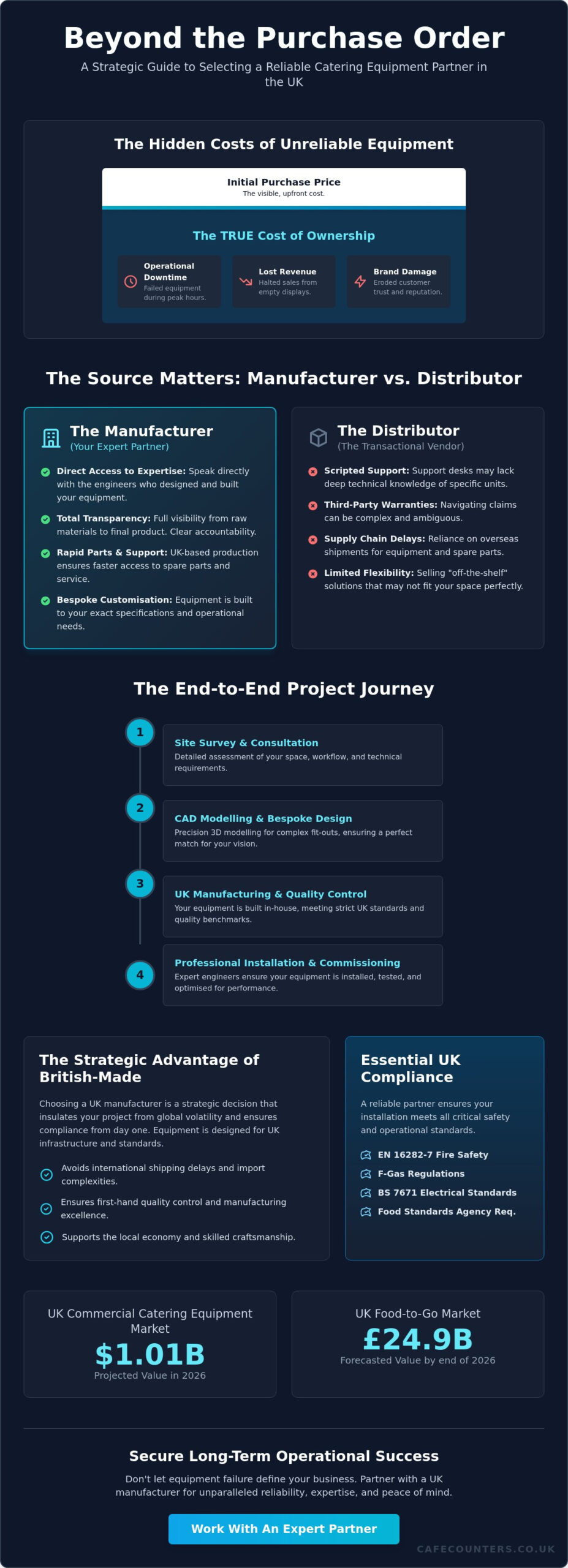
Reliability in a commercial kitchen environment is often misunderstood as a simple lack of mechanical failure. In reality, it represents a precise intersection of build quality, technical support, and total supply chain transparency. When you’re choosing a reliable catering equipment supplier, you aren’t just purchasing a stainless steel unit; you’re securing the future of your operational uptime. The UK commercial catering equipment market is projected to reach $1,017.7 million in 2026, and this growth is being driven by a shift toward high-performance, energy-efficient units that meet evolving standards like the EN 16282-7 fire safety regulations. These benchmarks demand equipment that performs under pressure while remaining compliant with tightening environmental and safety laws.
The allure of budget equipment often masks a grim financial reality. While the initial capital expenditure might seem lower, the true cost is revealed through downtime and lost revenue. A transactional vendor sells you a box and moves on, leaving you to manage the fallout of a breakdown alone. Conversely, the Expert Partner model shifts the focus from a one-off purchase to a collaborative alliance. This approach ensures that your equipment supports your vision from the initial CAD concept through to the final installation and commissioning.
The Hidden Costs of Equipment Downtime
Assessing Market Experience and Stability
Longevity in this industry isn’t accidental. A supplier’s heritage, such as a track record spanning over 30 years, correlates directly with product durability and the refinement of manufacturing processes. This experience allows for a diverse portfolio that spans everything from bespoke serving counters to integrated drop-in units across various hospitality sectors. There’s a distinct advantage to working with a firm that takes regional artisanal pride in its work. This commitment to quality control ensures that every patisserie display or salad bar is built to withstand the rigours of a professional environment while maintaining a high-end aesthetic. Choosing a partner with deep-seated experience in the regional market provides a steady, reliable hand in an increasingly complex field.
Manufacturer vs. Distributor: Why the Source Matters
Many operators view the equipment procurement process as a simple transaction through a catalogue. However, choosing a reliable catering equipment supplier often comes down to the physical distance between the workshop and your kitchen floor. A distributor acts as a bridge, but a manufacturer provides the foundation. When you buy directly from the maker, you gain total transparency into the manufacturing process. You can trace the journey of a bespoke serving counter from a sheet of raw stainless steel to a precision-engineered piece of hardware. This direct line eliminates the ambiguity of third-party warranties. It places accountability squarely in the hands of the people who designed and built the unit, ensuring that any after-sales needs are met with deep product knowledge rather than a scripted support desk.
Whether you are sourcing retail displays or exploring the Sale of industrial food processing and packaging machinery, the same rules of technical due diligence and direct manufacturer support apply to ensure long-term operational success.
The Advantages of Buying British-Made Equipment
Buying British-made equipment isn’t just about regional pride; it’s a strategic operational choice. You avoid the volatility of international shipping and the hidden costs of import complexities that often delay projects. Equipment built in the UK is designed specifically to meet local infrastructure needs, including BS 7671 electrical standards and Food Standards Agency equipment requirements. This ensures your deli counters and salad bars are not only compliant but also optimized for the unique pressures of the UK’s food-to-go market, which is forecasted to reach £24.9 billion by the end of 2026. Visiting a local facility allows you to witness quality control first-hand, providing a level of reassurance that no digital brochure can match.
Direct Access to Technical Expertise
Direct access to technical expertise removes the frustration of the middleman. If a customisation is required to fit a specific floor plan, you speak directly to the engineers who can make it happen. This feedback loop is vital for innovation. It allows for the seamless integration of technical features, such as ensuring your grab & go displays operate within the latest F-Gas regulations regarding GWP limits. Expert-led project management means the same team handles the initial survey and the final commission. This continuity reduces the risk of errors during a complex rollout. If you’re looking for a partner to bring your vision to life, exploring our range of bespoke serving counters is an excellent starting point for your next fit-out.
Sourcing locally also significantly reduces the carbon footprint of your project. By cutting out thousands of miles of transit, you align your business with the growing consumer demand for sustainability. This isn’t just about ethics; it’s about future-proofing your brand in a market where environmental impact is a key differentiator. Choosing a manufacturer who manages the entire lifecycle of a product gives you a steady, reliable hand in a complex and fast-moving industry.
Technical Due Diligence: CAD, Compliance, and Customisation
Technical due diligence is the structural backbone of any successful commercial kitchen project. When you’re choosing a reliable catering equipment supplier, you must look beyond the aesthetic finishes and scrutinize the engineering phase that precedes production. Precision is non-negotiable in modern retail and hospitality environments. Integrating drop-in units into a bespoke counter requires millimetre accuracy to achieve a seamless, hygienic finish that prevents debris buildup. This level of detail ensures that your equipment isn’t just a standalone item but a functional component of a high-performance workspace. High-grade stainless steel remains the professional standard, offering the non-porous surface required to meet strict hygiene standards while providing the durability needed for long-term operational efficiency.
Precision Planning with CAD Modelling
3D modelling acts as a digital rehearsal for your fit-out. It allows designers to identify potential workflow bottlenecks before a single sheet of steel is cut in the factory. By visualising the space in three dimensions, you can ensure that bespoke counters fit perfectly within existing structural constraints, such as irregular alcoves or support pillars. This process is especially critical when designing the lighting and aesthetics for patisserie display counters. CAD modelling allows you to share your vision and see exactly how the light will hit your products, ensuring the final physical space matches your brand’s aspirational goals.
Energy Efficiency and Operational Savings
Evaluating the long-term ROI of high-performance commercial refrigerators is a vital part of the procurement process. With the 2025 prohibition on virgin HFCs with a GWP of 2,500 or more, your supplier must provide future-proofed cooling solutions. The quality of insulation and glass directly impacts daily running costs; high-spec units retain cold air more effectively, which reduces the mechanical strain on the compressor. Integrating energy-efficient display units allows operators to reduce their carbon footprint while simultaneously lowering monthly utility overheads. This technical foresight ensures compliance with the latest F-Gas regulations and the EN 16282-7 fire safety standards, which become essential in November 2026.
A meticulous approach to technical planning eliminates the stress of on-site adjustments during installation. By insisting on detailed CAD drawings and verified compliance certifications, you protect your investment from the hidden costs of retrospective fixes. This methodical progression from initial idea to finished counter creates a sense of transparency and trust, allowing you to focus on your core business while we handle the technical complexities of the build.
Beyond the Purchase: Installation and Commissioning
The success of a commercial fit-out isn’t determined when the delivery truck arrives, but when the first customer is served from a fully operational counter. When you’re choosing a reliable catering equipment supplier, the post-purchase phase is where the true value of your investment is realized. There’s a fundamental difference between “delivery” and “professional commissioning.” A standard courier simply drops a crate at your door; an expert partner ensures every component is calibrated, connected, and compliant. This transition from a physical product to a high-performance operational asset requires a methodical approach that begins long before the equipment arrives on-site.
Professional Commissioning and Site Surveys
Site surveys are the foundation of any successful equipment rollout. We don’t leave technical details to chance. A comprehensive survey identifies electrical loads and ventilation requirements to prevent on-site failures during the critical first week of service. This is particularly vital when integrating Vision Heated Counters, which must be precisely calibrated to maintain perfect food holding temperatures while adhering to safety standards. Logistics also play a role. Our team manages the complex movement of heavy-duty display units through restricted access areas, ensuring that the physical installation is as precise as the initial CAD design.
After-Sales Support and Maintenance
The relationship with your supplier should be viewed as a long-term alliance rather than a one-off transaction. A structured warranty and clear service-level agreements provide the peace of mind necessary to run a high-volume business without the fear of extended downtime. Preventative maintenance is the only way to keep refrigerated grab and go display units at peak performance, especially during demanding peak hours. We focus on building these long-term relationships to support your future expansions. Beyond the hardware, we ensure your team is fully trained. Staff who understand how to clean and maintain the equipment correctly will extend its lifespan and ensure consistent food safety for your customers.
Integrating heated and refrigerated components into a unified counter system requires a steady, reliable hand. It’s about more than just aesthetics; it’s about technical precision and operational security. If you’re ready to move beyond simple procurement and want a partner who manages the entire lifecycle of your project, contact our expert team today to discuss your specific installation and commissioning requirements.
The TFSE Advantage: UK Manufacturing and Expert Partnership
Since 1991, TFSE Products Ltd has maintained a steadfast commitment to UK-based design and manufacturing. This heritage is more than just a date; it represents over three decades of deep-seated experience in the regional market that directly benefits our clients. When you are choosing a reliable catering equipment supplier, you are looking for a partner who maintains total control over every stage of the production cycle. We provide end-to-end project management that bridges the gap between an initial CAD concept and the final physical installation. This methodical approach ensures that the durability of our food-grade stainless steel and high-spec glass display units is matched by the precision of their placement in your professional environment.
Our Bespoke Design and Manufacturing Process
Our internal production facility allows for a level of quality control that is impossible for distributors to replicate. We utilize advanced CAD modelling to bring your unique vision to life, identifying technical requirements and structural constraints before manufacturing begins. This process allows for the deep customisation of patisserie, deli, and grab-and-go displays for maximum visual impact. By managing the transition from raw materials to finished hardware ourselves, we ensure that every unit meets our rigorous internal standards. This internal oversight guarantees that specific material choices lead to long-term operational efficiency, providing you with equipment that enhances both food presentation and sales volume.
Partnering with a Specialist for National Coverage
We possess the capacity to handle complex hospitality fit-outs across the entire United Kingdom. Whether you are a multi-site operator requiring consistent quality across several regions or an independent cafe owner seeking a single, high-impact counter, we offer a steady and reliable hand. Our experience extends across varied sectors, ranging from public services to commercial retail, ensuring we understand the unique pressures of your specific industry. This versatility makes us a collaborative ally rather than just a hardware vendor. If you require technical expertise for your next project, contact TFSE Products Ltd for a consultation on your next bespoke cafe counter. We invite you to share your vision while we provide the technical precision required to bring that vision to life with total confidence.
Choosing a partner who values its heritage and internal production capabilities projects an image of reliability in a complex field. Our goal is to alleviate the stress of commercial projects by projecting total competence throughout the journey from idea to finished space. By focusing on quality, durability, and a transparent professional process, we ensure your catering environment is equipped for the challenges of 2026 and beyond.
Securing Your Operational Excellence in 2026
Investing in a commercial kitchen is a significant commitment that requires a steady, reliable hand to ensure long-term success. We’ve highlighted how the intersection of UK-based manufacturing, technical precision through CAD modelling, and professional commissioning creates a foundation for operational security. Choosing a reliable catering equipment supplier isn’t just about the hardware; it’s about finding an expert partner who understands the unique pressures of the UK’s 2026 regulatory landscape and high-volume retail environments.
By prioritizing direct accountability and bespoke design, you eliminate the risks associated with third-party vendors. Our heritage of UK-based manufacturing since 1991, combined with advanced CAD modelling for all bespoke projects and a comprehensive national installation and commissioning service, ensures your vision is realized with meticulous detail. We’re ready to bring our technical expertise to your next project, from initial concept to the final physical space.
Request a consultation with the UK’s leading food display experts today and take the first step toward a seamless, high-performance retail environment. We look forward to helping you build a space that truly reflects your brand’s commitment to quality and durability.
Frequently Asked Questions
How do I check if a catering equipment supplier is reliable?
Reliable suppliers demonstrate transparency through their manufacturing process and long-term industry presence. You should evaluate their history, such as a track record spanning several decades, and confirm they possess internal production facilities rather than just a sales office. A trustworthy partner will provide detailed technical specifications and clear evidence of compliance with UK safety standards, ensuring they can support your operational needs long after the initial transaction.
What are the benefits of buying catering equipment direct from a UK manufacturer?
Buying direct from a UK manufacturer eliminates international shipping delays and ensures equipment is built to local electrical and safety standards. This proximity allows for a more responsive service journey and direct accountability for the build quality. When choosing a reliable catering equipment supplier, sourcing British-made units like bespoke serving counters also reduces your project’s carbon footprint and provides the opportunity to visit the facility to inspect quality control firsthand.
Why is CAD modelling important when choosing a catering equipment supplier?
CAD modelling is essential because it identifies potential workflow bottlenecks and structural constraints before manufacturing begins. This 3D visualization ensures that integrated drop-in units and large display counters fit with millimetre precision into your specific floor plan. Using advanced modelling allows you to see the final aesthetic, including lighting and material finishes, which prevents costly on-site adjustments and ensures the physical space aligns with your original vision.
What should be included in a professional equipment installation service?
A professional installation service must include a comprehensive site survey and technical commissioning. This process goes beyond simple delivery; it involves checking electrical loads, ventilation requirements, and calibrating equipment like Vision Heated Counters to precise holding temperatures. Expert installers manage the logistics of heavy-duty units in restricted areas and perform final safety checks to ensure every component is fully operational and compliant with the latest UK regulations.
How does energy efficiency impact the choice of a catering equipment supplier?
Energy efficiency is a critical factor due to rising utility costs and the 2026 phase-down of high-GWP refrigerants. When choosing a reliable catering equipment supplier, you should prioritize units with high-spec insulation and efficient glass that reduce mechanical strain. Selecting energy-efficient refrigerated grab and go displays helps you meet sustainability goals while ensuring long-term operational savings through lower daily running costs and reduced maintenance needs.
What is the difference between a standard supplier and an expert partner?
A standard supplier typically operates as a transactional vendor, focusing on selling a product rather than a solution. In contrast, an expert partner provides end-to-end project management, acting as a collaborative ally from the initial concept to final commissioning. This partnership model includes technical due diligence, custom design services, and a commitment to your long-term success, offering a steady hand throughout the complexities of a commercial fit-out.
Can a reliable supplier help with bespoke counter designs?
Yes, a reliable supplier with internal manufacturing capabilities is perfectly positioned to create bespoke counter designs. They can customize salad bars, deli counters, and back-bar units to suit specific architectural features or unique branding requirements. This artisanal approach ensures that your serving counters are not only aesthetically striking but also functionally optimized for your specific menu and service style, balancing visual impact with practical durability.
What after-sales services should I expect from a high-quality supplier?
High-quality suppliers provide structured warranties, clear service-level agreements, and rapid access to spare parts. You should expect technical support from experts who understand the engineering of your specific units, rather than a generic helpdesk. After-sales care also includes preventative maintenance advice and staff training to ensure your team can maintain the equipment properly, extending the lifespan of your investment and ensuring consistent food safety.