
Could a poorly planned back-bar be costing your business more in lost service time than the equipment itself is worth? When you’re integrating stainless steel back-bar units, you aren’t just buying furniture; you’re investing in a precision-engineered engine that dictates the speed and profitability of your entire operation. It’s a common frustration to see staff navigate inefficient workflows or struggle with equipment that fails after only a few years of heavy use. You deserve a workspace that reflects the quality of your service while meeting the rigorous demands of the UK’s 2026 food safety regulations.
We understand that every millimetre counts in a high-pressure commercial environment. This guide explores how bespoke, British-made fabrication transforms your hospitality workflow, hygiene standards, and long-term bottom line. We’ll walk you through the journey from initial CAD modelling to the final installation of AISI 304 food-grade units designed to last well over a decade. By the end, you’ll know exactly how to configure a bar area that looks professional, stays compliant with the latest FSA digital-first audits, and supports your team through every busy shift.
Key Takeaways
- Understand why AISI 304 food-grade stainless steel is the non-negotiable standard for maintaining hygiene and ensuring equipment lasts over a decade.
- Learn how the “Golden Triangle” design principle reduces staff fatigue and maximises your service speed during high-volume peak hours.
- Discover the operational benefits of integrating stainless steel back-bar units that are custom-built to fit your specific space and equipment requirements.
- Evaluate the long-term ROI of bespoke UK fabrication compared to off-the-shelf alternatives that often succumb to structural warping and tea-staining.
- Explore how CAD-led design and end-to-end project management ensure your vision is translated into a precision-engineered physical reality.
What are Stainless Steel Back-bar Units and Why Do They Matter?
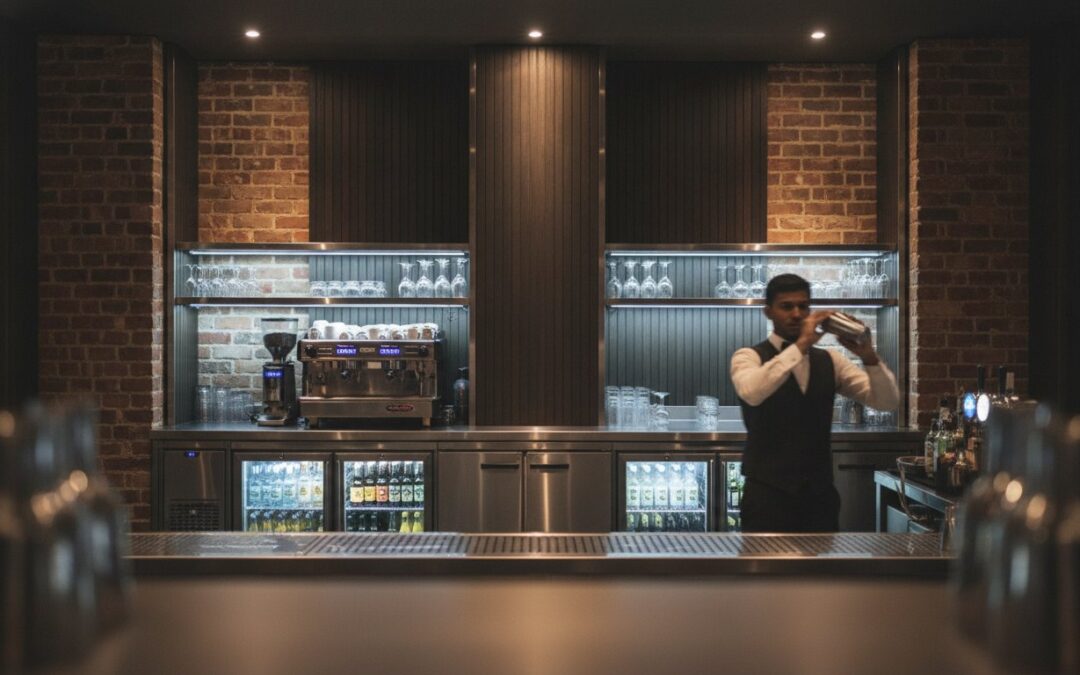
Think of the back-bar unit as the functional backbone of your hospitality space. It’s the silent partner in every pint poured and every espresso pulled, providing the structural support and organisational logic that keeps a busy service from descending into chaos. Successfully integrating stainless steel back-bar units requires more than just measuring a gap in your cabinetry; it requires an understanding of how your team moves during the Friday night rush. A well-planned unit ensures that every tool, from cocktail shakers to spare glassware, is exactly where it needs to be the moment a staff member reaches for it.
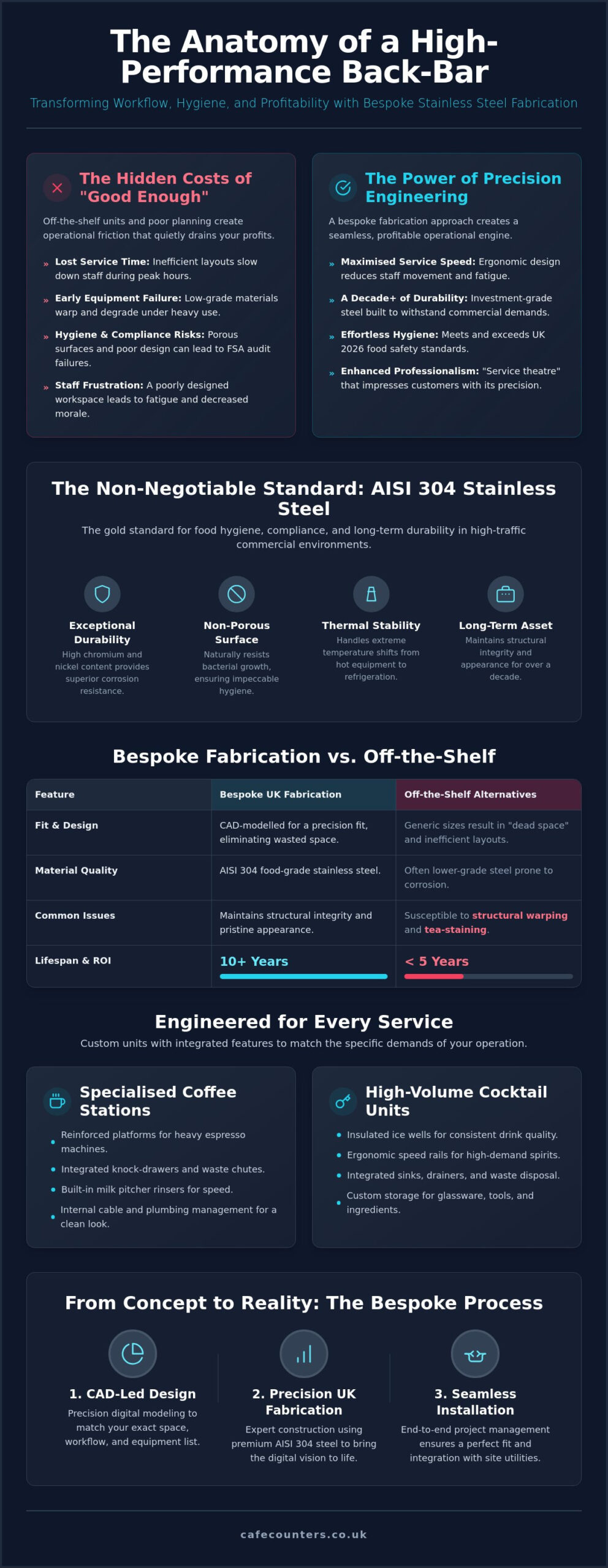
In modern hospitality, the back-bar has also become a central element of “service theatre”. As customers increasingly value transparency, your preparation area is often fully visible from the floor. A bespoke stainless steel setup projects an image of surgical precision and uncompromising hygiene. While generic, off-the-shelf furniture might look acceptable on opening day, it often lacks the internal bracing required to support heavy professional equipment. Over time, low-grade materials suffer from structural warping and tea-staining, whereas high-quality UK fabrication maintains its integrity through decades of heavy use.
The Role of the Back-bar in Modern Hospitality
The back-bar serves as the primary integration point for your most critical utilities. It’s where plumbing, power, and drainage converge to support sinks, taps, and specialised equipment like high-capacity coffee grinders. A meticulously designed unit also acts as a strategic support system for your commercial refrigerators. By positioning these cooling solutions within a bespoke frame, you ensure that refills and chilled ingredients remain within arm’s reach, significantly reducing the “travel time” that often slows down service in poorly planned layouts.
Why Stainless Steel is the Non-Negotiable Standard
The specific properties of stainless steel make it the only logical choice for high-volume environments. Its non-porous surface naturally resists bacterial growth, allowing your team to maintain impeccable hygiene standards with minimal effort. This material is also uniquely capable of handling extreme thermal shifts, such as a steaming espresso machine sitting directly above a refrigerated drawer. AISI 304 stainless steel is the gold standard for UK food hygiene compliance because its high chromium and nickel content provides exceptional corrosion resistance in damp, high-traffic environments. This ensures your investment doesn’t just meet current regulations but remains a durable asset for the long term.
Essential Configurations: Coffee Stations, Cocktail Units, and Storage
A successful service area relies on how well your equipment fits into the physical constraints of your site. When you’re integrating stainless steel back-bar units, the goal is to eliminate the “dead space” that often plagues off-the-shelf installations. In high-volume UK hospitality environments, every square inch must serve a purpose. Whether you’re managing a compact urban espresso bar or a sprawling cocktail lounge, the modularity found in high-end commercial kitchen fabrication allows for a layout that mirrors your team’s specific movements. This bespoke approach ensures that integrated features like speed rails, insulated ice wells, and waste knock-boxes aren’t just added on, but are built directly into the fabric of the workstation.
Specialised Coffee Bar Units
Coffee service requires a unique set of ergonomic considerations. A dedicated coffee back-bar unit provides a reinforced platform for heavy espresso machines while incorporating integrated knock-drawers and waste chutes to keep the area tidy. Speed of service is further enhanced by milk pitcher rinsers and dedicated plumbing channels that prevent unsightly and unhygienic water pooling. By planning for cable management within the internal structure, you ensure that counters remain clutter-free, allowing the craftsmanship of the machine and the skill of the barista to take centre stage. If you’re currently planning a new layout, our team can help you design bespoke stainless steel units that fit your specific equipment list perfectly.
Cocktail Stations and Under-counter Storage
Mixology is a high-speed discipline where seconds saved on every drink translate directly into higher turnover. Modern cocktail stations integrate insulated ice wells and tiered bottle rails into a single, seamless surface. This design minimises the need for bartenders to bend or overreach, reducing physical strain during long shifts. Maintaining high food safety and hygiene standards becomes much easier when there are no gaps between units for debris to collect. These stations often work in tandem with a refrigerator commercial unit, creating a unified aesthetic that combines ambient storage with precision cooling. Adjustable shelving within the stainless steel framework allows you to accommodate varied glassware heights, ensuring that your most fragile assets are stored securely yet remain easily accessible.
Ergonomic Design: Optimising Workflow and Speed of Service
Efficiency in a busy hospitality environment isn’t accidental. It’s the result of meticulous planning that prioritises the physical movement of your team. When you’re integrating stainless steel back-bar units, we focus on the “Golden Triangle” of bar service: the fluid connection between the point of sale, the preparation area, and the final serving point. If these three anchors are poorly positioned, your staff waste valuable minutes every hour simply navigating avoidable obstacles. A bespoke layout ensures that your most profitable service actions happen in the smallest possible footprint, reducing “travel time” and allowing your team to focus on the customer.
The visual impact of these units is equally important, particularly in open-plan venues. Your back-bar should act as a professional backdrop that complements your front-of-house equipment, such as a high-end deli counter or serving station. A cohesive aesthetic projects an image of total competence and artisanal pride, reassuring customers that your hygiene standards are as high as the quality of your products. By designing the back-bar as a continuation of your brand’s visual identity, you create a seamless “service theatre” that enhances the overall guest experience.
The Science of Bar Ergonomics
Most mass-produced units rely on standard dimensions that ignore the actual “reach” and “pivot” movements of a professional barista or bartender. We design around the person. Placing high-frequency items within a 600mm arm’s reach can significantly reduce physical fatigue during a ten-hour shift. We also carefully consider the specific heights and depths required for heavy equipment like commercial coffee machines and grinders. This prevents the back strain associated with poorly positioned machinery and eliminates the bottlenecks that occur when multiple staff members are forced to compete for the same square metre of workspace.
Integrating Utilities Seamlessly
A truly efficient workflow requires integrated utilities that don’t interrupt the preparation flow. We plan for plumbing, including sink positions and grease trap access, right from the initial survey. Safety in a wet environment is paramount, which is why we incorporate waterproof sockets and discreet, protected wiring routes. According to the FDA definition of food-contact surfaces, these areas must be durable and easily cleanable, a standard we meet by ensuring every weld is smooth and every corner is coved. Our precision CAD modelling ensures every utility outlet matches the physical unit perfectly, removing the stress of on-site modifications during the installation phase.
Hygiene, Durability, and the ROI of High-Quality Fabrication
The primary objection we encounter when discussing bespoke fabrication is the initial capital outlay. It’s a valid concern, but one that requires a shift in perspective from “price” to “lifetime value”. When you’re integrating stainless steel back-bar units into a high-volume venue, you’re investing in a 10-to-15-year asset. Cheap, off-the-shelf imports often suffer from tea-staining and structural warping within their first two years of service. This isn’t just an aesthetic issue; it’s a structural failure that compromises hygiene and safety. High-quality UK fabrication uses superior materials and construction techniques that drastically reduce long-term maintenance costs and the need for early replacement.
Material Science: Why 304 Grade Wins
The difference between a professional-grade unit and an economy version often comes down to the chemical composition of the steel. We specialise in AISI 304 food-grade stainless steel, which contains a high percentage of chromium and nickel. This combination creates a self-healing oxide layer that prevents rust even in the humid, acidic environments common behind a bar. Economy units often use 430-grade steel, which is magnetic and far more prone to corrosion when exposed to cleaning chemicals or spilled liquids. Additionally, our fully welded units offer far greater structural integrity than flat-pack alternatives. They don’t rattle, they don’t loosen over time, and they provide a rock-solid platform for heavy equipment. For projects requiring the same level of durability in cabinetry components, sourcing from premium suppliers like First Pro UAE ensures that hinges and sliders can withstand the rigours of a professional environment.
Meeting UK Food Hygiene Standards
UK hospitality regulations demand that food-contact surfaces are non-porous and easy to clean. Our bespoke designs incorporate integrated upstands, which act as a seamless barrier between the counter and the wall. This prevents spillages from seeping into wall cavities where they can cause hidden mould growth and structural damage. During a busy service turnaround, the ability to wipe down a smooth, continuous surface is a massive operational advantage. If you’re looking for equipment that combines durability with uncompromising hygiene, you can explore our stainless steel back-bar units to find a solution that fits your specific needs.
Bespoke Stainless Steel Fabrication: The TFSE Products Ltd Advantage
Choosing a partner for your commercial project involves more than just selecting a supplier; it requires finding a collaborator who understands the unique pressures of the UK hospitality industry. We position ourselves as your Expert Partner, providing a steady hand through every phase of your development. The process of integrating stainless steel back-bar units is a collaborative journey that transforms a conceptual vision into a high-performance physical workspace. Operating from our own UK-based manufacturing facility since 1991, we maintain total control over every weld and finish, ensuring that your equipment meets our exacting standards for durability and artisanal pride.
Our commitment to end-to-end project management acts as a conceptual anchor for every client we serve. We don’t just manufacture; we consult, design, and execute. This comprehensive service model alleviates the stress of coordinating multiple contractors and ensures that the final installation is perfectly aligned with your operational needs. By handling everything from the initial site survey to the final commissioning, we provide a turnkey solution that allows you to focus on what you do best: running a successful business.
From CAD Concept to Final Installation
Every bespoke project begins with detailed CAD modelling, which serves as the blueprint for your future success. This 3D approach allows you to visualise the entire bar workflow before fabrication begins, making it easy to identify and resolve potential bottlenecks in the “Golden Triangle” of service. Once the design is finalised, we utilise precision CNC laser cutting followed by expert hand-finishing in our facility. This combination of modern technology and traditional craftsmanship ensures that every unit fits the specific contours of your site with millimetre precision. Professional installation is a vital part of this process, particularly when commissioning units that feature integrated refrigeration or complex drainage systems.
A Holistic Approach to Your Venue
We don’t view back-bar units in isolation. Our deep-seated experience across commercial retail and public services allows us to take a holistic view of your entire venue. We can create a unified aesthetic by matching your back-of-house fabrication with front-of-house elements like patisserie displays or bespoke serving counters. This creates a professional environment that functions as a cohesive whole, supporting your staff and impressing your customers. By managing the journey from an initial idea to a finished physical space, we ensure that your investment delivers long-term operational efficiency and visual impact. We invite you to consult with our specialist design team today to begin bringing your vision to life.
Elevating Your Service Standards with Precision Fabrication
Successfully integrating stainless steel back-bar units is a strategic investment that future-proofs your hospitality operation against the shifting demands of the UK market. By prioritising ergonomic layouts and the uncompromising durability of high-grade AISI 304 stainless steel as standard, you create a workspace that supports your team while protecting your long-term profitability. Since 1991, we’ve helped businesses across the country transition from inefficient, generic setups to high-performance environments through expert CAD design and meticulous site surveys.
Your bar area serves as the engine room of your daily service. Choosing British-made quality ensures that every weld, radiused corner, and utility outlet is engineered to withstand over a decade of heavy professional use. We’re ready to act as your expert partner in transforming your vision into a precision-engineered reality. We invite you to explore our bespoke stainless steel back-bar solutions and see the difference that artisanal pride and internal production can make to your venue. Let’s build a space that reflects your commitment to excellence and efficiency.
Frequently Asked Questions
What is the standard height for a commercial back-bar unit?
The standard height for a commercial back-bar unit is typically 900mm, which aligns with the majority of professional catering equipment and ergonomic standing work heights. However, bespoke fabrication allows us to adjust these dimensions to suit your specific staff requirements or site constraints. We often vary heights to accommodate specific equipment or to create a more comfortable “pivot” point for bartenders during high-volume shifts.
Why should I choose 304-grade stainless steel over cheaper alternatives?
AISI 304-grade stainless steel is the non-negotiable professional standard because its high nickel and chromium content provides exceptional resistance to corrosion. Cheaper 430-grade steel is magnetic and far more prone to “tea-staining” and rust when exposed to the humid, acidic environments common in bars. Investing in 304-grade ensures your equipment maintains its structural integrity and hygiene standards for over a decade of heavy use.
Can back-bar units be custom-built to fit my existing coffee machine?
Yes, we use precision CAD modelling to ensure every unit is tailored to the exact footprint and utility requirements of your specific espresso machine and grinders. This bespoke approach eliminates the “dead space” found with off-the-shelf units and ensures that knock-boxes and waste chutes are positioned perfectly for your workflow. We can also reinforce the worktop to handle the weight and vibration of heavy commercial coffee equipment.
How do I clean and maintain my stainless steel back-bar to prevent staining?
Regular cleaning with warm water and a mild, chloride-free detergent is the most effective way to maintain the protective oxide layer of the steel. You should always wipe in the direction of the grain and avoid using abrasive pads or bleach, which can cause permanent surface damage. Properly maintaining your surfaces is a vital part of integrating stainless steel back-bar units and ensuring you pass unannounced EHO hygiene inspections.
Do you provide site surveys for bespoke bar installations?
We provide comprehensive site surveys as a core part of our end-to-end project management service across the UK. Our experienced team visits your venue to take millimetre-precise measurements and identify any potential challenges with plumbing, drainage, or electrical connections. This meticulous preparation ensures that when your equipment arrives, the installation is seamless and requires no costly on-site modifications.
What is the difference between a coffee station and a standard back-bar unit?
A coffee station is a specialised unit designed specifically for the rigours of espresso service, featuring reinforced tops and integrated waste management like knock-drawers. It often includes dedicated plumbing for milk pitcher rinsers and specific cable management routes for grinders. A standard back-bar unit is a more versatile storage or preparation area used for glassware, spirit bottles, and general bar sundries.
Can you integrate refrigeration into a bespoke stainless steel unit?
We frequently design back-bar units that either house integrated refrigerated drawers or sit alongside professional cooling solutions for a unified look. Our design process ensures that there is sufficient ventilation for compressors to operate efficiently, preventing equipment failure due to overheating. This allows you to keep high-turnover chilled items exactly where they are needed, significantly improving your team’s speed of service.
How long does the bespoke fabrication process typically take?
Lead times for bespoke fabrication vary based on the complexity of the project, though current 2026 market trends show that many operators are now quoting 20 to 24 weeks before their required installation date. We recommend engaging with our design team as early as possible to secure your production slot in our UK facility. This proactive approach ensures your project moves smoothly from the initial CAD concept to the final physical installation.