
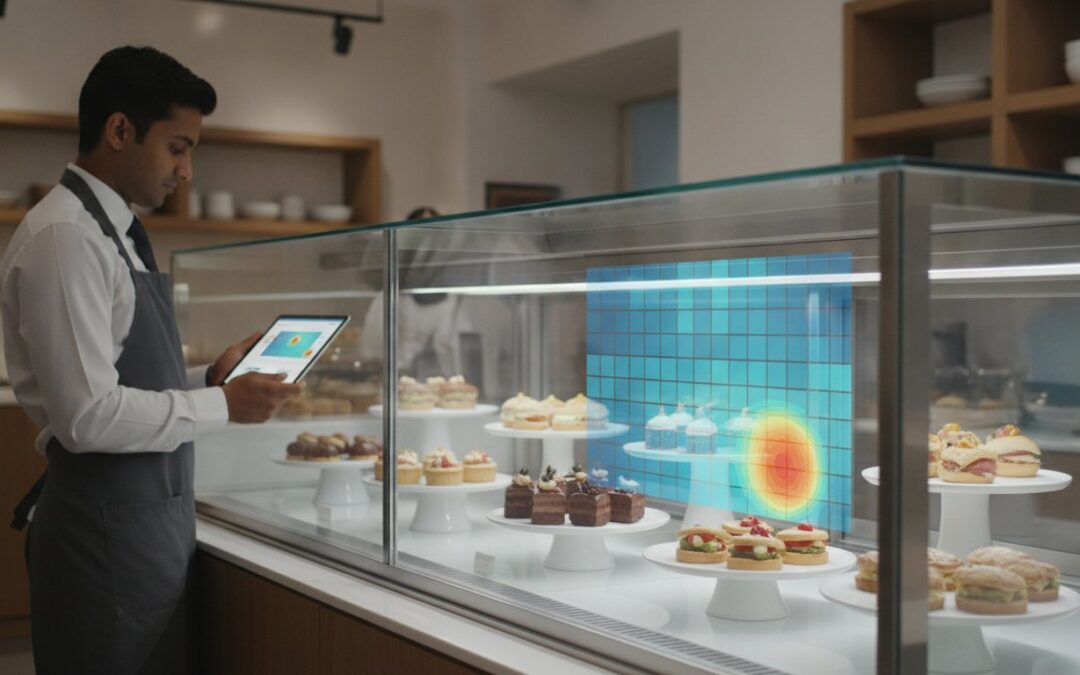
What if your digital controller reads a perfect 4°C, but your most sensitive stock is actually sitting in a hidden hot spot nearing the danger zone? It’s a scenario that keeps many hospitality managers awake before an inspection, especially as meeting commercial refrigeration temperature requirements UK becomes increasingly data-driven. You likely already understand that a standard daily check isn’t enough to prove total compliance to a meticulous auditor. The gap between a passing grade and a failed audit often lies in the invisible thermal currents within your patisserie displays or grab and go units.
We’ll help you bridge that gap by mastering the technical discipline of temperature mapping. This guide provides a clear roadmap for thermal validation, ensuring your equipment performs exactly to its engineering specifications. You’ll learn the precise logic of sensor placement in complex displays and how to generate the audit-ready documentation required by 2026 FSA standards. We’re moving beyond simple monitoring to give you the confidence to walk any inspector through your refrigeration system, backed by the certainty that every corner of your unit is a safe zone.
Key Takeaways
- Understand why temperature mapping is the essential bridge between daily monitoring and full HACCP compliance for 2026 food safety audits.
- Learn how to establish a 3D sensor grid to identify hidden risk zones and ensure your equipment meets all commercial refrigeration temperature requirements UK.
- Discover the critical components of an audit-ready report, from digital raw data files to the necessary calibration certificates for every logger.
- Identify how advanced CAD-optimised airflow and bespoke unit engineering work together to eliminate the persistent hot spots that lead to audit failures.
Understanding Temperature Mapping in the Context of Food Safety Audits
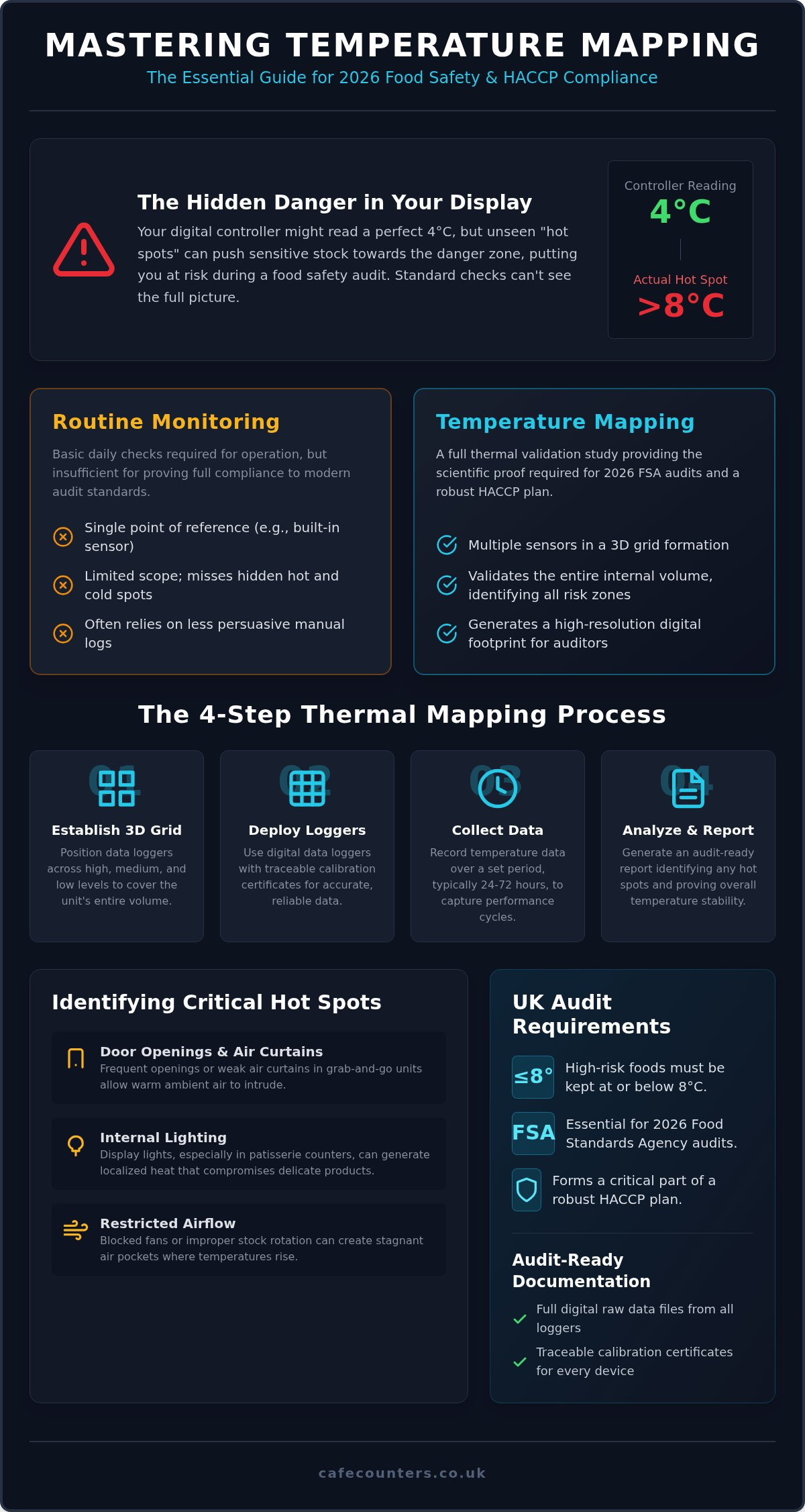
Temperature mapping is a rigorous thermal validation study designed to confirm that a refrigerated unit maintains consistent conditions across its entire internal capacity. Unlike a quick check with a handheld probe, mapping involves placing multiple sensors throughout a unit to record data over a set period, usually 24 to 72 hours. This process is essential for establishing a robust HACCP plan in 2026, as it provides the scientific evidence that your storage environment is stable. At TFSE, we consider professional commissioning the foundational step in any mapping programme, ensuring your equipment starts its lifecycle with a perfect thermal profile.
UK food safety auditors increasingly expect this level of detail for high-risk display equipment. While initial commissioning provides the baseline, seasonal mapping is equally vital. The way a patisserie display performs during a humid July heatwave differs significantly from its operation in mid-winter. By conducting these studies, you prove that your facility consistently meets commercial refrigeration temperature requirements UK regardless of external factors or ambient shop conditions.
Mapping vs. Routine Monitoring: Key Differences
Routine monitoring typically relies on a single point of reference, often a built-in thermometer or a daily manual probe. While these checks are necessary, they are inherently limited. They don’t account for “hot spots” caused by poor stock rotation or blocked fans. Mapping validates the entire internal volume, ensuring that every shelf and corner remains safe. Built-in equipment thermometers are often positioned near the evaporator, meaning they may display a lower temperature than what the food at the front of a display is actually experiencing. For professional UK hospitality environments, a full mapping study should be conducted annually or whenever significant changes are made to your equipment layout.
Why UK Auditors Prioritise Thermal Validation
Adhering to fundamental Food safety principles requires more than just good intentions; it demands verifiable data. Auditors from local authorities look for a safety net of documentation that proves due diligence under the Food Safety Act. In 2026, the shift toward digital record-keeping has made manual, paper-based logs less persuasive. A comprehensive thermal map provides a high-resolution digital footprint of your unit’s performance. It shows the auditor that you’ve proactively identified risk zones, such as doors or areas with restricted airflow, and have taken steps to mitigate them. This level of transparency builds trust and demonstrates that you’re in total control of your cold chain.
The Technical Process: How to Conduct a Thermal Map of Your Cold Storage
Conducting a thermal map requires a methodical approach to data collection that goes beyond surface-level checks. The process begins by establishing a 3D grid within the unit, positioning digital data loggers across high, medium, and low levels. This ensures every cubic centimetre of the storage space is accounted for, rather than just the area near the built-in sensor. For refrigerated grab and go display units, this grid is particularly critical because these open-fronted designs rely on a delicate air curtain to maintain stability. Selecting loggers with traceable calibration certificates is the standard for a professional 2026 environment, providing the raw data needed to survive a rigorous inspection.
Identifying Critical Risk Zones (Hot Spots)
Every refrigeration unit has inherent risk zones where airflow might be restricted or external heat may intrude. The area directly behind the display glass is a frequent failure point in audits because it’s most susceptible to ambient shop temperatures. In patisserie display counters, internal lighting systems can generate localized heat that compromises delicate creams or chocolates. To stay within the UK Food Safety (Temperature Control) Regulations, which mandate that high-risk foods remain at or below 8°C, you must account for these variables. We also recommend mapping “door-open” events during your busiest trading hours. This proves to auditors that your equipment recovers quickly enough to satisfy commercial refrigeration temperature requirements UK even under operational stress.
Placement Strategies for Data Loggers
A comprehensive mapping study involves two distinct phases: empty and loaded. Mapping an empty unit validates the base engineering and airflow design, while a loaded map shows how stock placement affects the internal climate. The number of sensors required depends on the unit’s capacity; a small counter might only need five points, while larger bespoke installations require nine or more to be statistically significant. At TFSE, we use advanced CAD modelling during the design phase to predict these thermal patterns before construction even begins. This proactive engineering eliminates the “hot spots” that mapping often reveals in off-the-shelf units. If you’re planning a new layout, choosing professionally commissioned displays ensures your mapping programme starts with a significant advantage.
Aligning Temperature Data with HACCP and Audit Requirements
Temperature mapping data serves as the scientific backbone of your Hazard Analysis and Critical Control Point (HACCP) plan. It transforms abstract safety goals into verifiable evidence, showing that your facility respects the foundational HACCP Principles & Application Guidelines. Merely stating that you meet commercial refrigeration temperature requirements UK isn’t enough for a 2026 audit. You must demonstrate that your daily monitoring points are strategically placed based on the results of your thermal validation study. Mean Kinetic Temperature (MKT) is a single derived value that expresses the cumulative thermal stress on food products over time, offering a more nuanced view of safety than a standard arithmetic average.
Evidence of Control: What Your Audit Report Must Include
A professional mapping report is more than a list of numbers. It’s a comprehensive document that guides an auditor through your cooling environment. To ensure total confidence during an inspection, your report should include:
- A detailed site plan or CAD drawing showing the exact 3D coordinates of every sensor used during the study.
- High-resolution graphical representations that track temperature fluctuations over a continuous 24 to 72 hour period.
- A clear summary identifying the absolute hottest and coldest points found within the unit’s internal volume.
- Traceable calibration certificates for every data logger used, ensuring the raw data files are beyond reproach.
Managing Deviations and Corrective Actions
If your mapping reveals a hot spot that exceeds the legal 8°C limit, the auditor will look for your documented response. An audit trail must show exactly how you adjusted your equipment or stock loading patterns to bring that zone back into compliance. This is where the engineering quality of your units becomes paramount. High-performance commercial refrigerators are designed with the thermal mass and airflow precision needed to make these adjustments effective and permanent. By linking your mapping results directly to your daily corrective action logs, you prove to the local authority that your food safety management system is a living, breathing process rather than just a box-ticking exercise.
Practical Steps to Prepare Your Facility for a 2026 Audit
Preparing your facility for an inspection requires a shift from reactive maintenance to proactive validation. Step one involves conducting a pre-audit thermal survey. This diagnostic run allows you to catch temperature drifts before they trigger an official non-conformance. Next, ensure all display equipment is professionally serviced. High-end deli counters and patisserie units rely on precise fan speeds and clean condensers to meet commercial refrigeration temperature requirements UK. Without regular calibration of these components, your mapping data will likely reveal inconsistencies that auditors won’t overlook.
You must also map your units under genuine stress conditions. A unit that passes while empty in December might fail when fully stocked during a July heatwave. Your mapping should reflect your peak trading reality, including frequent door openings and maximum product loading. Once data is collected, update your HACCP plan to reflect these findings. Use your thermal maps to justify your sensor placements and monitoring frequencies. Finally, digitise your records for 2026. Current FSA guidance prioritises instant data retrieval, so having your mapping reports available on a tablet or cloud drive is essential for a smooth inspection.
Frequency and Seasonal Mapping Requirements
An annual thermal map is the recognised standard for professional UK kitchens. However, seasonal shifts impact open-front displays significantly. External humidity and ambient shop heat can degrade the air curtain’s efficiency, making a summer validation study a critical piece of evidence for your audit trail. You should also re-map whenever you move equipment, change the shop layout, or undergo major component repairs. This ensures the thermal profile remains intact and your stock stays protected at all times.
Transitioning from Mapping to Permanent Monitoring
Mapping identifies the “worst-case” spot in your unit, which is exactly where your permanent daily sensors should live. This strategic placement proves you’re monitoring the most vulnerable area, not just the easiest one to reach. By integrating IoT monitoring that triggers real-time alerts based on these validated points, you maintain the high standards established during your initial study. This creates a continuous chain of evidence that satisfies even the most detail-oriented auditor. Explore our range of high-performance display units to ensure your facility is built for audit success from day one.
Ensuring Long-Term Compliance with High-Performance Display Equipment
The ultimate success of your thermal validation programme depends on the physical integrity of your refrigeration hardware. While mapping identifies problems, high-performance engineering prevents them from occurring in the first place. Units designed with CAD-optimised airflow ensure that chilled air reaches every corner of the display, effectively eliminating the stagnant zones that often lead to audit failures. By choosing equipment built to exceed commercial refrigeration temperature requirements UK, you transform your compliance strategy from a constant struggle into a predictable, manageable process. Quality manufacturing ensures that the thermal currents within your unit remain stable even during the most demanding service periods.
How Superior Counter Design Minimises Thermal Fluctuations
Superior thermal stability starts with the choice of materials and the precision of the build. High-grade stainless steel and high-density insulation create a robust thermal mass that resists external temperature spikes. Bespoke units offer a distinct advantage over generic off-the-shelf models because their internal geometry is precisely calculated for the specific volume of food they hold. This precision manufacturing acts as a guarantee of perfect audit scores. The unit is simply incapable of producing the “hot spots” that less sophisticated displays suffer from. When your equipment is engineered to maintain a steady 5°C baseline, the mapping process becomes a simple confirmation of quality rather than a search for faults. Our internal production facilities allow us to control every millimetre of this design, ensuring that your equipment meets the highest standards of the UK hospitality market.
The Role of Professional Commissioning
Professional commissioning is the critical bridge between manufacturing and operation. It’s a technical integration process that goes far beyond simply plugging the unit into a socket. We view commissioning as the moment we establish your unit’s thermal baseline. We calibrate the serving specifications to match your specific environment, ensuring the air curtain and evaporator are perfectly balanced. This methodical approach ensures your new unit is audit-ready from day one, providing a clean data set for your first mapping study. Investing in this level of quality doesn’t just protect your stock. It lowers your long-term compliance costs by reducing the need for emergency repairs and repeated validation studies. You aren’t just buying a display. You’re securing a steady, reliable hand for your business’s future that will consistently satisfy commercial refrigeration temperature requirements UK without the stress of recurring non-conformance.
Securing Your Thermal Integrity for the Future
Mastering temperature mapping is no longer an optional exercise; it’s a fundamental requirement for operational transparency in 2026. By transitioning to high-resolution digital validation, you demonstrate total control over your cold chain and ensure every audit is a success. Remember that the most robust HACCP plans are always built on a foundation of precision engineering. Units that feature CAD-optimised airflow and superior insulation don’t just store food; they safeguard your professional reputation by consistently meeting commercial refrigeration temperature requirements UK.
Our heritage in UK-based manufacturing since 1991 means we understand the unique pressures of the hospitality sector. We combine expert CAD modelling with meticulous installation to ensure your thermal baseline is perfect from the moment of commissioning. If you’re ready to upgrade your facility with equipment designed for lifelong compliance, our team is ready to assist. We’ll work as your expert partner to bring your technical vision to life with reliability and artisanal pride. Contact TFSE Products Ltd for a Bespoke Counter Consultation today. You can move forward with the confidence that your refrigerated displays will perform exactly as designed.
Common Questions Regarding Thermal Validation
What is the difference between temperature monitoring and temperature mapping?
Routine monitoring involves a single point of reference, usually a built-in sensor, to provide a daily snapshot of equipment performance. In contrast, temperature mapping is a comprehensive 3D validation study of the entire internal volume. It uses multiple data loggers to identify how air flows and where fluctuations occur over time. This ensures your equipment meets commercial refrigeration temperature requirements UK across every shelf, not just near the primary thermometer.
How often should temperature mapping be performed for a food safety audit?
You should perform temperature mapping at least once a year to maintain a robust HACCP plan. It is also essential to re-validate your equipment after any major repairs, significant layout changes, or if you install new units like bespoke deli counters. Seasonal mapping during peak summer months provides additional evidence to auditors that your cooling systems can handle extreme ambient temperatures without compromising food safety standards.
Is temperature mapping a legal requirement for UK food businesses in 2026?
While the specific term isn’t always explicitly named in every regulation, the legal requirement to maintain a food safety management system based on HACCP principles makes it essential. By 2026, FSA guidance on digital record-keeping has intensified the need for verifiable thermal data. Without a mapping study, you cannot scientifically prove that your high-risk chilled foods stay at or below the legal 8°C limit throughout the entire display.
How many data loggers do I need to map a standard deli counter?
For a standard deli counter, we typically recommend a minimum of five to nine data loggers to establish a valid 3D grid. You should place sensors in the four corners and the centre of each shelf level to capture a complete thermal profile. Larger or bespoke serving counters may require additional points to account for complex airflow patterns. This level of detail ensures no dead zones are missed during the validation process.
What is a hot spot in refrigeration, and why does it matter to an auditor?
A hot spot is a specific area within a refrigerated unit where the temperature consistently rises above the safety limit, often due to restricted airflow or external heat intrusion. Auditors prioritise these zones because they represent the highest risk for bacterial growth and food spoilage. Identifying these via mapping allows you to adjust stock loading or fan speeds, proving you have total control over your storage environment.
Can I perform temperature mapping myself, or do I need a professional?
You can perform mapping yourself if you invest in calibrated data loggers and validation software. However, many hospitality managers prefer a professional partner to ensure the study meets rigorous audit standards. As an expert manufacturer, we provide professional commissioning that sets the initial thermal baseline. This technical expertise helps you interpret raw data and make engineering adjustments that a standard DIY approach might overlook.
How long should a temperature mapping study last?
A standard temperature mapping study should last between 24 and 72 hours to capture a full cycle of operational use. This duration allows you to record how the unit performs during peak trading, door-opening events, and quiet overnight periods. For commercial refrigeration temperature requirements UK compliance, this extended window provides the statistical depth needed to prove your equipment maintains stability under varied stress levels and ambient shop conditions.
What happens if my temperature mapping shows a deviation during the audit?
If mapping reveals a deviation, you must document a formal corrective action in your HACCP records. An auditor will check that you’ve identified the root cause, such as a blocked vent or a worn door seal, and implemented a permanent fix. Showing that you caught and corrected the issue through proactive mapping is often viewed more favourably than an auditor discovering a hidden hot spot themselves during an inspection.